Green Gulch Zen Center: Themes and Appraisal of Significance
The cultural heritage significance of Green Gulch Zen Center lies in its day-to-day practice within the normal parameters of life. We have classified several themes surrounding the site, which we feel contribute to its cultural heritage importance.
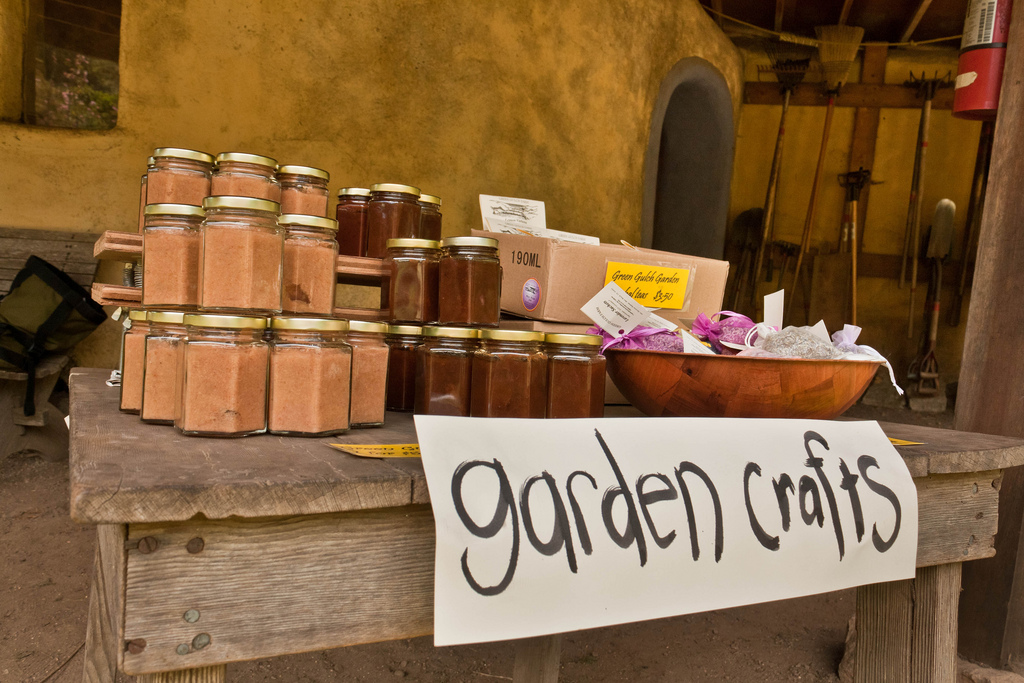
Outside of the garden center, a table is set out with jams and teas made from the garden.
Culinary
The connections between food and community are apparent at Green Gulch. The food preparation and sharing is a strong part of the Green Gulch experience. Through our K-8 program, we hope to educate children about the process of growing food and to use Green Gulch as a model for sustainable culinary practices. One potential challenge we foresee are distribution channels of food around local areas and furthermore internationally.
Landscape
This theme relates the spiritual nature of Green Gulch with the surrounding landscape. While the zendo is the place where formal meditation takes place, the entire property is a place of worship – through hiking the trails, enjoying the gardens and working the farm.
Preservation of nature
Since Green Gulch was founded in 1973, members of the Green Gulch community have focused on respect and cooperation with nature. Our proposed nature center would incorporate Buddhist teachings with educational guides for visitors, as well as work actively to sustain and preserve endangered wildlife.
History of Green Gulch and Surrounding Area
One theme that we feel would appeal to many visitors is using Green Gulch as a resource for those interested in Marin history. Because of its rich history in the area and cooperation with the land, we feel that Green Gulch is an ideal space for teaching others about the various transformations that Marin has gone through in the past few centuries. Archiving Green Gulch history along the line of archaeology, anthropology, and various other discourses will allow for the broader importance and modern relevance to contemporary issues that Green Gulch is addressing directly, for example through their on-site gardens and Green Restaurants.
Green Gulch Zen Center: Cultural Heritage Significance
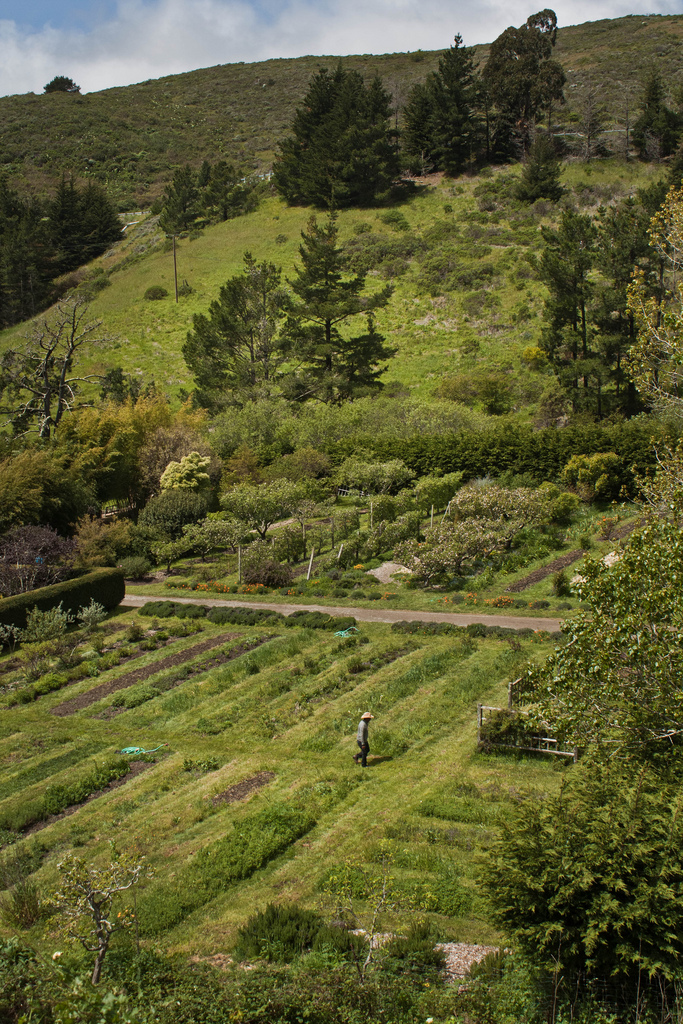 The Green Gulch Zen Center encompasses a vast array of tangible and intangible sources of heritage. For example, the Zen Center practices organic farming of vegetables and fruits, which is a tangible source in the physicality of the farming equipment and raised beds. It also displays an example of intangible in the community building and environmental appreciation produced from the gardening process. Also, the educational learning of gardening and agriculture falls into intangible. The meditation practice also functions as intangible and tangible. The meditation rooms with blankets to kneel on and traditional clothing are tangible. The spirituality and teacher-student relationships are intangible. In addition, the tea served in the teahouse as well as the traditional teapots, cups are tangible. The ritualistic aspects of the tea ceremony are intangible. The books sold in the bookstore are tangible, while the group discussions after lectures are intangible because they create development of community knowledge. The cookbooks and written recipes are tangible. Yet, the activity of cooking and experiencing food together is intangible and creates food education and experience.
Green Gulch follows the management blueprint designed by the original founders of San Francisco Zen Center. Both practicing monks and visiting resident students communally live in the space. Two cultures merge in the site: Western culture based on local agriculture and Japanese culture focusing on spirituality and aesthetics. The intangible heritage has become very important to preserve as originally developed by Suzuki Roshi, founder of San Francisco Zen Center.
Green Gulch produces spirituality by the use of its landscape and tradition. Green Gulch is not only a spiritual site for Buddhists but also open in many ways to public usage. Aesthetic values such as the atmosphere of solitude created by the Zen Center fosters spiritual values or just gives individuals a quiet place to think. Some visitors come solely seeking a place where they can seek generic spirituality. Green Gulch provides residents and visitors a place to meditate, alone or part of the community. Green Gulch also provides a rural and costal environment for individuals that enjoy the outdoors. Hikers and cyclists frequently take advantage of the land set aside by the Zen Center and the Nature Conservancy.
Alcatraz – Implementation
Native American history is a theme that runs through all of these projects. The overarching goal for this project is to increase awareness of and educate people about the Native American history of Alcatraz Island. Funding for the projects is expected to come from the federal government, donations, and the $26 fee to visit Alcatraz Island. The success of the projects would depend on cooperation between researchers, the NPS, and the Native American community, in order to gain more information and implement the activities.
Project # 1: Increased Tangible Heritage on Alcatraz Island

Specific objectives for this project include drawing attention to the Native American heritage on Alcatraz Island and preserving remaining tangible heritage, particularly graffiti. This project would entail setting up plaques around the island to help users find the graffiti and help viewers decipher what they say, installing memorials, preserving the remaining graffiti and developing an interpretive trail as an audio tour.
Project # 2: Storytelling
The particular goals for this project are to honor and revitalize Native traditions of storytelling, to provide employment for Bay Area Native Americans, and to teach visitors about Native American values, such as community and respect for elders. During the activity the visitors would gather around the campfire. Traditional foods like fry bread and coffee would be served. The stories would concentrate on the Native American presence on the island, as well as some traditional Native American tales. The content and delivery would largely be at the discretion of the storyteller.
Project # 3: Re-enactment of the Landing: “This Land is My Land”

This activity would start on the ferry ride to Alcatraz, during which Native American actors would explain briefly the history of the occupation. On the island, the visitors would then be escorted to the Warden’s House, which was the Native American headquarters during the occupation. Here the audience would experience a celebratory powwow, and afterwards hear the story about life on Alcatraz during the occupation and the speech by Richard Oakes. Visitors would also experience aspects of Native American culture such as jewelry-making. Finally, actors dressed as US marshals would escort visitors back to the ferry.

Project # 4: Picture Scavenger Hunt
Some specific goals for this project include encouraging research on Native American history, increasing visitor participation and expanding the representation of the island’s Native American history online. The participants would listen to an informative talk about Native American history. They would then be lent cameras and given brochures outlining the subjects of the history, and instructed to go around the island and take pictures of each subject, which would finally be compiled on a web site.
Project # 5: A Play of Multiple Voices
This project aims to establish ties among the communities involved with Alcatraz Island and its history. For this activity, an online survey would be created, collecting the input from all the key players of Alcatraz Island. Some additional interviews could also be conducted. On the basis of the collected information the play would be written and performed.
To read more about these Project Profiles, please go to the main page (Alcatraz – Native American Presence and Occupation) in order to download the full Site Management Plan.
Alcatraz – Key Players
People on Site and Scientific Interest Groups
Currently no permanent populations live on the island. Most of the people present on the island are visitors, NPS park rangers, volunteers for the Alcatraz Garden project and contractors who work on renovation. No archaeological research is currently being done on Alcatraz, as most of the research has been taken off site.
Organizations
Some of the key players are the organizations involved with Alcatraz, such as the PRBO and the U.S. Geological Survey, who are currently conducting a Landscape Survey. Outside of the NPS, there are groups that try to help keep our national parks accessible, such as The National Parks Conservation Association (NPCA), who are a nonpartisan group working to minimize threats to national parks.
International Community
Some other key players include visitors from different countries and regions, as well as recreationists like marathoners and hikers. The US National Park Service is working on developing sister park relationships with national parks all over the world. Other key players include school groups: part of the NPS budget is reserved for education.
Native Americans

Richard Oakes
Native Americans are also important key players for Alcatraz. This group includes the local Miwok and Ohlone Indians, those Indians who occupied Alcatraz from 1969 to 1971, and many other Native Americans for whom this island is a symbol of the Native American movement.
Local Business
Local business key players include all hotels, shops, restaurants, and tour companies that have ties to Alcatraz Island.
Descendants
Another group of key players includes the descendants of prisoners and the Federal Penitentiary employees at Alcatraz Island.
The following is a list of sponsors:
• Golden Gate National Parks Conservancy (The Gardens of Alcatraz)
• Federal Bureau of Prisons (Inmates perform maintenance work)
• The Friends of Civil War Alcatraz (docents of Civil War history)
• American Reinvestment and Recovery Act (solar panels to be installed on the island)
• Save American’s Treasures (Garden restoration)
• Alcatraz Cruises
The following is a list of academic partners:
• Golden Gate National Parks Conservancy Native Plant Nurseries
• American Youth Hostels
• Bay Area Discovery Museum
• Headlands Institute
• YMCA Point Bonita Outdoor & Conference Center San Francisco
• Exploratorium
To learn more, please go to the main page (Alcatraz – Native American Presence and Occupation) in order to download the full Site Management Plan.
By Tatyana Kovaleva
Alcatraz – Modern Context
Ownership and Legal Status
Alcatraz Island is managed by the National Park Service, one of eight bureaus run by the Department of the Interior, a Cabinet-level agency of the US Government. It is a part of the NPS Golden Gate National Recreation Area (GOGA). As a national park, Alcatraz is under the jurisdiction of Parks, Forest, and Public Property Code of Federal Regulations.
Buildings and Visitor Facilities

The island as a NPS and GGNRA park.
There are numerous buildings on the island, including the Guardhouse, the Cellhouse, the Officer’s Club, the Warden’s House, the Lighthouse, the Warehouse, the Power Plant, the Electrical Repair Shop, the Modern Industries Building, the New Industries Building, the Morgue, and the Recreation Yard. There are also gardens, including the Officer’s Row Gardens alongside the Cellhouse. Alcatraz includes a Parade Ground area and numerous trails and pathways that are accessible to visitors such as the Agave Trail.
Condition of the Site

An example of the ruins at Alcatraz.
The condition of buildings on Alcatraz varies. Some buildings, such as the Cellhouse and the Guardhouse, are renovated and accessible to the public. Other buildings, like the New Industries Building, are renovated externally, but are closed to visitors. Some structures, like the Warden’s House, have nothing but outside walls remaining.
Conservation
Many measures have been taken to preserve the man-made structures of Alcatraz and the natural features of the island. Organizations like PRBO, the US Geological Survey, Lutsko Associates, the Olmsted Center, and the Golden Gate National Parks Conservancy strive to preserve and properly manage the bird populations and the gardens of Alcatraz.
Current Points of Interpretation
The primary perspective of interpretation of Alcatraz is that of a federal penitentiary, because most of the surviving structures pertain to that period, which is also the most documented. Other aspects of history, such as the Native American presence or the military fort, are under-represented.
Tourist and Visitor Profiles

Alcatraz Cruises is the only commercial company that is allowed to dock on Alcatraz Island.
The Alcatraz experience is targeted at the general public, rather than specific groups. However, there are certain accommodations for groups with special needs, such as people with limited mobility. The Alcatraz management offers the Cellhouse guided audio tour in English, Spanish, German, French, Italian, Japanese, Dutch, Mandarin, Portuguese and Korean languages. Alcatraz Island does not have age-specific programs.
By Tatyana Kovaleva
Alcatraz – The Island and its Environment
Environment
The environmental aspects of Alcatraz Island can be divided into three categories: birds, rock formations, and plant life. Each of these categories has a unique value and varying stakeholders.
The Birds

Canada Geese
In 2007 there were 1078 pairs of birds on the island, including western gulls, pelagic cormorants, pigeon guillemots, a pair of black oystercatchers, snowy egrets and black crowned night herons. These birds have migrated to Alcatraz because of a decrease of crayfish on the Farallon Islands, and to escape the pollution of the SF Bay Area. The bird population of Alcatraz has an intrinsic value.

Snowy Egret
One of the issues with the birds is that they can be disturbed by tourists on the island and kayakers, causing them to abandon their nests along with their chicks. Their presence on Alcatraz thus limits the use and development of Alcatraz as a tourist attraction. Some sites are closed off to prevent disturbance to the nests. To meet these challenges the Golden Gate Park Conservancy has been working on and implementing strategy outlines in The Bird Conservation and Management Strategy for Historic Alcatraz Island. They are working with organizations such as PRBO Conservation Science and the US Geological Survey, who help monitor the birds.
The Geological Formation – the “Rock”
As with the bird population, the “Rock” itself has intrinsic value. Alcatraz has socio-cultural values, which include historical, cultural/symbolic and aesthetic values. The people who lived on the island, such as the Native Americans, army officers, prison inmates and prison wardens, had a connection with the island itself, and experienced its isolation.
Some of the most pressing problems with the “Rock” are the natural erosion of formations, damage caused by construction, and demolition of the debris remaining from conservation projects. The park staff are repairing water and electric systems, removing dangerous materials, stabilizing buildings and bringing them up to modern safety standards. Also, the park managers made the decision to sell the debris from reconstruction as souvenirs in the gift shop. This allows the debris to be cleaned up, and opens up another revenue stream for the park.
The Gardens

Officer Row Gardens
Another aspect of the environment is the plant life of Alcatraz. Besides having an intrinsic value, the plant life of Alcatraz also has socio-cultural values, such as historical, cultural/symbolic and aesthetic values. The gardens were cultivated by the various inhabitants of the island during each era. First, the gardens were planted and tended by the soldiers, then by prison inmates and officers’ families.
The biggest challenge for the gardens is the maintenance of the plants. Lutsko Associates, the Olmsted Center, the Golden Gate National Parks Conservancy, and the Garden Conservancy have combined their efforts to create a survey of the surviving plants and a plan for landscape maintenance and stabilization. These organizations created the Alcatraz Garden Project, which attracts volunteers to help maintain the gardens. In 2009, 613 volunteers put in 7,000 hours of service. During 2005-2007 plans for Main Road and Officer Row Gardens were implemented. The volunteers have also devised a rainwater irrigation system.
By Tatyana Kovaleva
All picture metadata can be found at our Flickr account; To access it, please click one photo from the right side-bar.
City Lights Bookstore: Other Beat Cities
While San Francisco is often attributed as the main gathering place of the Beat movement, the movement was also international and the cities listed below played important parts as well.
New York
- Many of the Beats attended Columbia University where they met through classes and mutual friends
- Began to get together regularly to discuss different topics, poetry, and explore the city
- Influenced by the jazz scene, coffee shops, and art scene. The jazz scene in particular influenced Kerouac’s poetry as he tried to mimic the jazz rhythm in his writing
Paris
- The Beats were attracted to the Latin Quarter and cheap rates at Madame Rachou’s hotel (cheap because it lacked proper accommodations such as a kitchen, access to showers)
- The city provided a free environment for the Beats to experiment in many ways through poetry, sexuality, and community
Mexico City
- Accessible through the Pan American Highway, promotion of tourism by the Mexican government, peso devaluation
- Beats inspired to visit after friends’ experiences and books written about the country
- Attracted to the easy lifestyle the city provided but later became disenchanted after certain events
- Jack Kerouac visited and lived in the city multiple times, and wrote many works, including Mexico City Blues
- William Burroughs lived in the city with his wife and children, hosted friends, and wrote other works. Also ended up accidentally killing his wife in drunken game of “William Tell”
- Other Beats attended school and took courses in indigenous languages and anthropology
City Lights Bookstore: Project Profiles
Below are some extended descriptions of projects our teams proposed for City Lights.
Virtual City Lights
Creating a virtual City Lights would provide access to all people, ensuring that those who cannot physically visit the space have the opportunity to experience all that City Lights has to offer. The opening page would be the entry to City Lights Books, the first space one encounters when they enter the store. When physically visiting the store a customer would have the opportunity to check-in their bag, ask staff about various titles carried or about certain sections. From the point of entry, the visitor could choose to wander the main floor, visit the basement, or visit the second floor. If the visitor decides that they would like to see the “Stolen Continents” section they are directed to the basement. The visitor is “lead downstairs” demonstrated by a video camera that zooms in on the basement from the top of the stairs. Once in the basement the visitor can peruse the section they’re interested in by seeing a direct, head-on shot of the available titles. To “look” at a book, the visitor would click on the title which would link them to the book’s information webpage. This page provides a brief description of the book and an option for more detailed information.
We would like to note that part of the visitor’s experience should include sound to make the experience as authentic and interesting as possible. Some ideas for incorporating sound include people reading their poetry, spoken word clips, historical audio clips, and clips from reading by visiting writers. We do not want the audio clips to be a primary experience for the visitor and therefore too distracting however, so we would ensure that visitors have the opportunity to mute the sounds.
The visitor is not required to travel through the website in a linear fashion but rather has the option to make this a multi-dimensional experience with the freedom to explore the site. A visitor can “travel” floor by floor or section by section. For example, if the visitor reads about a poet in the history section and wants to see that poet’s collection they could travel to the main entry for directions or if they are familiar with the site “travel” directly to the poetry section or to the third floor.
We hope to make the experience as authentic and personable online as they might experience actually visiting the store in person.
Share Your Poem Project
The “Share Your Poem Project” will focus on giving an audience to voices that aren’t always heard and linking the residents of the Chinatown and North Beach neighborhoods together through the process of recording and sharing poetry. The “Share Your Poem Project,” will invite local residents to contribute poetry through recording and listening stations set up throughout the community, and increase the number of literary voices in the air of the neighborhood. The emphasis on local residents as the intended participants will also foster neighborhood connections and a sense of community to help maintain City Lights as a Literary Meeting Place, a theme and principle it was founded upon. People who want to be a part of the project can stop into an old phone both converted into “poetry station” and submit their favorite poem. They can compose their own work, recite something they were taught as a child, or read any poem that has stuck with them. They can also listen to others contributions.
There will be 8 stations set up at locations within the two neighborhoods (in addition to City Lights) that already serve as important gathering places. The neighborhood is often overwhelmed by tourists, yet the locations selected are more “everyday” on the surface and aim to serve people living in the neighborhood, even those who have no personal connection to City Lights. Each station will have both a recording booth and a listening booth. The recording booth will include an audio recorder, pen and paper, and a typewriter. The listening booth will include a bulletin board and headphones to display the poems recorded in the designated station. Each booth has been placed in a location that either fosters beat generation/literary ideals or that reaches a distinct part of the community that we hope to include in the project. The locations are displayed below, followed by an explanation as to why they are sites of importance for this project.
In order to reach those who aren’t particularly interested in poetry, there will also be a different copy of one collection from the City Lights Pocket Poet Series at each station. This will be designed to increase participation to include those who may have never written poetry before or who have not received enough exposure to poetry to be able to recite or write down a favorite poem. Even people who have never read poetry before can read through the poems from the City Lights series and recite one of the poems out loud for the aduio recorder, adding their own personal touch and bringing it to life. The inclusion of early well-known poems published by City Lights in this series (such as Howl) will also help people connect to the the history and realize the relevance of older work in the neighborhood today and may help inspire people to write their own poems.
One of the goals of this project is to connect the people who visit different sites in Chinatown and North Beach in their daily routines. Spatially. these two neighborhoods not only closely border each other, but are tightly woven together and in some areas the boundary is unclear. Yet they seem to be considered very different neighborhoods. There have already been a few public art projects that have emphsized the physical and literary connection between the two neighborhoods. The aim of this project is to strengthen the connection of people and ideas in both neighborhoods.
There will also be live reading events in connection with the poems collected. However, keeping in spirit with the idea of sharing and connecting, people will not recite the poem that they contributed, but instead pick another from the collection. There will be “happy hour” reading events occurring on weekday evenings for those who live in the neighborhood to stop by on their way home from work. The weekend scene seems to be filled with tourists and rowdy partiers who frequent the adult entertainment clubs, so these evening events will provide a nice contrast as they will be more low-key and hopefully appeal to local residents.
“Howl” Trial Re-Enactment
This project aims for City Lights Bookstore to preserve the heritage of free speech that it pioneered. While the purpose behind City Lights Bookstore was to promote free speech and thought that was not able to be expressed elsewhere, the historical event that solidified and gave credibility to City Lights’ purpose was the “Howl” trial. “Howl” was written by Allen Ginsberg and was published and distributed by City Lights. However, the sale of this work was stopped and deemed obscene. Lawrence Ferlinghetti and Shigeyoshi Murao were taken to court and charged with obscenity because of the poem’s references to drugs and heterosexual and homosexual acts. Keeping in mind this was all occurring during the late 1950s and that nothing like this had ever taken place before, the monumental decision that did not deem the work obscene but rather that it was of “redeeming social importance” was a landmark.
In order to highlight the importance of the trial and its impact, we would like to propose to have a re-enactment of part of the trial in conjunction with other events. Seeing as how City Lights continues to promote literary events such as readings, we believe it would be a good idea to continue in this tradition and do brief theatrical re-enactments of either parts of the trial, or the arrest that lead to the trial. One idea would be to perform different parts of the trial in chronological order and have the performances coincide with the plaza event. The performances would take place before the actual plaza celebration in order to attract interest and hype up the event. City Lights’s Poetry Room would be a fitting setting in which to perform scenes because it provides space and it also highlights that Ginsberg’s “Howl” was essentially a poem. In order to signify the importance of the trial and the decision, the opening scene before the trial could be that an actor (or willing participant/attendee), at the register paying for merchandise is suddenly “arrested” for purchasing “obscene” merchandise. Once the customer and cashier are “taken away”, a narrator could pose the question, “Imagine if what you read was regulated today?” This opening question could lead some of the attendees to reflect as they watch the re-enactment progress.
Keeping in mind that “Howl” was a poem, and the people present at the re-enactment might want to discuss what they just saw and debrief with other audience members, it might also be a fun idea do a “Poetry as a Weapon” workshop after the performance. While the workshop has Bay Area youth as its target audience, it would be available to anyone who is interested in participation. Themes to be used as inspiration are: free-speech, censorship, activism, and life journeys. To link the present with the past, Beat authors could facilitate the workshops. These poetry workshops could be used to demonstrate the impact and power of words can have to create social change and reinforce freedom (of word, speech, expression).
City Lights Bookstore: Plans and Suggestions
Taking into account the different components that have been presented in City Lights bookstore management plan, our team has come up with different suggestions and recommendations that will be helpful to implement through an action plan that can be very beneficial for City Lights, both as a bookstore and as a cultural heritage site. Below are timeline suggestions as well as brief descriptions of what the recommendations entail.
Short Term Plans & Suggestions (to be considered within the next 5 years):
- Establish a timeline or routine to check for building’s seismic and earthquake safety and implement it periodically.
- Begin looking into possibilities of making bookstore ADA accessible and examine alteration guidelines established by the city for historical landmarks.
- Brainstorm ways in which businesses that are historically tied to the Beat Movement might be able to collaborate to increase both the visitor and tourist market that would benefit all businesses involved. Continue collaboration if successful.
Medium Term Plans & Suggestions (to be considered within the next 10 years):
- Discuss and consider the possibility of tapping into new markets such as the electronic book industry.
- If ADA accessibility is not completely realistic with building alteration, ideas such as “Virtual City Lights” and the book request kiosk should be considered.
- Outreach to North Beach and Chinatown residents and businesses to begin a coalition that meets regularly to discuss the ways in which the cost of living is affecting the community and neighborhoods and what can be done about it.
- Examine how the commemoration of dissident and marginalized voices within the Beat Movement can be executed and come up with project ideas and events.
Long Term Plans & Suggestions (to be considered within the next 25 years):
- Look into and research ways in which the Poet’s Plaza can become a reality. Although there are currently monetary and capacity limitations, promoting the idea now might lead to public interest and potential donors that may help fund the project in order to turn it into a reality.
- Despite being named a historical landmark, it is in City Lights’ interest to continue to promote its history and contribution in order to emphasize its relevancy and stay in business. Projects like “Share Your Own Poem” and “Howl” trial re-enactment should be carried out and can be possibly incorporated into annual events.
City Lights Bookstore: Threats to the Site
The potential expansion of the financial district is a threat to the neighborhood that supports City Lights, and therefore a threat to City Lights itself. The bookstore sits right on the edge of San Francisco’s economic center. Despite the proximity to the skyscrapers, North Beach has continued to maintain a small, cohesive true neighborhood feel with some relatively affordable housing, mainly in the form of SRO (single room occupancy) hotels and small apartments. While City Lights owns the building that they operate from, neighboring residential buildings and businesses face the threat of being displaced by higher-profit tenants. The potential change to the demographic of the tenants could dramatically alter the character of the neighborhood. Preventing developers who try to expand high rises and condominiums into the Chinatown and North Beach areas will continue to be crucial in preserving the City Lights community.
Keeping rent affordable for tenants is vital in keeping the literary nature to the neighborhood. In order to maintain a creative community that is supportive of City Lights it is vital to keep the single room occupancy hotels in the area so that particularly artists (including the poets of the Beat Generation who may be nearing an age where they are too old to work) and creative folk struggling financially can still stay in the neighborhood and bring their work to the community.
Here are some links to community groups working on behalf of the neighborhood in various ways:
Chinatown Community Development Center: http://www.chinatowncdc.org/
North Beach Merchants Association: http://northbeachmerchants.com/index.html
Telegraph Hill Dwellers: http://www.thd.org/
North Beach Citizens: http://www.northbeachcitizens.org/
Manilatown Heritage Foundation (I-Hotel senior housing): http://www.manilatown.org/
(Lucy)


 Who Owns the Past? Cultural Heritage in the Digital Age