Blog Archives
Alcatraz – Media
Visiting Alcatraz
Alcatraz_movie_02 from Ruth Tringham on Vimeo.
Audio:
Alcatraz Island Audio Clip 1 – Professor Anthony Garcia
Alcatraz Island Audio Clip 2 – Professor Jim Quesada
(1) Five Wounds Church: Background

Five Wounds in the Early 20th Century (Date Unkown). Courtesy of Portuguese Historical Museum
History :
Located at 1375 East Santa Clara Street in San Jose, CA (just off U.S. Highway 101) the Portuguese National Church of Five Wounds are the heart and soul of Little Portugal. On November 16, 1913, Portuguese residence of San Jose purchased the land to what became the site of Five Wounds. However, it was not until 1914 that the parish was created. In collaboration with Mr. Manuel Teixeira de Frietas, the Portuguese community asked Archbishop Patrick Riordan for the blessing to build a church. The blessing was given and in 1914 “we opened the house that today is the parish residence and the first bazaar in benefit of the church.” But in 1915, through a petition signed by the Portuguese residence of San Jose, the Archdiocese of San Francisco officially approved the parish as the National Church of Portuguese of Five Wounds. Timber and wood from the Portuguese Pavilion that was in display in the Panama Pacific International Exposition in San Francisco in 1915 was used to build the church. The building material, which was brought over from Portugal to build the Portuguese Pavilion, was transported by wagon through the Camino Real. On the 15th of November “Msgr. Henrique A. Ribeiro celebrated the first mass as pastor of the new parish.”
Modern Context :
Since its creation, Five Wounds has been an integral part of the Portuguese community. Although historically Five Wounds has been able to sustain dedicated pastors bilingual in both English and Portuguese who been willing to work with the community, during the 21st century the church has not been able to host a pastor that stays longer than two years. In early 2011, the church announced that the current Pastor Rev W. D. Morgan will be stepping down from his duties at Five Wounds because he feels like the Portuguese community is unhappy with his leadership. Currently, the church is experiencing a lack Portuguese culture; a decline in bilingual mass and community participation has caused the church to rethink its leadership. However, the community continues to support the church financially and hope for a better one.

National Portuguese Church of Five Wounds
SEE CHURCH OF THE FIVE WOUNDS HERITAGE, REVITALIZATION AND SUSTAINABILITY PROPOSAL
Five Wounds Church Inteperative Plan
(2) Five Wounds Church: Key Players (Stake Holders)

Clergy Members: Key players of Five Wounds (Date is Unkown). Courtesy of Portuguese Historical Museum
The Plan addresses key players and interest groups, both obvious and inconspicuous, from immediate community members to “memory” community members surrounding Five Wounds in order to recognize and respect their stake in the Plan. Overall, the Plan has an opportunity to institute a variety of engaging activities that may keep current stakeholders as well as attract new ones to the church. This would, in the long run, keep the spirit of Five Wounds alive and promote a perpetuation of the culture within Little Portugal. The development of events and activities considered in the modern contexts, when applied to concerns of key players, may result in an enhancement of cultural experiences, a win-win type of situation. The follow were identified as stakeholders of Five Wounds:
- The clergy, and especially the priest’s influence and involvement in the church are directly correlated to the future growth and development of the church
- Portuguese Community in San Jose (not including the younger generation): Due to the historical implications, the Portuguese community developed a deep personal value towards the church.
- Vatican Church: The Vatican’s, having the most at stake in Five Wounds Church includes tangible and intangible items. The church being part of a larger and powerful organization, the Vatican is the top leader for catholic churches worldwide.
- Diocese of San Jose: The diocese of San Jose is under the direction of the Vatican. The Vatican appoints leaders to the diocese and that leadership decides what is best for the churches in the district of the diocese of San Jose. This branch of leadership decides the decisions of the church; recently, the diocese decided to rent out the school house adjacent to the church to a private organization.
- Younger Portuguese Generation: their stake is having the church available to them once they grow older. In other worlds, the preservation of the Portuguese heritage in the church is at stake.
- Local Businesses: their stake is economic. Businesses in Little Portugal benefits economically by church goers getting .
- The Vietnamese community in San Jose also utilizes the church on Wednesdays and Saturday nights for mass.
- Portuguese Band: Bands use the space to promote Portuguese heritage through their music.
- St. Isabel Kitchen uses the space to feed needy families. This organization is supported by Five Wounds.
- Needy Families: Families that are in need of food look to Five wounds Church for help. Located to the building adjacent to the church, families are able to attend the kitchen of Santa Isabel for free food; no questions asked.
- Daycare: the current tenant occupying the space that was once the school of Five Wounds is a private daycare. The daycare pays a monthly rent to diocese of San Jose.

Portuguese Bakery located in Little Portugal. Many church goers get their pastries after mass.
(5) Five Wounds Church: Appraisal-Community
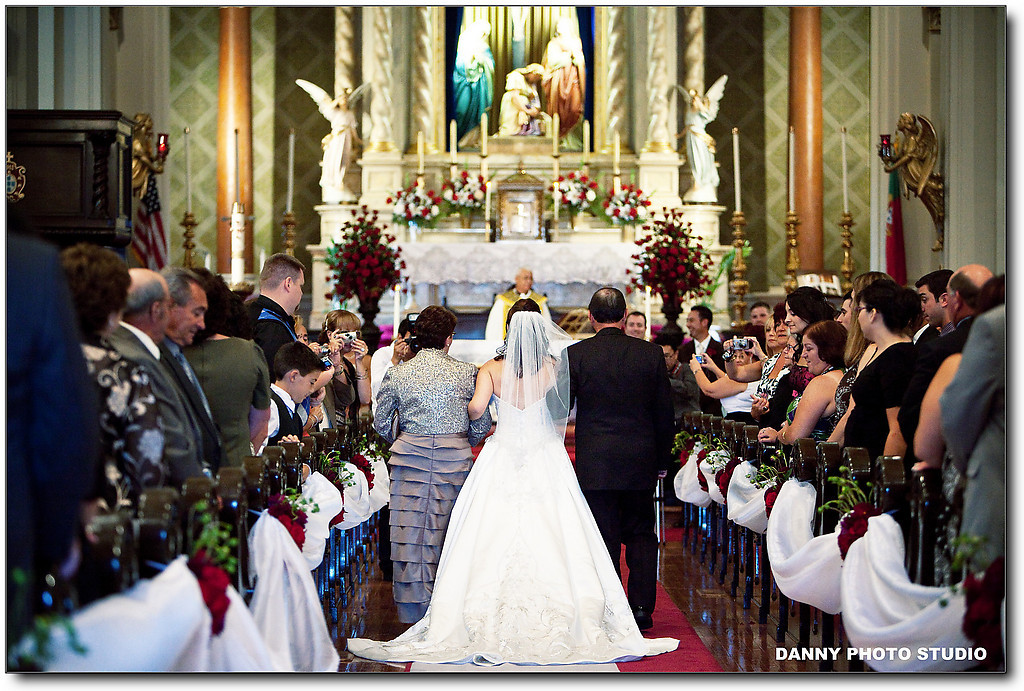
Bride Walking Down the Aisle at Five Wounds. Courtesy of Danny Photo Studio
It is perhaps best to begin an appraisal of the Site and its residents by recognizing the regional connections within which it is situated. There are four levels of community that involve the church and the targeted audience. The four levels are local, regional, national, and international. To begin with the smallest, Little Portugal surrounds Five Wounds Church in San Jose. This defines the site proper, and as such, is the focus of the Plan. Examples of local area links are the Portuguese newspaper and the local bulletins used to convey local activities and ordinances. These particular media examples provide a channel through which the community may become aware of local activities as well as current situations involving Five Wounds.
A step up from the local, the regional level includes the city of San Jose and the county of Santa Clara. Increased recognition of the Site will create an opportunity to collaborate and engage with many different neighborhoods and audiences, exposing them to the rich heritage of the Portuguese. At the local level, a desire to sustain the Portuguese culture is warranted; at the region and larger links, awareness and appreciation of the culture from multiple perspectives and ethnic backgrounds is wanted.
Specifically, the national and international links can be accessed by anyone with an Internet connection these days. What used to mandate a long voyage across the Atlantic now only takes a click of a button. People involved at the national and international levels of the community appraisal would hardly invest in such a trip anymore; the Internet provides a more cost effective and safer experience of Five Wounds, but not with the current web access offered by the church. A connection to the Site is available be anyone from anywhere with Internet access, internationally or otherwise.
Over the years, as is the case with the Portuguese youth, a fusion of Western and traditional Portuguese culture has birthed a cultural perspective unique to Portuguese American heritage. For instance, the local sport clubs provide a unique atmosphere that houses both Portuguese and Portuguese-American guests sharing food, wine, and laughs. Such a club is ideal to observe the people of Little Portugal closely precisely because the business structure of the club refuses to bend to the requests of traditional Americans (e.g. serving only traditional Portuguese food) and remains focused on Portuguese authenticity.
Back at the church, we find a healthy rhythm of weddings and baptisms scheduled. Aesthetically, the church has not lost its beauty over the years and needs little restoration support. There are no major ecological issues that need to be addressed immediately apart from the daily maintenance of the local ecology already outlined. There are little to no environmental risks besides the church being located rather close to the California 101 highway. Although the fumes and especially the noise which emit from the high traffic of highways can be taken as deterrents to the tourism of the Site, having the highway so close to the church keeps potential visitors from taking complicated directions and decreases the potential of getting lost or frustrated. Getting off the highway, Five Wounds is a two-minute drive.
(9) Five Wounds Church:Interpretive Project Proflies-Mobile Detection
Mobile Detection:
Visitors who participate in a scavenger hunt become more observant resulting in a more meaningful experience. According to Erik Champion, navigation influences visitors in what to do, whereas exploration allows visitors to lead themselves where they want. In result, participants will experience their own interpretation of the environment that creates a whole new perspective. A scavenger hunt attracts visitors of all ages and especially children and adolescents. A scavenger hunt is an active way to get visitors involved with the church. Families can participate in a scavenger hunt and work together to figure out answers to clues and riddles regarding the historical and cultural heritage of the church. Children and adolescents are the main targeted audience along with parental supervision. With guidance and prior knowledge, family members can learn from each other and the scavengers hunt itself. The idea of answering the clues and riddles is to think about the many possible answers that can be used. There are many different ways to approach a scavenger hunt, but it takes some thought and energy. In consideration of the variability of age, there will be three levels of difficulty.They are easy, moderate, and hard. To make sure that there is no repetition of answers, fresh new clues and riddles will be provided each time.
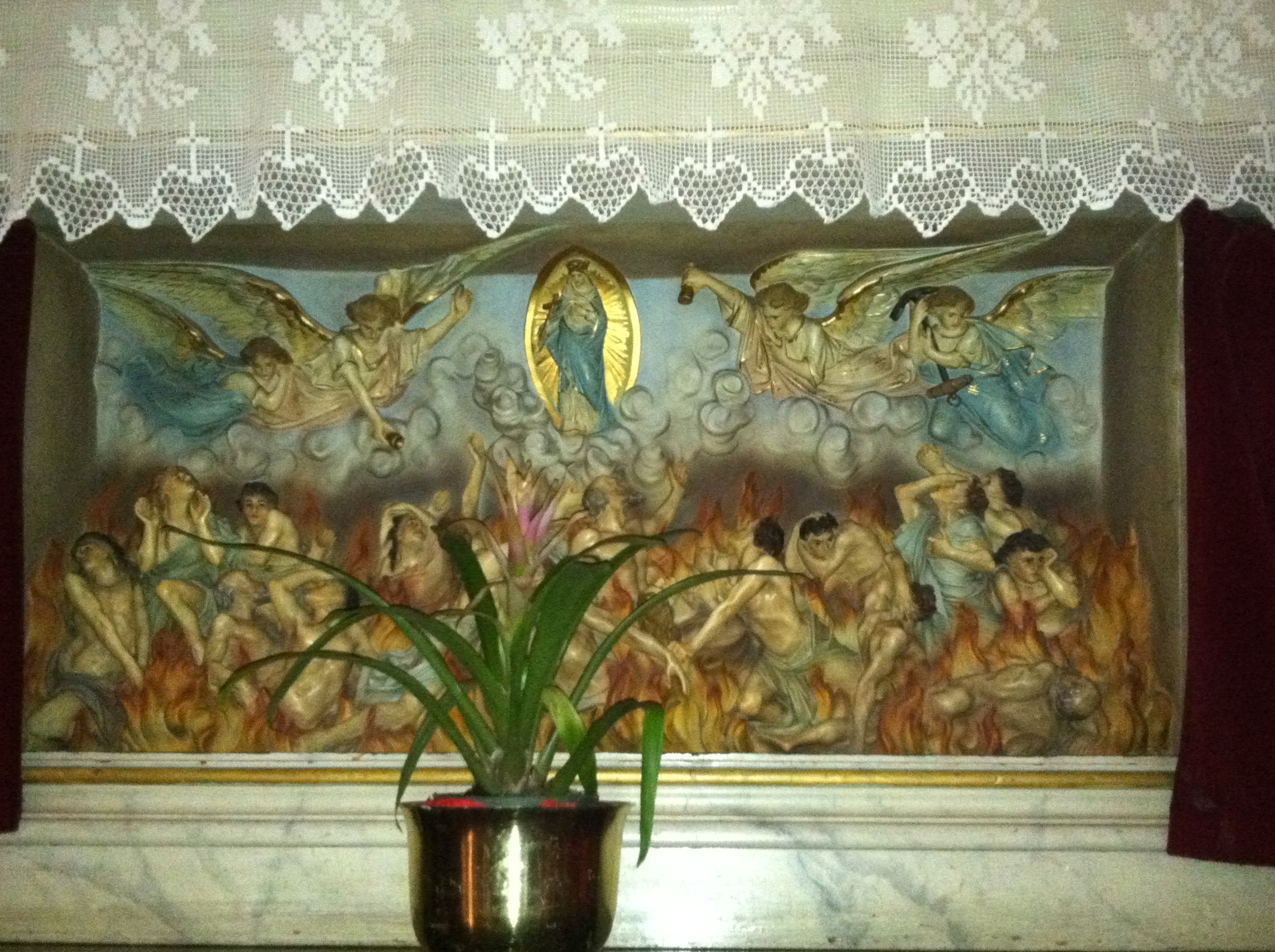
The scavenger hunt can consist of finding an image such as this one.
(10) Five Wounds Church: Interpretive Project Profiles-Ascertaining Authenticity

Interior of Five Wounds: Examine the Architectural style
Ascertaining Authenticity:
This ongoing project will address such questions of authenticity within the intangible and tangible portions of church structures. for example, making architectural descriptions available to audience members over the correct analysis of Five Wounds becomes foundational to any claims of “authentic” (or in this case, unauthentic) style. This project will be executed by reprimanding the official church website to correctly identify the buildings “authentic” style. How? By building paragraphs embodying a certain portion of Manuelian architecture, such as armillary spheres found on ships (a navigational instrument and the personal emblem of Manuel I), and then providing two pictures for the reader to choose from; one picture will perfectly embody the Manuelian style, and the other will not. We hope that this will begin to help audience members establish what the core representation styles of Manuelian architecture are in order for them to create critiques not only on the church of the Five Wounds, but what will ultimately serve them in any travels as they mention to their mate “Aha! I have seen such a structure before – this style is Manuelian!”

Exterior Picture: Examine the Architectural Style
Alcatraz – Implementation
Native American history is a theme that runs through all of these projects. The overarching goal for this project is to increase awareness of and educate people about the Native American history of Alcatraz Island. Funding for the projects is expected to come from the federal government, donations, and the $26 fee to visit Alcatraz Island. The success of the projects would depend on cooperation between researchers, the NPS, and the Native American community, in order to gain more information and implement the activities.
Project # 1: Increased Tangible Heritage on Alcatraz Island

Specific objectives for this project include drawing attention to the Native American heritage on Alcatraz Island and preserving remaining tangible heritage, particularly graffiti. This project would entail setting up plaques around the island to help users find the graffiti and help viewers decipher what they say, installing memorials, preserving the remaining graffiti and developing an interpretive trail as an audio tour.
Project # 2: Storytelling
The particular goals for this project are to honor and revitalize Native traditions of storytelling, to provide employment for Bay Area Native Americans, and to teach visitors about Native American values, such as community and respect for elders. During the activity the visitors would gather around the campfire. Traditional foods like fry bread and coffee would be served. The stories would concentrate on the Native American presence on the island, as well as some traditional Native American tales. The content and delivery would largely be at the discretion of the storyteller.
Project # 3: Re-enactment of the Landing: “This Land is My Land”

This activity would start on the ferry ride to Alcatraz, during which Native American actors would explain briefly the history of the occupation. On the island, the visitors would then be escorted to the Warden’s House, which was the Native American headquarters during the occupation. Here the audience would experience a celebratory powwow, and afterwards hear the story about life on Alcatraz during the occupation and the speech by Richard Oakes. Visitors would also experience aspects of Native American culture such as jewelry-making. Finally, actors dressed as US marshals would escort visitors back to the ferry.

Project # 4: Picture Scavenger Hunt
Some specific goals for this project include encouraging research on Native American history, increasing visitor participation and expanding the representation of the island’s Native American history online. The participants would listen to an informative talk about Native American history. They would then be lent cameras and given brochures outlining the subjects of the history, and instructed to go around the island and take pictures of each subject, which would finally be compiled on a web site.
Project # 5: A Play of Multiple Voices
This project aims to establish ties among the communities involved with Alcatraz Island and its history. For this activity, an online survey would be created, collecting the input from all the key players of Alcatraz Island. Some additional interviews could also be conducted. On the basis of the collected information the play would be written and performed.
To read more about these Project Profiles, please go to the main page (Alcatraz – Native American Presence and Occupation) in order to download the full Site Management Plan.
Alcatraz – Key Players
People on Site and Scientific Interest Groups
Currently no permanent populations live on the island. Most of the people present on the island are visitors, NPS park rangers, volunteers for the Alcatraz Garden project and contractors who work on renovation. No archaeological research is currently being done on Alcatraz, as most of the research has been taken off site.
Organizations
Some of the key players are the organizations involved with Alcatraz, such as the PRBO and the U.S. Geological Survey, who are currently conducting a Landscape Survey. Outside of the NPS, there are groups that try to help keep our national parks accessible, such as The National Parks Conservation Association (NPCA), who are a nonpartisan group working to minimize threats to national parks.
International Community
Some other key players include visitors from different countries and regions, as well as recreationists like marathoners and hikers. The US National Park Service is working on developing sister park relationships with national parks all over the world. Other key players include school groups: part of the NPS budget is reserved for education.
Native Americans

Richard Oakes
Native Americans are also important key players for Alcatraz. This group includes the local Miwok and Ohlone Indians, those Indians who occupied Alcatraz from 1969 to 1971, and many other Native Americans for whom this island is a symbol of the Native American movement.
Local Business
Local business key players include all hotels, shops, restaurants, and tour companies that have ties to Alcatraz Island.
Descendants
Another group of key players includes the descendants of prisoners and the Federal Penitentiary employees at Alcatraz Island.
The following is a list of sponsors:
• Golden Gate National Parks Conservancy (The Gardens of Alcatraz)
• Federal Bureau of Prisons (Inmates perform maintenance work)
• The Friends of Civil War Alcatraz (docents of Civil War history)
• American Reinvestment and Recovery Act (solar panels to be installed on the island)
• Save American’s Treasures (Garden restoration)
• Alcatraz Cruises
The following is a list of academic partners:
• Golden Gate National Parks Conservancy Native Plant Nurseries
• American Youth Hostels
• Bay Area Discovery Museum
• Headlands Institute
• YMCA Point Bonita Outdoor & Conference Center San Francisco
• Exploratorium
To learn more, please go to the main page (Alcatraz – Native American Presence and Occupation) in order to download the full Site Management Plan.
By Tatyana Kovaleva
Alcatraz – Modern Context
Ownership and Legal Status
Alcatraz Island is managed by the National Park Service, one of eight bureaus run by the Department of the Interior, a Cabinet-level agency of the US Government. It is a part of the NPS Golden Gate National Recreation Area (GOGA). As a national park, Alcatraz is under the jurisdiction of Parks, Forest, and Public Property Code of Federal Regulations.
Buildings and Visitor Facilities

The island as a NPS and GGNRA park.
There are numerous buildings on the island, including the Guardhouse, the Cellhouse, the Officer’s Club, the Warden’s House, the Lighthouse, the Warehouse, the Power Plant, the Electrical Repair Shop, the Modern Industries Building, the New Industries Building, the Morgue, and the Recreation Yard. There are also gardens, including the Officer’s Row Gardens alongside the Cellhouse. Alcatraz includes a Parade Ground area and numerous trails and pathways that are accessible to visitors such as the Agave Trail.
Condition of the Site

An example of the ruins at Alcatraz.
The condition of buildings on Alcatraz varies. Some buildings, such as the Cellhouse and the Guardhouse, are renovated and accessible to the public. Other buildings, like the New Industries Building, are renovated externally, but are closed to visitors. Some structures, like the Warden’s House, have nothing but outside walls remaining.
Conservation
Many measures have been taken to preserve the man-made structures of Alcatraz and the natural features of the island. Organizations like PRBO, the US Geological Survey, Lutsko Associates, the Olmsted Center, and the Golden Gate National Parks Conservancy strive to preserve and properly manage the bird populations and the gardens of Alcatraz.
Current Points of Interpretation
The primary perspective of interpretation of Alcatraz is that of a federal penitentiary, because most of the surviving structures pertain to that period, which is also the most documented. Other aspects of history, such as the Native American presence or the military fort, are under-represented.
Tourist and Visitor Profiles

Alcatraz Cruises is the only commercial company that is allowed to dock on Alcatraz Island.
The Alcatraz experience is targeted at the general public, rather than specific groups. However, there are certain accommodations for groups with special needs, such as people with limited mobility. The Alcatraz management offers the Cellhouse guided audio tour in English, Spanish, German, French, Italian, Japanese, Dutch, Mandarin, Portuguese and Korean languages. Alcatraz Island does not have age-specific programs.
By Tatyana Kovaleva
Alcatraz – The Island and its Environment
Environment
The environmental aspects of Alcatraz Island can be divided into three categories: birds, rock formations, and plant life. Each of these categories has a unique value and varying stakeholders.
The Birds

Canada Geese
In 2007 there were 1078 pairs of birds on the island, including western gulls, pelagic cormorants, pigeon guillemots, a pair of black oystercatchers, snowy egrets and black crowned night herons. These birds have migrated to Alcatraz because of a decrease of crayfish on the Farallon Islands, and to escape the pollution of the SF Bay Area. The bird population of Alcatraz has an intrinsic value.

Snowy Egret
One of the issues with the birds is that they can be disturbed by tourists on the island and kayakers, causing them to abandon their nests along with their chicks. Their presence on Alcatraz thus limits the use and development of Alcatraz as a tourist attraction. Some sites are closed off to prevent disturbance to the nests. To meet these challenges the Golden Gate Park Conservancy has been working on and implementing strategy outlines in The Bird Conservation and Management Strategy for Historic Alcatraz Island. They are working with organizations such as PRBO Conservation Science and the US Geological Survey, who help monitor the birds.
The Geological Formation – the “Rock”
As with the bird population, the “Rock” itself has intrinsic value. Alcatraz has socio-cultural values, which include historical, cultural/symbolic and aesthetic values. The people who lived on the island, such as the Native Americans, army officers, prison inmates and prison wardens, had a connection with the island itself, and experienced its isolation.
Some of the most pressing problems with the “Rock” are the natural erosion of formations, damage caused by construction, and demolition of the debris remaining from conservation projects. The park staff are repairing water and electric systems, removing dangerous materials, stabilizing buildings and bringing them up to modern safety standards. Also, the park managers made the decision to sell the debris from reconstruction as souvenirs in the gift shop. This allows the debris to be cleaned up, and opens up another revenue stream for the park.
The Gardens

Officer Row Gardens
Another aspect of the environment is the plant life of Alcatraz. Besides having an intrinsic value, the plant life of Alcatraz also has socio-cultural values, such as historical, cultural/symbolic and aesthetic values. The gardens were cultivated by the various inhabitants of the island during each era. First, the gardens were planted and tended by the soldiers, then by prison inmates and officers’ families.
The biggest challenge for the gardens is the maintenance of the plants. Lutsko Associates, the Olmsted Center, the Golden Gate National Parks Conservancy, and the Garden Conservancy have combined their efforts to create a survey of the surviving plants and a plan for landscape maintenance and stabilization. These organizations created the Alcatraz Garden Project, which attracts volunteers to help maintain the gardens. In 2009, 613 volunteers put in 7,000 hours of service. During 2005-2007 plans for Main Road and Officer Row Gardens were implemented. The volunteers have also devised a rainwater irrigation system.
By Tatyana Kovaleva
All picture metadata can be found at our Flickr account; To access it, please click one photo from the right side-bar.


 Who Owns the Past? Cultural Heritage in the Digital Age