Category Archives: Microhistories
(3) Vesuvio – Appraisal
Significance of Vesuvio:
Click on this link for a look at the PDF file of our complete Interpretive Plan for Vesuvio.
Management Policy
The management policy holds that all final decisions concerning the culture heritage management of Vesuvio ultimately lie with the management staff of Vesuvio. Our role as culture heritage consultants is to make educated and well-researched suggestions and proposals to present to Vesuvio’s staff. Our management plan will be created in dialogue with Vesuvio’s staff and stakeholders to create ideas that represent multivocal solutions. The plan will also reflect the overarching goal of the project, which is to convey and maintain Vesuvio’s identity and history.
Values
These values are of course highly subjective and are left open to interpretation. They can also change as Vesuvio sees fit. These values were designed with a holistic and anthropological approach drawing heavily from culture heritage academic theory, specifically from Mason, R. 2002. Assessing Values in Conservation Planning: Methodological Issues and Choices and In Assessing the Values of Cultural Heritage, edited by M. De la Torre, pp. 5-30. Getty Conservation Institute, Los Angeles.
Historical Value:

Interior photo of Vesuvio, with Bruce Weiss tending bar, April 1963.
Mason (2002) describes historical value as “the capacity of a site to convey, embody, or stimulate a relation or reaction to the past” and states that is can come in various forms, such as the age of the site or from its association with people or events (11). Vesuvio embodies this definition on all accounts. The physical landscape of the bar, with its walls covered in art from the early days of Lenoir’s tenure to today, and its antique lighting and furniture, transports the visitor simultaneously to the past and into different narratives of the present. The bar’s history is literally written on the walls; relics of the Beat movement hang on the walls along with photographs of patrons and works from local artists. This history also gives Vesuvio aesthetic value, for the bright colors and tangible imagery, along with the heirloom furnishings, create a sensory experience that is unique to Vesuvio and distinctly San Franciscan (Mason, 2002:11; Peters, 1998:199).
Cultural Value:
Mason (2002) defines cultural value as tools to build cultural affiliation in the present (11). Historically, Vesuvio has been an integral part of the counterculture movement, both because of its early clientele of exotic dancers, sailors, and the like, and because of its association with City Light’s Bookstore, a cradle of the Beat Generation (personal communication with E. Pallo, 2011). Today, Vesuvio is still a center of counterculture, for it welcomes all types of people and continues to be a place that fosters political debate and artistic expression. For example, the bar identifies itself as a consistent place for alternative culture: “[Vesuvio] remains an historical monument to jazz, poetry, art and the good life of the Beat Generation. Vesuvio attracts a diverse clientele: artists, chess players, cab drivers, seamen and business people, European visitors, off-duty exotic dancers and bon vivants from all walks of life” (http://www.vesuvio.com/index2.html). The diversity of counterculture characters that Vesuvio celebrates also constitutes two other values that Mason gives credence to: political value, best demonstrated by the Beats and their cultural and civil protests; and craft, or work-related value, expressed both in the celebration of artists and poets, as well as the art and science skills (mixology) of the bartenders (2002:11-12).
Social Value:

Bruce Weiss, tending bar with waitress Alice Holden,1950.
Mason (2002) defines social values as a site’s ability to enable and facilitate social connections and networks and its role or association with a particular community or neighborhood (12). On a very general level, Vesuvio is a neighborhood bar where people come to meet other people, chat with the bartenders, or to seek solitude in a familiar place. Vesuvio can be equated to the village pub found in much of Europe – a center of social gathering, a designated social space for both locals and non-locals. As mentioned above, Vesuvio is also intimately tied to the city of San Francisco and indeed serves as a microcosm of the city.
Stakeholders

"Homo Beatikus", postcard from scrapbook, c. 1950.
There is a multiplicity of stakeholders who sometimes have contradicting objectives at Vesuvio, though the majority of their overarching goals are similar enough that most friction is prevented. The owners desire success for Vesuvio so that their business and primary source of income can continue. The bartenders, cocktail waitresses, maintenance man, and night cleaning crew all have a large stake in Vesuvio as well. The beer, wine and soda vendors are also stakeholders since they get paid indirectly by Vesuvio’s clients and thus support Vesuvio and its core of patrons. Other important stakeholders include the local residents of the North Beach and Chinatown neighborhoods surrounding the bar. All of the artists, musicians, football (soccer) fans, and recipients of the fundraisers are also stakeholders. Patrons who frequent the bar regularly have a stake in Vesuvio. Tourists are also stakeholders as there are many visitor activities in the area such as exotic-dancing clubs, venues for live jazz and other music performances, poetry readings, art shows, coffee shops, and other working-class bars that keep old-time traditions alive. Other stakeholders are people involved with the tourism trade and historical preservation societies.
Interpretation and Multivocality:
Our management and interpretation work together to achieve the same goals and are based on multivocality at all stages of the management process and interpretive projects (see Management Aims and Objectives and Management Policy sections for more information). Vesuvio is unique in that it has an acute awareness of its tangible and intangible heritage values as well as a distinctive sense of self. These features are the most important things to preserve and convey to the public. We equate the term preservation within the context of our management plan to continuity rather than to the archaeological understanding of the term. The goal of the preservation plan is to help Vesuvio to better articulate their own narrative with as few changes to the existing bar as possible, for Vesuvio is a living entity and should be maintained as such.
Visitor Experience and Access
The fact that Vesuvio is an active bar poses interesting challenges for interpretation and thus by extension, visitor experience and access. A bar is a fluid and socially essential entity where people come and go as both insiders and outsiders of the bar’s scene. It is an extremely diverse landscape of stakeholders who range from regulars, to distributors to tourists, all of whose interests come together around alcohol and entertainment, though pursued and achieved in different ways.

Vesuvio patron, 2011.
The transient nature of its patronage, mixed with its presence as a valid social meeting place, has created an ethos that has facilitated the intertwined identity and function of Vesuvio. We thus seek to help Vesuvio articulate its identity and history to visitors through subtle interpretation. Subtle interpretation is defined here to mean interpretative tools or events that do not disrupt the normal flow and atmosphere of the bar and enhance the understanding of Vesuvio’s story.
Therefore the visitor will receive no formal tour when coming into Vesuvio; they can get that experience virtually on the re-designed website. Instead, they will be encouraged to simply engage in the drinking, artistic, musical, and literary activities of the bar that are incorporated into our interpretive projects (see Implementation section for more details).
Vesuvio is a public space that is on a busy, major street in a heavily populated neighborhood. Parking is a challenge but public bus transportation is widely accessible. The bar is also handicap accessible to the level possible for such a building and business. Janet Clyde says that handrails were added to the stairwells leading up to the women’s restrooms and down to the men’s facilities to comply with ADA regulation.
Community:
Tourism

Photo courtesy of photobucket.com.
For an interactive GigaPan image of the cocktail above, click on this link and scroll through the snapshots under the image. Once the snapshot is selected, more contextual information will appear to the bottom, right of the image.
Vesuvio does not stand one either side of the tourism line for while it supports certain kinds of tourism, the bar is more strongly committed to its local patrons. Vesuvio does participate in some of the tourist folklore, even serving a drink called “The Jack Kerouac,” but while they appreciate the patronage and want to welcome new clients, Vesuvio wants to be a place of peace where locals can be left undisturbed.

Henri Lenoir's do-it-yourself BEATNIK KIT displayed in the front window, sometime in the late 1950s-early 1960s.
There are many connections to tourism in the area. For example, visitors who come to participate in local events may also be interested in Vesuvio. Some of these points of interest include local (from North Beach as well as San Francisco) art, music and literature festivals; local culture promotional happenings; visitors to the San Francisco Art Institute (in North Beach); neighborhood art galleries and music venues; The Beat Museum; City Lights Books; and other famous watering holes like The Saloon, Specs, Tosca Cafe, and Café Trieste.
Vesuvio has garnered accolades and recommendations from around the world. It has received write-ups in printed and online travel guides like Lonely Planet, Frommer’s and Fodor’s; in local, national and international newspapers and magazines; and on interactive tourist sites such as Yelp and Citysearch. Vesuvio is a popular stop on the agendas of many walking tours and in general is a vital part of the San Francisco experience for vacationers from all walks of life. There are also Happy Hour specials advertised above the bar, on the Internet, and on a sidewalk sandwich board outside the bar. Ultimately, word-of-mouth advertising is one of Vesuvio’s best tools for tourism.
Community Events
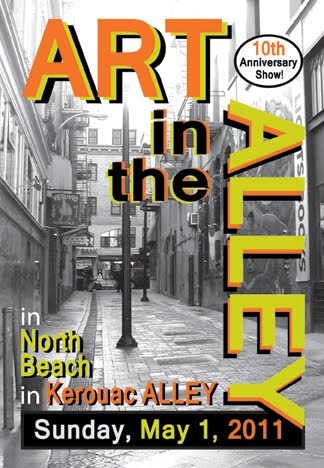
Courtesy of vesuvio.com.
Vesuvio holds a variety of in-house events that encourage cultural awareness. Some of these include poetry and literature readings of both contemporary and past writers, live World Cup match screenings with pancake breakfast specials, “educational” materials like “Leo’s Short Guide to Good Bar Behavior,” and painting, illustration and other art media displays in the bar.
To keep Vesuvio (relatively) up-to-date, the owners ask for employee, patron, and other stakeholder input in addition to the usage of non-aggressive marketing for bigger events. Vesuvio also sponsors all-ages events with a strong emphasis on the immediate community. For instance, the event that owner-manager Janet Clyde is proudest of is Jazz in the Alley, which takes place in Jack Kerouac Alley and was inspired by local artist Elizabeth Ashcroft. Two other functions in the Alley are the mixed-media gathering Art in the Alley, and A Fair To Remember that features twenty-plus local designers, artists, collectors, and scavengers and happens once a month from April to October. Here is a little film about the latter event:
Regional Links
Vesuvio is in the heart of North Beach San Francisco and remains an integral part of the neighborhood. North Beach is adjacent to Chinatown and Fisherman’s Wharf, two sections of the city with their own distinct identities. A large part of the management plan deals with maintaining and expanding Vesuvio’s close tie with the North Beach community (see the Interpretation section and Implementation section for more details) and specific interpretative projects linking the bar to its surrounding neighborhoods.
(4) Vesuvio – Implementation (Action Plan): Interpretive Project Profiles
Plans of Action for Vesuvio:
Click on this link for a look at the PDF file of our complete Interpretive Plan for Vesuvio.
We have many ideas to further integrate Vesuvio into the San Francisco community. We also want to welcome and increase the diverse populations of locals and tourists from around the world that interact with Vesuvio both in person and virtually. Our ideas include the promotion of safety measures; preservation precautions; the pursuit of different heritage and historical statuses; a greater use of technology for advertisement, economic and artistic prosperity; and the “digital preservation” of the bar. We hope that these ideas introduce unacquainted residents of San Francisco and the world to Vesuvio, connect them to the bar’s history and future projects, maintain established community events, and inspire more to come.
Short Term

Exterior of Vesuvio, 2011.
In the short term, or the next five years, our aims for Vesuvio are to engage the local and tourist public, utilize technology for both publicity as well as documentation, and ensure safety at the bar.
This means that Vesuvio should continue current events they host such as “Art in The Alley,” “Jazz in the Alley,” and “A Fair to Remember” and their ongoing art shows, which reach out to the broader San Francisco community. Our team proposes to introduce a new event, a “Caption Contest,” that encourages the community to interact with the artwork at Vesuvio on an ongoing basis.

A Vesuvio-sponsored benefit for the SF Art and Film for Teens project, November 11, 2010. Photo courtesy of Conrado Henriquez.
Some of our more engaging ideas involve the implementation of technology and social media. One way to use these tools is with an advertisement and networking campaign that integrates the bar’s re-designed website and Facebook page into a more widely accessible, user-friendly format. Published updates would be for Vesuvio’s hosted art exhibitions in order to increase exposure of the showings; reach out to interested artists and patrons, spread the word about other Vesuvio happenings like World Cup screenings, fundraisers, and all-age, community events; give some contextual information about the bar’s history; and provide a place where patrons can interact with and comment on their favorite aspects of this long-time hangout. We suggest these events be photographed both for documentation purposes and as reference to enrich other new media as it becomes available.
Another ongoing project is the development of a new-and-improved website as the current one is out of date. This interactive space will also demonstrate another technological endeavor, the GigaPan documentation project that came about in collaboration with Professor Michael Ashley’s Spring 2011 Digital Documentation and Representation of Cultural Heritage class at the University of California at Berkeley. The GigaPan software captures high-definition, panoramic photographs that can be made available online as well as embedded into other media formats. The main benefit of this technology is that it allows the viewer to zoom in extremely close on specific elements of the scene, which reveal images usually hidden in a standard digital photograph. This feature is particularly valuable to us as anthropologists because we would like to use this technology on Vesuvio’s re-designed website to document the bar’s tangible heritage such as its artwork and specialty drinks, in addition to providing other intangible, anecdotal information such as stories behind the origins of a drink or the history behind a work of art. Shots were taken of the mural on Vesuvio’s exterior wall in Jack Kerouac Alley, the view inside looking down over the bar from the balcony, and the entire bar area on the main floor (see image and link below). For other examples of the projects Ashley and his group produced, see their image gallery on the GigaPan website. To view some behind-the-scenes photos of how the class made this magic happen, go to their Flickr account that documents all of their hard work.
To view Vesuvio’s finished interactive GigaPan imagery of the photo below click on this link.

Click on image to view in full screen.
We also recommend increased planning and safety measures be designed and taught to the staff in the event that there should be an emergency. Specifically, crucial tools such as an earthquake-preparedness kit is highly advisable.
It is also suggested that Vesuvio continue in its pursuit to be environmentally friendly. Currently, all glass, cardboard, paper, and plastic bags are recycled, energy-efficient lighting is utilized where possible, low-flow toilets have been installed, and “Eco Friendly Cocktails” are offered that include organic wine, vodka and sake.

Vesuvio's Eco-Friendly Cocktails. Photo courtesy of photobucket.com.
Medium and Long Term

Gas-lit chandelier and Calso the black cat at full alert and on guard above the bar, 2011.
For our Medium-Range Plan (to happen over the next 5-10 years) we suggest that Vesuvio apply to become a San Francisco Local Landmark by working to implement the requirements of the the San Francisco Landmarks Preservation Advisory Board that ultimately would decide their case. Two features that are in Vesuvio’s favor are its connections to crucial figures of the Beat Movement, and its unique lighting fixture – the last gas-lit chandelier in the city – that ultimately could be the deciding factors in this campaign. Once landmark status is established, Vesuvio would then be designated an official Historic Structure, so it is recommended that Vesuvio investigate TPS Tax incentives for preservation that it would then be eligible for in order to maintain the integrity of the building.
We hope that this time period past traditions of the bar are also revived, such as “The Bartender’s Bike Race,” which in days past was a popular event on which even the local paper looked forward to reporting.

Two Vesuvio waitresses win an award, 1962.

Saloon keepers bicycle race, 1962.
In the long term, we hope to find ways that Vesuvio can expand the public’s exposure to its art showings by incorporating a larger, more diverse quantity of work that requires a larger amount of space than Vesuvio can currently offer. After years of building a base of art enthusiasts through the social networking and other online projects we recommend, we propose a collaborative project with Cookhouse, Vesuvio’s upstairs neighbors. Cookhouse is both a location for dinner parties and a unique catering service that occupies the top-floor loft space of the building. Vesuvio could host art openings in the bar downstairs while simultaneously using the loft as a “spill-over” room for the opening’s guests as well as extra space in which to display pieces that do not fit in the bar itself. The art could then be left in the loft to be viewable during upcoming Cookhouse events. This would expand the potential sales market for the artist and add an interesting aesthetic to the room for the guests of the catered event.
There are also hopes for a Vesuvio Museum, where the documented artwork from the Bancroft Library as well as sample art pieces could be hosted.

Click on image to view in full screen. Location of Vesuvio designated by red arrow. Within red box is San Francisco's public transportation near Vesuvio. Map courtesy of baycityguide.com.
Finally, we suggest that the BART (Bay Area Rapid Transit) transportation system, which is the main public transport for most of the Bay Area, be expanded into the North Beach neighborhood as it does not currently function in that part of the city. Personal vehicles and Muni (San Francisco Municipal Railway) buses are presently the only ways (other than by walking) to get to the area. Buses are widely accessible and several stop on the same block as Vesuvio, but they often require several transfers from other bus routes. It would be easier for most people (both visitors and locals) if the BART system that originates downtown, could provide a direct link to North Beach. The city’s famous cable cars do intersect parts of the neighborhood and are another option for transportation, but the routes do not pass by Vesuvio directly and require some neighborhood navigation that might intimidate a tourist unfamiliar San Francisco streets. Parking is restrictive at best for those who wish to drive into North Beach and only street parking is available near the bar with little prospects for any more space to be allotted for parking lots or garages as the densely populated area lacks the space needed for such projects. We therefore prefer to focus on public transit, which would also be the more environmentally friendly direction to take.
City Lights Bookstore: Women of the Beat Movement

Carolyn Cassady, Brenda Frazer, Joanne Kyger, Diane DiPrima, and Hettie Jones are a few of the historical voices from the margins that chronicled the reality of the women of the Beat movement. Cassady, author of Off the Road, was responsible for the mortgage when husband Neal Cassady lost money betting at the racetrack but this didn’t hold her back from pursuing her own literary agenda (Morgan: 2003). Frazer, author of Troia: Mexican Memoirs, worked as a prostitute to support her family while husband Ray Bremser focused on avoiding the law and prison. Kyger, was able to move through many literary circles and break into the literary male circle. DiPrima uses “rhetoric to her own advantage” by turning “masculine traditions…and using it against itself” (Charters 1992: 359). DiPrima, mother of five children, has had her poem about an early abortion used as propaganda to support the pro-life movement’s cause. Jones, writes of her transformation from a young Jewish woman to the wife of a radical African-American writer. Jones supported herself and her husband on a full-time day job only to come home in the evenings to help her husband run an underground magazine and press.
Male writers such as Allen Ginsberg, Jack Kerouac, Jack Spicer and Neal Cassady dominated the Beat movement, while women were defined by the movement’s male circles and continued in their marginal roles as wives, mothers, or lovers (Davidson: 1989). A movement that stressed independence, free choice, and shucking social conformity ensnared many women in traditional roles teeming with domestic responsibility. The post-war 1950s embodied certain attitudes towards women that relegated them to traditional female roles but created conflicting expectations as women became a strong presence in the workforce (Davidson: 1989). The Beat movement may have reinforced 1950s sexist attitudes and misogynistic views towards women but the women of the Beat movement created a foundation for future feminist movements.
The women of the Beat Movement would continually push back against the confining attitudes towards their gender and redefine their future role. These fearless leaders unabashedly challenged society’s attitudes towards women by creating a life of their own which embraced their courage, intellect, and sexuality. The freedom they experienced and the progress they made as intellectual equals with their male counterparts would inspire future generations of feminists. Many of today’s feminists and women writers derive their inspiration from the women of the Beat movement.
Voices continue to migrate from the margins into mainstream culture due in part to bookstores and publishers such as City Lights who ensure people from all backgrounds are given a voice. Ferlinghetti adds that, “the most interesting writing today comes from Third World writers or women” whose revolution is still underway (Wilner 2007: 34). City Lights strives for freedom of speech as well as for freedom to express oneself without rigid academic and social constraints.
(Stephanie)
City Lights Bookstore: History
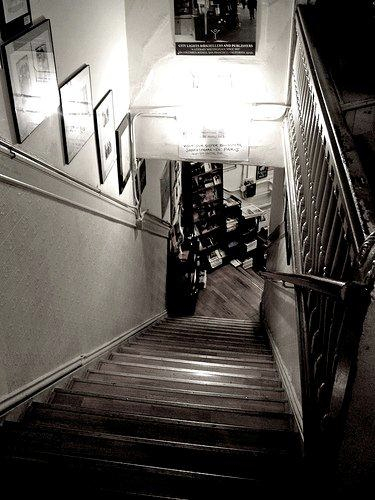
City Lights Bookstore is located at 261 Columbus Avenue between Broadway and Jack Kerouac Alley. The store is situated in North Beach and surrounded by several neighborhoods including the Financial District, China Town, and Russian Hill. The 1906 earthquake leveled the original building that stood at the site. However, the brick arches from the original building were salvaged and incorporated into the construction of the Artigues Building in 1907 (Morgan: 2003). The Artigues Building originally housed several businesses including a flower shop, an Italian travel agency, a barber shop and A. Cavalli & Co. which is still in business today at another location (Morgan: 2003). At first, City Lights Books rented and occupied a small area of the building. City Lights came to occupy more and more of the building as the business expanded over time. This culminated in the purchase of the entire building in 2000. The triangular building was initially overlooked as a site of architectural and historical significance until the 1950s when Peter Martin and Lawrence Ferlinghetti opened the first paperback bookstore in the nation. While the physical building clearly symbolizes City Lights’ historical significance, the intangible heritage is embodied within Peter Martin and Lawrence Ferlinghetti. To truly understand the tangible and intangible history of City Lights Books, we must look to the key players and original owners of City Lights.
Peter D. Martin was a sociology teacher at San Francisco State College (now SFSU) who published a popular culture magazine called City Lights. Ferlinghetti was a U.S. Navy veteran. He received a Master’s Degree from Columbia University in 1947 and a Doctorate de l’Université de Paris (Sorbonne) in 1950. He eventually settled in San Francisco in 1951 where he taught French in an adult education program, painted, and wrote art criticism. He and Martin founded City Lights Bookstore, the first all-paperbound bookshop in the country in 1953.
By 1955 Martin left City Lights to start his own bookstore in New York City and Ferlinghetti became sole owner of City Lights. He founded City Lights Publishing in 1955, beginning with Ferlinghetti’s Pocket Poet series, which now has nearly 200 books in print. Ferlinghetti, a painter and a poet, is the recipient of numerous prizes. Most recently Ferlinghetti was named San Francisco’s Poet Laureate in August 1998. He was later awarded the Robert Frost Memorial Medal, the Author’s Guild Lifetime Achievement Award, and he was elected to the prestigious American Academy of Arts and Letters in 2003. Ferlinghetti has played an unforgettable role as a champion for free speech, a representative of the Beat movement (although he doesn’t claim to be a Beat poet), and businessman who provided a space for dissident voices. City Lights has served for half a century as a meeting place for writers, artists, and intellectuals and is a symbol of counter culture, revolution, and free speech.
(Stephanie)
(6) Vesuvio Image Gallery
Click on this link for a look at our complete Flickr account of images.
Crowd Listening to Mussolini Speak

Jan. 1, 1931.
A Quiet Night at Vesuvio

Vesuvio Cafe's original owner (when it was still an Italian restaurant), Mrs. Georgetti, July 1949.
“Homo Beatikus”
"Homo Beatikus", c. 1950.
For Customers Barred From Vesuvio

Vesuvio Annex, 1950.
The Former Walls of Vesuvio

Signs above the bar, the one to the right still hangs in the same spot today, c. 1950.
Bohemia’s Last Stand

Name contest for Bohemia's Last Stand, 1950.
Season’s Greetings

Christmas card, 1955.
The Outside of Vesuvio in Days Past

Exterior of Vesuvio, c. 1959.
Another Look at Vesuvio in Days Long Gone

Closer look at exterior of Vesuvio, 1959.
Beatnik Kit
Lenoir's do-it-yourself BEATNIK KIT displayed in front window that is visible in previous two photos, date unknown.
Bartenders and Waitresses at Vesuvio

Original owner Henri Lenoir with employees and customers, no date.
A Bike in the Bar

Xmas card photo of (left to right) customers Tony La Paz and Jim Bell; waitresses Maya Dhillon, Alice Holden, Suzanne Mazursky, Lyn, and Adriana; bartenders Bruce Weiss, Ron Leon, David Wood, and Burnie Priest; and Lenoir with Calso the cat, on Maya's motorcycle, c. 1960s.
Rallying the Troops

Henri Lenoir behind the bar, c. 1960s.
Don’t Bother Your Bartender!

Vesuvio cupboard, c. 1960s.
Lenoir Looking Sharp

Henri Lenoir and Vesuvio, 1960.
Vesuvio Ready for its Advertising Debut

Lejon advertisement, no date.
Vesuvio Interior

Vesuvio interior, c. 1960.
Saloon Keepers Bicycle Race
The contestants line up, 1962.
Saloon Keepers Bicycle Race Begins

Joe E. Brown starting the race, 1962.
Winners of Saloon Keepers Bicycle Race
Two Vesuvio waitresses win an award, 1962.
Henri Lenoir and Vesuvio

Henri Lenoir in front of Vesuvio, 1963.
A Bartender at Work in Vesuvio
Interior photo of Vesuvio, with Bruce Weiss tending bar, April 1963.
The Social Scene
Bruce Weiss tending bar with waitress Alice Holden, 1963.
Lenoir and a Waitress at Vesuvio

Henri Lenoir and JoAnne Low, c. 1963.
“Where the Neater Beats Meet to Bleat”

Illustration from article in San Francisco magazine, 1964.
Artwork on the Walls

Vesuvio interior, 1967.
Bob Dylan at Vesuvio

1968.
Vesuvio Today
Exterior of Vesuvio, 2011.
Neighborhood Aesthetics

Exterior of Vesuvio looking northwest down Columbus Avenue, 2011.
Vesuvio Mural

Shawn O'Shaughnessy's mural on wall of Vesuvio in Jack Kerouac Alley, 2011.
Mural on City Lights Books

Mural on City Lights exterior wall across the alley from Vesuvio, 2011.
Come on in!

Doorstep at Vesuvio, 2011.
Beware Pickpockets and Loose Women!
Vesuvio patron in front of wall artwork, 2011.
Interior Wall Artwork

2011.
Table Artwork

Hand-painted table on balcony level, 2011.
Gas-Lit Chandelier
Gas-lit chandelier and Calso the black cat guarding above the bar, as seen from the balcony, 2011.
Heading Downstairs

Stairway down to Men's Restrooms in the basement of Vesuvio, 2011.
For more photographs of Vesuvio’s past and present, including original posters collected by Henri Lenoir, click on this link to see our Flickr account.
Alcatraz – Appraisal
Cultural Values
In determining the significance of Alcatraz Island, the island’s different values must be taken into account. Alcatraz Island has restitutive, cultural, economic, environmental, historical, social and spiritual values. It represents a pivotal moment for the Native American movement and also has considerable historic value as a former Military Fortress and as a Federal Penitentiary.
Environmental Values
The environmental values of Alcatraz include unique geological formations, rare birds, and an abundance of plants. The flora on Alcatraz have significant value because they were introduced to the island and cultivated for decades.
Social, Spiritual and Symbolic Values
Since Alcatraz has a significant amount of history, it also has a significant amount of social, spiritual and symbolic value. For Native Americans the island stands as a symbol of Native American activism and to them it always has been and always will be “Indian Land”. With the advent of the “Unthanksgiving” ceremony, Alcatraz Island has also become a place with spiritual values. The island’s social values pertain to anyone who has had a relationship to the island, for example prisoners, prison guards and their families during the island’s time as a federal penitentiary.
By realizing the overall significance of Alcatraz Island, the National Park Service has created a well thought-out and comprehensive management plan that helps to preserve the island’s values and minimize the threats to the site. The aim of this management plan has been to conserve and protect the island’s significance and to make it available for future generations to appreciate. Nevertheless, the National Park Service should place more emphasis on the period (1969-1971) when it was occupied by Native Americans.
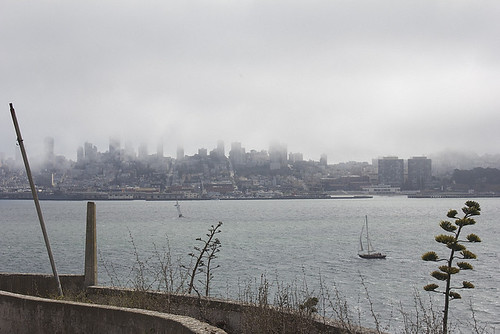
View of SF from Alcatraz
By Julia Frers-Karno
Alcatraz – A Brief History
Alcatraz: A Brief History
Prehistory

18,000 years ago, at the end of the last glacial period, Alcatraz was a sandstone hill at the entrance to a valley. As the ice melted, the Pacific Ocean rose and the valley filled with seawater to become San Francisco Bay, while the hill became an island. According to the National Park Service, Native Americans have lived in the San Francisco Bay area for over 10,000 years. The two native groups that inhabited the area when the Spanish arrived in the late 18th Century were the Miwok and the Ohlone. The Miwok lived to the North of the Golden Gate, while the Ohlone lived to the South and the East.
Pre-contact
Little is known about Alcatraz from the pre-contact period: based on oral histories it appears that local tribes gathered bird eggs there, and also used it as a place of banishment.
Arrival of Europeans

The Spanish naval officer Juan Manuel de Ayala made the first survey of the island in 1775. He called it “La Isla de los Alcatraces,” which meant “Pelican Island”.
Lighthouse

Alcatraz lighthouse was the first to be established on the west coast of the United States, and began operating in 1854. It was damaged during the 1906 earthquake, and replaced with a new lighthouse in 1909.
Fort

In 1859 the US government built a fort to protect its recently acquired territory of California. However, by the end of the Civil War in 1865 it was already obsolete.
Military Prison
The commanders of the garrisons at Fort Point and the Presidio realized that Alcatraz would be a convenient place to send their worst offenders, and in 1861 it became a military prison.
Hopi Indians Imprisoned

In 1895, 19 members of the Hopi tribe were imprisoned for seven months for refusing to allow their children to be taken to government-run boarding schools.
Expansion of Prison

Beginning in 1909 the army demolished the original fort and replaced it with a huge prison complex which, when completed in 1912, was the largest reinforced concrete building in the world.
Federal Penitentiary

Because of the prison’s high maintenance costs, the Army handed it over in 1933 to the Federal Bureau of Prisons, which turned it into a maximum-security federal penitentiary. During this time it housed some of the country’s most notorious criminals. Eventually, like the Army, the FBP decided that the prison was too expensive to maintain, and closed it in 1963. The island was now declared surplus federal property.
Indian Occupations

On March 9, 1964, five Sioux Indians occupied Alcatraz for a few hours, demanding that the government build a cultural center and an Indian university on the island. This protest inspired a group of Native students led by Richard Oakes to occupy the island for 19 months, beginning November 20, 1969. US Federal Marshals ended the occupation on June 10, 1971.
National Park

In 1972, Alcatraz Island was incorporated into the Golden Gate Recreation Area, and is currently administered by the National Park Service.
By Ian Wilson
All picture metadata can be found at our Flickr account; To access it, please click one photo from the right side-bar.
Cultural Heritage in the Digital Age
Cultural Heritage in the Digital Age is a portal into the Microhistory/Cultural Heritage projects of a UC Berkeley course Anthropology 136k/LS180c held in Spring semester 2011.


 Who Owns the Past? Cultural Heritage in the Digital Age