Category Archives: Anthro136kF2015
Plaque and Mural Project
Davis House’s provision of student housing introduces unique challenges to its preservation. In a two-step approach, this project intends to take into account both the contribution of the inhabitants, as well as attempting to affix more permanent documentation in a way that will survive the constant turnover of student life. Step one of this project is a commemorative plaque mounted on the front of Davis house, in a space that is both visible and accessible. The plaque will give a brief history of the house detailing its construction and various histories. By affixing a plaque to the house, house members will have an accessible point of documented memory from which to draw, that will also be available to visitors and outsiders as well, opening the house to the public. The second part of this project would be the creation of a living mural, documenting the history of the house while leaving stylized blank spaces for residents to create and add their own content to the mural. This mural would encourage the house’s history to evolve as the house grows and continues to exist. The key to the success of this project lies in the blended approach of “official” and interpretive history practices that incorporate both elements of the institutional as well as the cultural values of the cooperative. We hope to retain the cultural values of the people to whom this heritage site belongs, while also encouraging longevity, creativity, and preservation.
Berkeley Beats Poetry: Installation of Text into Sites – Interpretive Plan
We hope to physically incorporate Ginsberg’s poems at the sites to showcase their cultural and historical value. This means informing the public about the wider Beat Movement by including additional text about how the movement affected free speech, the gay rights movement, activism, and censorship. Instructions on how to download the audio tour, the crowd sourcing app, and information about the poetry showcase will also be included to bring our interpretive projects together. This will evoke the senses of sight and touch for tourists and belonging for locals.

An example of what the monument in front of the Milvia Street apartment complex could look like.
Specifically, the plan for Ginsberg’s home is to place a historical marker where the cottage used to be on Milvia Street. The base would be shaped like an open book with Ginsberg’s poem “A Strange New Cottage in Berkeley”, the information mentioned earlier, and point out the John Greenleaf Whittier Elementary School poetry garden across the street inside of it. This would stress the themes of local history, beat poetry, and the legacy of Ginsberg.
For the Greyhound Station, we hope to have a permanent poetry exhibit occupy the blank walls near the entrance of the college. His poem “In the Baggage Room at Greyhound” would be placed in the center along with a portrait of himself and the background information. Poems created by the surrounding community and the students would be displayed as well which would generate a sense of community, belonging, and accentuate the themes of poetry, Allen Ginsberg, and physical changes to the landscape.

An example of the physical installation of text that could go on the Sconehenge tables.
The project at the old Town Hall Theater will be challenging since there are plans to turn it into a Honda showroom. But, if we can get the building classified as a historic structure, it’s possible to stop the construction. So, we believe the best course of action is to implement our interpretive project. This includes putting the text of Ginsberg’s “Howl” on the café tables along with signs that explain the background information. This would emphasize the themes of beat poetry, performance poetry, Ginsberg’s legacy, physical changes to the landscape, and local history.
At the U-Save Market, we hope to invite people to walk down the actual “Supermarket in California” and to experience the sounds Ginsberg describes in his poem. We could do this by writing the poem and the background information on the front windows which would highlight the themes of Ginsberg’s legacy; beat poetry, local history, and physical changes to the landscape.
Although these proposed changes would physically modify the sites, they have already been heavily altered. Because of this, our proposed changes will not damage any tangible heritage. They are also sustainable and won’t harm the environment since they are small permanent additions. Instead, they will bring context to Ginsberg’s poems, show the importance of the history at these locations, and sustain the cultural heritage at these sites. All stakeholders will also benefit from these changes since business owners will see more customers and everyone will be able to learn about Beat history.
Read about our Short Term Implementation
Berkeley Beats Poetry: Short Term Implementation
The first five years will need to focus on the actual execution of our various interpretive plans. Planning, implementing, and revising will be key steps during the first few years to successfully get the interpretive plans off the ground. There are bound to be numerous problems that we could encounter at the beginning, therefore troubleshooting issues, distributing surveys, and having an open communication of feedback with the users and visitors of our plans should be key practices to uphold.
For the implementation of the audio tour, we would want to be sure that not only the technical aspect of the app is in working condition (ensuring that the app works well, GPS location and navigation is accurate, narration stays up to date, etc), but also that our audience is understanding our main message and enjoying the experience. The production aspect of creating an audio tour needs to be emphasized when we begin implementing this project. Questions to focus on in regards to our own audio tour include: Why did we choose to place a certain piece of narration or other sound clip at this point in the tour? Therefore, what did we want to evoke by doing this? How are we using place to create a dramatic story—especially since the original buildings are no longer there/have been transformed into something else? What themes are we incorporating with this tour and how does it relate to Allen Ginsberg and the Beat movement?
With the crowd sourcing app we intend to encourage users to write their own poems and express what they are passionate about, so the app’s format and narrative must be open and free of expecting a presumed, singular-linear experience. The app should therefore not ever be a static piece of media technology but should be dynamic and change as the political and social culture in Berkeley changes. Typical updates, maintenance, and troubleshooting with such an app would need to be done as necessary to ensure the app continues to run properly without any serious performance issues.
For the poetry slam, it will be important to spread the word about the events and get a good following early on. This will help it gain popularity and momentum, and allow the slam to maintain a constant number of interested participants and audience members. The short term implementation plans of our sites seek to guarantee that these planned activities get off the ground, gain the attention of the public, and are constructively revised for their betterment so that they will survive into the future and create a lasting and meaningful impact.
For the execution of text installations of Ginsberg’s poems at the Berkeley Trader Joe’s, Ginsberg’s apartment on Milvia Street, Sconehenge Café, and the California College of the Arts, it is important that we take into account the selected piece of text and what and/or who we want its relevance to apply to. It would probably be best received if the various pieces of selected text retained its past significance to the Beat movement and socio-cultural aspects, while referencing today’s events and relating to the people of the local Bay area community as well. The specific location of these installations should be in a place that can be easily located and read.
Read about our Long Term Implemetation
Frozen in a Moment: The Oakland Tribune Tower Audio Tour
Frozen in a Moment: The Oakland Tribune Tower Audio Tour
The goal and aim of this interpretive plan is to convey the aura and the feelings (through audio particularly but also through sight, narrative, and even touch) to the visitor of what it might have been like to take a walk through the Tribune Tower at the peak of The Oakland Tribune’s occupation of the Tower. This specific era in history, reflective and relevant to the Tower’s primary use throughout its lifetime, is chosen based on an evaluation of what the most interesting time period would have been to be inside of the Tower in order that the visitor get the most satisfying experience on the tour. The era that I would like to freeze the Tower in for the audio tour is the 1950s, when The Oakland Tribune became Oakland’s primary news source. Having the audio tour take place during this period in the Tower’s history would showcase the Tower at its peak as The Oakland Tribune was climbing the news podium in the City of Oakland and debatably the Bay Area at the time.

The audio tour will begin with the visitors arriving at the site and putting a pair of headphones on connected to an audio device. This audio device will play audio guiding the visitors around the building to different places all the while narrating relevant history about the particular location that they are in. It would say things like “Go through the hallway adjacent to the doorway and proceed to the far corner of the room that you will then be standing in”. This will tell visitors exactly where to go and would allow the tour to be taken correctly in accordance with how the area is set up. When the visitor arrives at the instructed location, the device will say something like “Look at the desk with the typewriter on it. This desk belonged to John Peterson who was a writer for the…..”. There will also be different narrators who would come on at particular times and tell their own oral histories relative to the spot the visitor would be standing in. The audio device will be the main tool on the tour and will allow each visitor to learn about the site individually without an outside bias influencing their thought process. The tour will take them throughout the building from the ground floor where the newsroom used to be all the way up to the top of the Tower stopping at relevant floors and spots in the building (relevant meaning that it had to do with the period that the Tower is set up to commemorate). Moving throughout the building would require listening to instructions which will guide visitors through the tour which will include riding the elevator or going up stairs but most of the time simply walking around the room and observing the setup of the room while listening to the audio created for it.
The Tower would be set up to resemble how it would have been at the peak of a typical business day in the 1950s. In the audio tour, there will be multiple narrators associated with different parts of the building, many of whom will be people who used to work for The Oakland Tribune when it occupied the Tribune Tower. It would be most ideal to have the majority of these narrators be people who worked in the building for The Oakland Tribune during the 1950s but considering that that was 60 years ago, this might be difficult. The narrators would talk about daily life working inside the Tower and give history of the Tower throughout the tour. It would all be aimed at giving the visitor a feel for what it must have been like to work inside the Tower as a reporter during the peak of The Oakland Tribune’s occupation of it. This would be enhanced through sounds going on in the background of the narrator’s voice reflective of what a bustling newsroom would have sounded like in the Tower during the 1950s.

There would be certain parts of the building that would be set up to look nearly exactly like it did in the era that it is resembling. An example of this would perhaps be a desk with a typewriter on it, an ashtray, and a wristwatch. On the wall above the desk would perhaps be a framed newspaper article pertaining to the person who used to occupy that desk. The visitor might be instructed to walk over and touch the objects set up at the desk while pausing with background noise of conversations in the work office, doors opening and closing, Zippos being struck, etc., being played through the headphones. All of this would give the visitor a feeling of actually being there with the noise and the way the building is set up enhancing the experience. The audio tour would navigate you through the Tower and the building adjacent to it stopping you along the way for these kinds of experience. By the end of the tour, you would be at the top of the tour looking around at the City of Oakland having had an enriching interpretive experience of the heritage site.

The main theme that will be incorporated into this site will be the historical theme. This is obvious considering the fact that the tour is taking you into the past to a unique time in the Tower’s history. Tourism is also a theme that will be incorporated into this project considering that people will be visiting the site for the sake of the experience and therefore be creating more people traffic in that area. The audience that I feel this would reach out to most would be the people who used to work in the building for The Oakland Tribune. They are the ones that would be able to enjoy the experience the most as it would hopefully bring back memories of working in the tower. However, with this being said, this is also the interest group that we would have to be most careful with. This is so because they may also be oral histories of the building and if our depiction of the tower during their period of time does not fit their oral description, then the genuineness and the authenticity of the project takes a toll. I would suggest, as I said earlier, that these are the people that should be incorporated into the project as their insight would be incredibly helpful with depicting the building the correct and authentic way. Another audience that might be drawn to this project would be the building owner or any building owners over the years considering that they have seen the tower and what it has gone through over the years making this experience very meaningful to them. The last (but not least) audience to be incorporated would be members of the Oakland community considering that this building is in a sense theirs as it has been a part of their community for a long period of time.
This project exemplifies sustainability through the way that it sustains the history of the Tower which is something that may be easily forgotten. This history is sustained through the recreation of a setting within the Tower and immersing the visitor into that setting. The audio tour will hopefully be so successful as to trick the visitor into feeling like it is not the present day anymore therefore having them feel as if they have “time travel” to a different time through the sights, feelings, and the sounds of the bustling 1950s news room in the Oakland Tribune Tower.
The aim of this interpretive project is to convey the sights, sounds, and feelings of being inside the Tribune Tower in the 1950s (a unique time in the Tower’s history) to the visitor through an audio tour. This tour will shed some light on the history of The Oakland Tribune and will hopefully give the visitor an enriching experience leaving them feeling as if they have traveled in time while they were on the tour.
This will hopefully open the community’s eyes to the importance of the Tower and the role that it has played in the community of Oakland over the years.
Re-Imagining the Tower: An Alternative History of Oakland
Re-Imagining the Tower: An Alternative History of Oakland
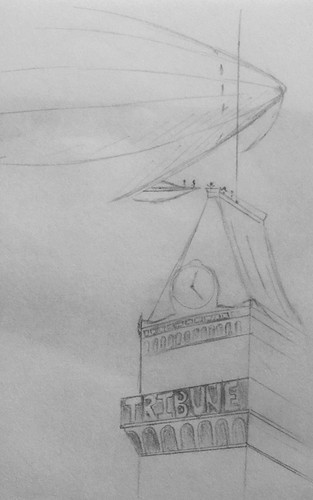
The web browser goes dark a moment and requests permission to use the full screen. You click the button that says “Allow” and the computer screen becomes a window pane looking down over the City of Oakland. In your headphones, a brief crackle of radio precedes a voice telling you that the captain will be landing soon. Pressing a button that says “Next”, the image fades away and is replaced by another that shows a zeppelin hovering in the sky above the Oakland Tribune Tower. The images are static, but around you, in surround sound, are the muffled voices of the cabin crew directing everyone to prepare for docking. On the screen, text appears paneled to one side as if in a comic book. It informs you that the year is 1926, the height of the roaring twenties, and that you are a reporter from New York aboard a zeppelin preparing to land in Oakland and that you are about to investigate the story that is going to make your career…
Thus begins the interactive visual novel set in an alternative, steam-punk interpretation of downtown Oakland. Also referred to as an interactive fiction computer-game, a visual novel is a computer game that uses static graphics, text, and background sound to immerse the user in a story that leads them with audio and visual cues. However, the Tribune Tower’s interactive story has a twist, in which the user will quickly learn that they are being brought into a story about a story – a visual novelization of a historic event that took place in Oakland during the 1920’s. Using archived stories from The Oakland Tribune itself, this project seeks to re-tell history through a fictional and alternative steam-punk lens – blending Oakland’s authentic history with an imagined history where the Tribune Tower was used as a zeppelin mast and the city became the primary docking station for transatlantic travel as opposed to San Francisco.
The main themes that are encapsulated in this project are history, accessibility, media production, technological innovations, and tourism. First, the project seeks to engage the audience in Oakland’s history by telling stories about events that really happened and were reported by The Oakland Tribune. Second, it challenges issues of accessibility by rendering the Tower as something inherently accessible while transforming the site into the very conduit that permits passengers to enter the City of Oakland. At the moment, the modern Tribune Tower is largely inaccessible. It is an area occupied by a building that one must go around. The visual novel transforms this entirely by making the Tower something that one travels through. Media production is also included in this project as it invites the audience to think about how content was produced by The Oakland Tribune. No matter what twists and turns the story may take however, the participant will always be returned to the “official” story that was published in the newspaper, raising questions about how truth is manufactured by places that produce media. Technological innovation is also a key part of the visual novel as the steam-punk setting requires a re-imagination of how technology might have evolved if zeppelins and steam-power had taken off. In this alternative history, Oakland becomes the international hub and the center of innovative technology rather than San Francisco. Finally, tourism lies at the heart of the project as a large part of it revolves around the desire to engender more interest and visitors to the City of Oakland and the Tribune Tower.
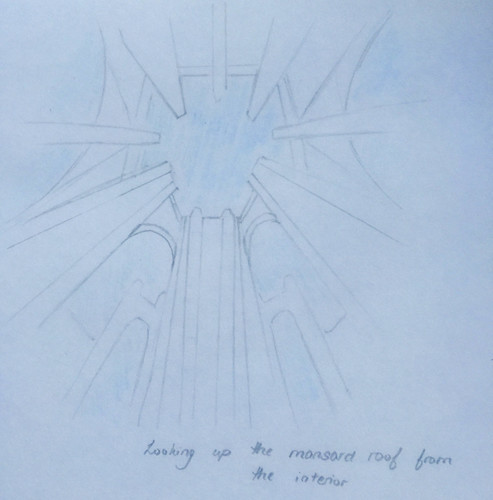
The project has three primary goals. The first is to act as an outreach program for a potential audience. It targets members of the many alternative communities in the Bay Area (particularly the steam-punk community) and provides them with a means of engaging with the site from the comfort of their own home. Hopefully, this will inspire users to visit the site and will draw new tourism and customers to the City of Oakland. The second goal is to provide a story about Oakland that challenges current and accepted narratives, one being, for example, that Oakland is violent and unsafe or a place where only poor people live. It encourages re-conceptualization of Oakland as a place where exciting and interesting things once happened and may still be happening today. This will target the residential audience within the Bay Area that already knows of Oakland but avoids it. Finally, it seeks to re-imagine the Tribune Tower and how it exists in its own space. From the zeppelin, the user sees the Tower from the perspective of someone looking down at it from above, a point of view most people never consider. In the next scene, when the zeppelin is shown approaching the Tower, the user is looking up and the peak of the Tower is given relativity in context by being placed next to something. Close up shots can provide the user with a sense of how near (and how far) the landing mast is to the zeppelin and as they cross from the zeppelin to the docking station, a glance down shows them how high above the city the Tower stands. By playing with the space, the project invites the user to re-consider the space the Oakland Tribune Tower inhabits and perhaps invites them to play with the space in reality too. This will draw in not only the first two audiences but also people who currently occupy the Tower’s space such as the people who work there, the people who live near there, the people who maintain it, and the people who own and manage it.

The project primarily incorporates the senses of sight and sound, but also proprioception as the user is invited to re-consider the Tower’s location in space and their relative position beside and within it. It also incorporates cinema as background music, sounds, and “fade to black” moments all contribute to a sense of drama. However, the visual novel also offers itself to device-specific “mini-games” in which after having completed the interactive story, the reader is able to download an app that takes them to the “real life” scene of the event and allows them to visit the memories they have already created in the story world. By blending such physically-aware apps as DeTour and Google Stories, visitors could lift their phones in certain locations and see on the screen the scene as it was in the novel while immersing themselves even more completely in the sights, sounds, and smells of Oakland as well as their own movement through the streets.
An important way in which this project contributes to the sustainability of Oakland is that it generates new interest and seeks to attract new visitors. Although the economic aspects of sustainability are vital to keeping the Tower maintained, there’s also a key area of intangible heritage that is sustained by this project. When I first began researching the Oakland Tribune Tower, the rumor associated with it was that it was supposed to have been a zeppelin docking station. This rumor was quiet but quite persistent. The existence of the rumor led me to question why the idea of Oakland as a zeppelin landing port had so thoroughly captured the imagination of the city’s inhabitants. But as I listened to the extant narratives about the city (the stories of its violent past, its rough neighborhoods, and its poverty) I realized that the zeppelin in a way represented everything Oakland was “supposed” to have been. It was never intended to be a food desert or a dumping ground for the poverty-stricken. Drawing upon this realization, I began to research zeppelin landing docks in the United States and I could find only two, both unused. The first is the InterContinental Hotel in Chicago, Illinois, built in 1929, and the Empire State Building in New York, built in 1930. This places Oakland on the same level as these great cities which can be described as the jewels of the United States. The idea that the Oakland Tribune Tower might once have been a landing mast for a zeppelin represented everything Oakland itself might have become. It places the city on par with the places that tourists want to go to, and the big names in America. This sense of pride is an enormous part of the Tower’s intangible heritage and although it is not consciously linked to zeppelins and airships, the Tower still stand as a representation of a golden-era and a hope that the city unfortunately was not able to fully realize but however, a hope that can be re-inspired and sustained by this project.
Read All About It: Technological Innovations (for kids from 1-92)
Read All About It: Technological Innovations (for kids from 1-92)
For this interpretative project we would like to propose an educational way to engage new generations that have never had the chance to see the Oakland Tribune Tower as a newspaper producer. Our goal is to reopen the Oakland Tribune Tower as a museum open to the public free of charge. The museum will have multiple printing presses ranging from the early 1900s to the present day as well as different custom made bikes, cars, and vans to be used for a tracked tour to depict newspaper distribution and the change in transportation. The target audience of this interpretive project will mainly be youth but also extends to include adult interaction. Students and youths will be given the option to participate in the “Read All about It” tour in which they will be given a sheet of paper and will have the chance to write their own news based on their experience within the museum or in the City of Oakland.
This “Read All about It” tour, will be a tracked tour similar to a roller coaster. The building itself will consist of twenty three floors total, enough space to make it a rollercoaster. The track will run through all floors with twenty of those floors consisting of people sitting on bicycles, cars, and vans depicting the change of methods used to distribute paper. On the three remaining floors, people will be asked to get off the track to experience the other interpretative projects, which will also be part of the museum. This “rollercoaster” will be secured for youths to ride alone or alongside parents, depending on their age. This track tour will also be ADA accessible so that people can enter the tour vehicles with their wheelchairs so that they don’t have to leave them behind. The ride itself will then transport everyone to the different levels of the Tower.

The guests will then be able to take another elevator, also ADA approved, to return to the bottom. This form of exit will one, avoid repetitive information by replaying the tour on the way down; and two, eliminate congestion of more people trying to get on the ride. The vehicles on the track themselves will go down to the bottom in a similar way almost like how bowling balls are retrieved. At the end, the elevator will leave you on the first floor where there will be printers for children and guests who can print out their news with the help of museum volunteers.

Although our intial hope was to provide access in a less restricted manner, health and safety considerations make it difficult for us to allow visitors to roam the site unsupervised. By making this plan a track tour we would be able to enforce more controlled access, avoiding accidents and problematic scenarios (such as the suicide in 2004). The track tour will also allow us to direct the attention of our visitors and encourage them to be engaged with news articles decorating the walls, or the audio narrations that will be built into the museum. This track tour will create an interactional experience stimulating most of their senses such as touch, sight, and sound. (The taste factor will come in after the track tour in the restaurants which exists below the Tower.)
This “Read All about It” tour fits our educational theme since it will allow youth to be part of the Oakland Tribune Tower by making their own news, but also by learning how numerous papers were produced in this Tower. Seeing how the forms of transportation for the Oakland Tribune evolved over time alongside the different printing presses will show the technological innovations that have occured since the 1920’s – another of our considered themes. This interpretative plan will also consider tourism (one of our themes) in which multiple stakeholders, such as the owner of the building and restaurant owners, will benefit since it will attract more people to the Tower and to their business.

With this interpretive plan, the space containing the Oakland Tribune Tower as a whole will once again change in its use. Yet by looking at the prior uses within its history, it may become evident to many community members that the Tower is in fact a member of the contemporary community as much as any building in Oakland is. Sustainability of the Tower will be continued by historical documentation and oral history that has been stagnant since the Oakland Tribune left the Tower. Re-opening the Tower to the public will guarantee that the Tower is being looked after and taken care of. Things that are necessary like electricity, sewage, earthquake reinforcement, etc. will become a concern for the entire building as opposed to just the restaurants and businesses that occupy the building. Although this will maintain the physical sustainability, opening the museum will encourage the historical sustainability by passing down knowledge to a different generation here in Oakland and those who wish to visit. Having then created the actual physical track tour, “Read All about It” can then be made into a virtual tour exactly, replicating the track tour considering that the track layout would be a perfect walk through for the virtual tour. Making this site accessible online to people that cannot come to visit the museum but are interested in the history will also broaden the knowledge of this site and help it reach more people in an easier way. This however will not be as fully enriching as visiting the site and taking the actual physical tour will be.
Interactive Tribune Museum
Interactive Tribune Museum Interpretive Plan
The Interactive Tribune Museum plan will immerse the visitor in the news publication process. A recreation of the newsroom floor will be the setting for the museum. The visitor will move through a physical timeline that highlights the progress from the start of The Oakland Tribune as a news source all the way to the contemporary period. The visitor will be guided throughout the decades of the Tower’s existence revealing the news that shaped the City of Oakland as we know it today.
One of the goals we would love to accomplish with this heritage project would be to see The Oakland Tribune resume news production from within the Tribune Tower. Considering this realistically with politics and business bureaucracy, this endeavor must be rethought.

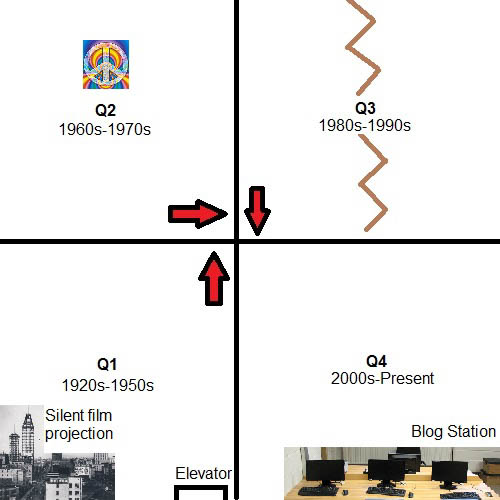
Refashioning this goal into the proposed interactive museum allows for a wider audience reach than restoring the paper to the Tower. An existing floor of the Tower will be dedicated to the museum. The entire floor will be divided into four sections, or quadrants. Each of these quadrants will represent a specific linear time period.
The first will chronicle The Oakland Tribune from its construction to the 1950s. As the visitor moves around the quadrant, they will progress through time. This quadrant will display the construction and dedication of the Tribune Tower in the 1920s and will then progress to the 50s era. Desks where reporters would have typed out columns will be arranged just as they would have been in the original newsroom that occupied the Pantages Theater many years ago. Visitors will be able to watch a silent film about the construction of the Tower which will be projected onto one of the walls of the quadrant and will contain early video recordings and images of the City of Oakland in its infant years. Visitors will be able to have a seat at the desk of a reporter where they will be able to pick up a freshly printed copy of The Oakland Tribune and read headlines from the roaring twenties. On another desk, the needle point of a record player will scratchily run across a jazz record from the 1940s to encompass the feel of that era.
Quadrant two will focus on the era ranging from the 1960s to the 70s. Visually, each quadrant will differ from the next. Each will reflect the aesthetics of that time period in order to situate the visitor in a more realistic environment. Flower power, peace, and love will adorn quadrant two on one side, while a focus on civil rights and socioeconomic movements will be the headlines for visitors to read as the quadrant transitions to the 70s decade.
The third quadrant will focus on the 1980s and 1990s. The major visual draw to this quadrant will be the recreation of the Loma Prieta earthquake that rocked the Bay Area in 1989 resulting in The Oakland Tribune having to relocate from the Tower while the building underwent repairs and retrofitting. A giant “crack” will run through the middle of the room while visitors will have to zigzag around overturned chairs and desks. Papers will be scattered aimlessly around littering parts of the floor. Headlines will reflect the earthquake that shook the amassing Tower. Now that we’re in the 80s, televisions can replay old news stories that documented the aftermath of the disaster around the Bay Area.

The fourth and final quadrant will consist of news from the early 2000s to the present. This quadrant will be most similar to the current newsroom of The Oakland Tribune, and will be the most technologically advanced quadrant. Desks will be outfitted with computers with which visitors will be able to scroll through archived headlines or watch videos of current events. Large touch screen panels around the room will allow the visitor to interact with previous Oakland Tribune journalists. Press a name and a prerecorded life size image of a person will appear, introduce themselves and will engage with you around news that they reported on.
Probably the most interactive and exciting feature of the museum will be The Oakland Tribune blog that museum visitors will be able to directly publish their own stories to. Visitors can sit down at the blog station and type their thoughts, reflections, comments, and concerns after completing their tour of the museum. Their only instructions will be to pen an original piece of work that will then be published to an online blogroll that will be publically accessible through The Oakland Tribune’s website. Visitors will be able to comment on their experiences at the museum, or write their own versions of some of the news articles that were highlighted as they moved through the different quadrants of time.
This interpretive project will incorporate many historical aspects as it chronicles the history of the City of Oakland. This will be done by the visitors literally walking through different decades of the paper and the Tower’s history while viewing the big news stories that were covered during these periods of time. With this interpretive plan, there is also a heavy focus on technological innovation (another one of our themes) to show the technological evolution of The Oakland Tribune from a paper using the hand printed press method to one that today might be described as completely digitalized. The advancement of technology as the visitor walks throughout the plan also allows for a more interactive experience.
Perhaps the most vital theme incorporated into this plan is tourism. The museum is set up to attract individuals to experience the cultural heritage of The Oakland Tribune within the Tribune Tower. Without tourism, there is no museum. Without daily visitors, the vision of the interactive museum will be lost and the dream of having the newspaper again housed within the walls of the Tower will never come to life.
Our target audience of the museum will be by and large the community of Oakland. The news stories published by the Tribune are the stories of the individual people in the city. Visiting the museum should evoke memories, and take visitors back to a certain place and time. The great thing about the museum is that it will make the Tribune Tower the most accessible to the public that it has ever been. People will even have the opportunity to become, for a short time, reporters themselves while experiencing news production first hand via the blog function. We really hope to draw people into the building and to make their visit one that leaves them feeling as if they just time traveled into the past to a different time period in the City of Oakland.
Sight, sound, and touch will be used to enhance the visitor’s sensory experience in the museum. This will be done by seeing the design of the quadrants change as you progress along the timeline of the city, listening to the different prerecorded oral stories, and touching copies of the papers produced by The Oakland Tribune. We don’t want the visitor to come into a static environment where all they do is look but instead we want them to engage with the environment using their different senses. The goal of the interaction in the museum is to make the visitor feel as if they are a journalist for The Oakland Tribune themselves. The timeline and the ways we will represent each decade in the quadrants will hopefully bring the visitor back to those periods of time in their own lives.
This project relates to sustainability in several ways that will benefit both the Tribune Tower and The Oakland Tribune newspaper. The museum will have a nominal entry fee with proceeds going to making the museum more self-sustaining. Any additional profits left over can then be directed to the preservation of the Tribune Tower itself in order to ensure that future generations can enjoy the newly founded museum inside. In regards to The Oakland Tribune, the museum acts as a living archive. People will be able to engage in the news production process and the printed word of The Oakland Tribune and the news realm in general will continue to live on.
Berkeley Beats Poetry: Long Term Implementation
After we implement our interpretive plan, it is our hope that these sites will remain in the same condition for the next 25 years. The audio tour could continue to be used as long as the sites did not drastically change their location, function, or exterior aesthetic. As most of the audio tour’s narration discusses the history of Ginsberg and his poems, small changes to the sites will not affect the narration as it mainly talks about the past. The pictures shown during the tour will all be from the 1950s, so they will always be relevant and will not need to be updated over time. The narration will have to be altered (ex: markers need to be modified) if a site changes enough that it no longer matches the description in the app. The application will also require a feature that allows it to update and sync with any changes in navigation and GPS, as well as general technology updates to stay current with the ever changing technologies and devices continuously changing and becoming obsolete.
The crowd sourcing app would ideally be used in concert with visiting each of these sites and being inspired by Ginsberg’s site-specific poems. If the sites remain in their current form, the app can continue to be used in this same manner, although regular updates with technology would be necessary. However, the app would still serve an important and effective function even if the sites were altered or destroyed. It will also encourage users to write their own poems and express what they are passionate about in different ways, which can be aroused by an ever-changing culture as much as by a dynamic place. Just as Ginsberg fought for free speech and personal expression through poetry in the 1950s, the app can be used to express support or opposition for whatever issue is currently facing users and their community. It could then be used as an interesting digital archive, documenting and digitally storing the thoughts and feelings of users over many decades.
Assuming that the Sconehenge Café and California College of the Arts remain in their current condition, the slam poetry showcases could continue into the long-term future, assuming a positive community turnout to the event occurs. As with the crowd sourcing app, the showcases’ content and forms of expression may change over time. However, regardless of how the political and social culture in the Bay area changes, the ability to express oneself in a manner similar to slam poetry will remain popular and important. If the Sconehenge Café is turned into a Honda showroom, it may be necessary to end the slam poetry showcases at this location and hold them only at the old Greyhound station.
Having text about Allen Ginsberg and his poems installed into these sites will only be effective in the long term if these sites do not change. Since most of the sites are not expected to change, we expect that installing text into these sites can be enjoyed for the next 25 years. For the old Town Hall Theater location, which might be reconstructed into a Honda Showroom, we hope that any installed text could be moved into a future renovated and repurposed building and stand as a symbol of the historic importance of the location. It is important that each of these sites retain a physical indication of their relation to Ginsberg and the Beat Generation so that locals, visitors, and tourists alike can understand and enjoy the location’s significance for decades to come.
Berkeley Beats Poetry: Works Cited
“1885 University Avenue Initial Study and Environmental Checklist.” (2006): Planning and Development Department Land Use Planning Division. City of Berkeley, June 2006. Web. 11 Oct. 2015.
2777 Shattuck Avenue Project Evaluation (2015): City of Berkeley Planning and Development Department, 14 May 2015. Web. 11 Oct. 2015.
“Allen Ginsberg Project.” AllenGinsberg.org. Allen Ginsberg Project, 2014. Web. 10 Oct 2015.
“Berkeley Home.” 1624 Milvia St APT 2 94709. Zillow, n. d. Web. 11 Oct 2015.
Dalzell, Tom. “Gone: Allen Ginsberg and Jack Kerouac.” Quirky Berkeley, 7 Oct. 2014. Web. 11 Oct. 2015.
“Executive Summary 1111 8th Street.” (2013): n. pag. San Francisco Planning Department, 18 Apr. 2013. Web. 11 Oct. 2015.
Ginsberg, Allen, Mary Beach, and Claude Pélieu. Reality Sandwiches. Paris: C. Bourgois Editeur, 1972. Print.
Jones, Carolyn. “BERKELEY / Neighbors Say No to Popular Market / Trader Joe’s Project Hits Snag Over Traffic, Low-priced Alcohol.” SFGate. Hearst Communications, Inc., 3 Oct 2006. Web. 11 Oct. 2015.
Lawlor, William. “Life of Allen Ginsberg.” Beat Culture: Lifestyles, Icons, and Impact. N.p.: Google Books. ABC-CLIO Pubishers, n.d. 134-35. Print.
Raskin, Jonah. “American Scream:Allen Ginsberg’s Howl and the Making of the Beat Generation.” Google Books. University of California Press, n.d. Web. 5 Oct. 2015.
Skeryl, Jennie. “Individual Resistance and Collective Action in the Beat Counterculture.” Reconstructing the Beats. N.p.:Google Books. Palgrave Macmillian Publishers, n.d. 41-43. Print.


 Who Owns the Past? Cultural Heritage in the Digital Age