(4) Five Wounds Church: Appraisal-Interpretation and MultiVocality

Visitors are meet at the church with the opportunity to self-explore. However, as it is see, there are no descriptions of the statues
The following are the results from our analysis of the MultiVocality of the site:
- There is only one bus serving the entire neighborhood of Little Portugal. The only way a visitor can reach Five Wounds via public transportation is via the Santa Clara Valley Transportation Authority (VTA) bus number 22, which runs along E Santa Clara Street (Santa Clara 2011). However, a proposed expansion of Bay Area Rapid Transit is under way.
- Parking lot is not big enough to accommodate all guest.
- There are currently no visitor facilities and/or retail stores on the property.
- The visitors are not met by visitor guides, church leaders, or the pastor.
- The church does hold office hours for visitors. The office is open Monday through Friday from 9am to 4pm. Moreover, visitors are allowed to explore the church without supervision.
- A schoolhouse adjacent to the church graduated its last class in 2009. Since then, the educational opportunities have run dry. As a result, the facility is rented out to the highest bidder. Within the building there is a large cafeteria and a large venue ready for potential parties, festivals, and plays. Special privilege must be obtained to visit the schools; the space is not open to the public. A visitor might not be able to enter the school today, but they wouldn’t be missing much if they did.
- on the left hand side we find a smaller building that houses offices of the pastor and clergy. The building is also used by Saint Isabel’s Kitchen to provide food for needy families of San Jose. Aside from the described usage there are no other usages of the building. The building is off limits to the public during non-usage hours and only accessible through Saint Isabel’s Kitchen or through special access via the church’s leadership.
- Visitors are able to attend English mass on Sundays at 8am and 5:30pm, Monday, Wednesday, and Friday at 9am. Latin mass is given at 9:15am on Sundays and a Bi-lingual English/Portuguese mass is given on Saturdays at 6pm. In addition, visitors are able to confess on Saturdays from 5 to 6pm and any other times by appointments. In addition, if visitors want to hold their weddings, baptisms, etc. at the church they must contact the church three to six months ahead.
- First, the church website is not appealing and is in need of further attention.
- visitors at the church have no way of making sense of the stained glass windows, other physical aspects of the site or the long history of the church because no such material is available.
- Five Wounds Church has become meaningful to the San Jose community Anyone who has created and experienced or a memory at Five Wounds is thus part of the community. The Vietnamese community in San Jose that also use the space for mass are thus part of the memory community of Five Wounds. In addition, community members also use the space to celebrate weddings, quinceañeras, baptisms, etc
- Of the multiple voices among key players, the older generation of Portuguese-Americans has had the most to say. It was not apparent whether they had strong feeling for the church because it has been a larger part of their lives when compared to the lives of the Portuguese youth, or because it

Beautiful Image without any description.
(5) Five Wounds Church: Appraisal-Community
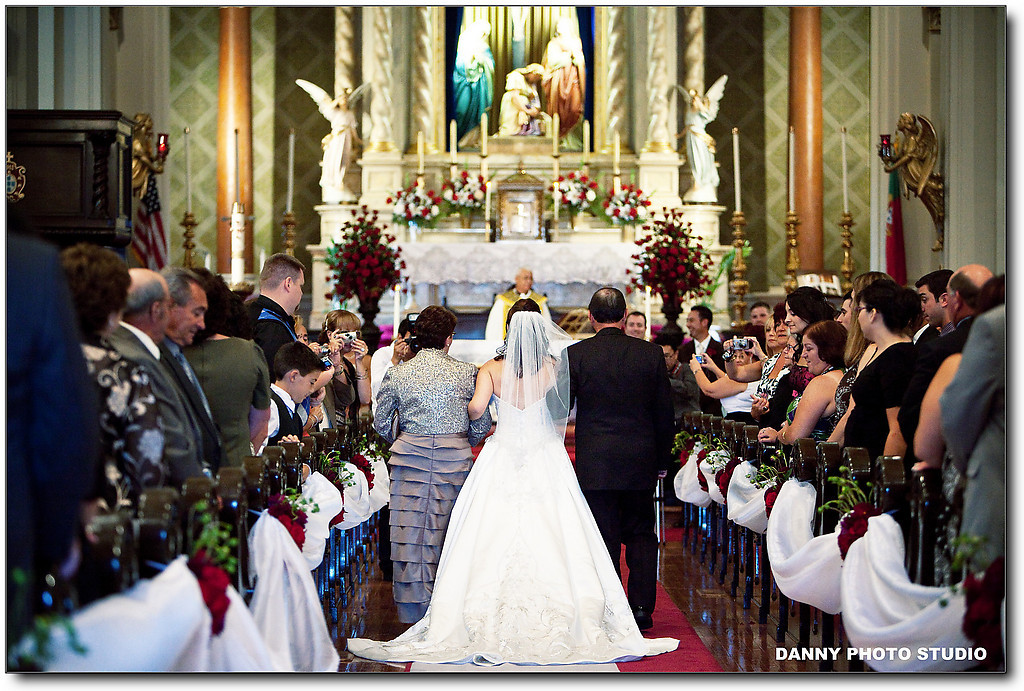
Bride Walking Down the Aisle at Five Wounds. Courtesy of Danny Photo Studio
It is perhaps best to begin an appraisal of the Site and its residents by recognizing the regional connections within which it is situated. There are four levels of community that involve the church and the targeted audience. The four levels are local, regional, national, and international. To begin with the smallest, Little Portugal surrounds Five Wounds Church in San Jose. This defines the site proper, and as such, is the focus of the Plan. Examples of local area links are the Portuguese newspaper and the local bulletins used to convey local activities and ordinances. These particular media examples provide a channel through which the community may become aware of local activities as well as current situations involving Five Wounds.
A step up from the local, the regional level includes the city of San Jose and the county of Santa Clara. Increased recognition of the Site will create an opportunity to collaborate and engage with many different neighborhoods and audiences, exposing them to the rich heritage of the Portuguese. At the local level, a desire to sustain the Portuguese culture is warranted; at the region and larger links, awareness and appreciation of the culture from multiple perspectives and ethnic backgrounds is wanted.
Specifically, the national and international links can be accessed by anyone with an Internet connection these days. What used to mandate a long voyage across the Atlantic now only takes a click of a button. People involved at the national and international levels of the community appraisal would hardly invest in such a trip anymore; the Internet provides a more cost effective and safer experience of Five Wounds, but not with the current web access offered by the church. A connection to the Site is available be anyone from anywhere with Internet access, internationally or otherwise.
Over the years, as is the case with the Portuguese youth, a fusion of Western and traditional Portuguese culture has birthed a cultural perspective unique to Portuguese American heritage. For instance, the local sport clubs provide a unique atmosphere that houses both Portuguese and Portuguese-American guests sharing food, wine, and laughs. Such a club is ideal to observe the people of Little Portugal closely precisely because the business structure of the club refuses to bend to the requests of traditional Americans (e.g. serving only traditional Portuguese food) and remains focused on Portuguese authenticity.
Back at the church, we find a healthy rhythm of weddings and baptisms scheduled. Aesthetically, the church has not lost its beauty over the years and needs little restoration support. There are no major ecological issues that need to be addressed immediately apart from the daily maintenance of the local ecology already outlined. There are little to no environmental risks besides the church being located rather close to the California 101 highway. Although the fumes and especially the noise which emit from the high traffic of highways can be taken as deterrents to the tourism of the Site, having the highway so close to the church keeps potential visitors from taking complicated directions and decreases the potential of getting lost or frustrated. Getting off the highway, Five Wounds is a two-minute drive.
(6) Five Wounds Church: Implementation (Action Plan)- Short Term Goals

Fundraiser: Efforts by Five Wounds
Short Term Goals:
Proposing short term goals is difficult in the sense that this Plan had to first identify which projects, when implemented, would strengthen the succeeding implementations. It was like arranging a set of dominoes upright in a predetermined path so that when complete, the entire project would rely on only one push. Such effort is converse to the current implementation plans by the Comity which deals with annual events and issues as they come along. This proposal aims beyond the festivals and Sunday mornings to give a supportive yet dynamic structure to the sustainability and practice of cultural components comprising the Portuguese culture of Little Portugal up to any international relations. The following are the proposed short term goals:
- Setting up locked donations boxes at the entrance of the church. Collections from boxes may be used to offset some of the expenses used by the food kitchen at St. Isabel’s next door.
- Redeveloping the educational facilities. This will be done by having weekly meetings among key players and stakeholders until an agreed until an agreement is made. Courses in Portuguese culture and language should be thought in collaboration with the local state and community colleges.
- Creation of arts and crafts course to attract children, teenagers, and parents.
- Implementation of multiple interactive Cultural Heritage Day throughout the year in the church parking lot. For example, events at the festivals can include cooking classes, cooking contest, arts in crafts, etc.

Up Close shot of the graduating class of 1967 school picture
(7) Wounds Church: Implementation (Action Plan)-Medium and Long Term Goals

Display at Portuguese Historical Museum
Once the short term goals are meet, the medium and long term goals will serve to further strengthen the sustainability of Five Wounds. The plan’s final strategic move is to build a stronger connection with the home land of Portugal. The goal is to continue developing the educational facility, educate and celebrate the Portuguese culture, and the beautification of the church. We believe that in twenty five years it is possible to begin holding events within the church by inviting scholars, politicians, and ambassadors’ representative of the Portuguese people. Throughout history, Portuguese immigrants have been prominent in contributing to the development of culture and society in the United States. Benjamin Cardoza, the Supreme Court Justice (1932-1938), John dos Passos (1896-1970), the author of the famous USA trilogy and other works on American society, John Phillip Sousa (1854-1932), the composer of America’s best-loved marching songs, were men of Portuguese heritage who have important places in the history of the United States. Although these great people are no longer of this world, the idea is clear that members of the Portuguese community can carry the culture of the Portuguese people by speaking directly to them at the church of Five Wounds. The following are the important goals we have identified to strengthen Five Wounds through a 25 year period.
Medium Term Goals:
- Have graduating students reach out to other students from every educational institution in San Jose to serve as role models. In addition, they will promote Five Wounds through the advertisement of their experience and the Portuguese culture.
- Digital documentation of clergy members. This project will allow future visitors to revisit the history of the church. In addition, the documentation will allow for research to be conducted on the church.
- Begin the process to find an individual to fix and clean the organ. In addition, the construction of a second stairway to meet San Jose building codes must begin. Access to organ will enhance visitor experience.
- completion of an unattended portion of an incomplete ceiling paint job right above the main alter.
Long Term Goals:
- Document the number of individuals engage wit the free services provided by St. Isabel Kitchen.
- Requests the local government for an easier travel rout for visitors and tourists to Little Portugal.
- Creation of a shuttle between Five Wounds and the Portuguese Heritage Society (only 3 miles apart).
- Creation of promotional tours video feed aimed inside the church. This would give internet viewers a freedom to explore the church at their own direction and offers the potential to stream video feed across the internet for special occasions

Sign of Portuguese Museum
(8) Five Wounds Church: Interpretive Project Profiles-Digital Exploration
Outlined here are three proposals to engage the community over the years. They can be implemented at any time given the necessary resources. The reason for their inclusion has been to supplement the historical, appraisal, and implementation approaches to the revitalization of the Portuguese culture. The following is are suggestions actively invite and retain visitors once the cultural aspect of the church and little Portugal has been established.
Digital Exploration:
Digital exploration immediately addresses the Portuguese youth and removed visitor audience begins by creating an interactive website. Digital tourism allows visitors-real and virtual- from around the world to visit Five Wounds Church, which will Increase the number of visitors. Currently, the church does not explain the history of the church and the meanings of all tangible items inside the church. The creation of website will allow visitors to create their own experience while maintaining the goals of Five wounds Church. In order to keep the visitors interested, the website will “not force-feed them a programmatic view of heritage. Rather we should create a design structure that is influenced by the goals of mulit-vocality and reflexivity” (Gonzalez 2005) as it is stated “Multivocality and the Virtual Interpretive Environment” by Sara L. Gonzales. The website will be created by using the free software WordPress. The ability for the visitor to explore the site in 3D will be created by a Google 3D program. visitors can click on an object that will produce the description and history.

For Example, if a visitor clicks on this object a description of the object will appear.

This stain glass window will explain the history of Portuguese to America that is portrayed
(9) Five Wounds Church:Interpretive Project Proflies-Mobile Detection
Mobile Detection:
Visitors who participate in a scavenger hunt become more observant resulting in a more meaningful experience. According to Erik Champion, navigation influences visitors in what to do, whereas exploration allows visitors to lead themselves where they want. In result, participants will experience their own interpretation of the environment that creates a whole new perspective. A scavenger hunt attracts visitors of all ages and especially children and adolescents. A scavenger hunt is an active way to get visitors involved with the church. Families can participate in a scavenger hunt and work together to figure out answers to clues and riddles regarding the historical and cultural heritage of the church. Children and adolescents are the main targeted audience along with parental supervision. With guidance and prior knowledge, family members can learn from each other and the scavengers hunt itself. The idea of answering the clues and riddles is to think about the many possible answers that can be used. There are many different ways to approach a scavenger hunt, but it takes some thought and energy. In consideration of the variability of age, there will be three levels of difficulty.They are easy, moderate, and hard. To make sure that there is no repetition of answers, fresh new clues and riddles will be provided each time.
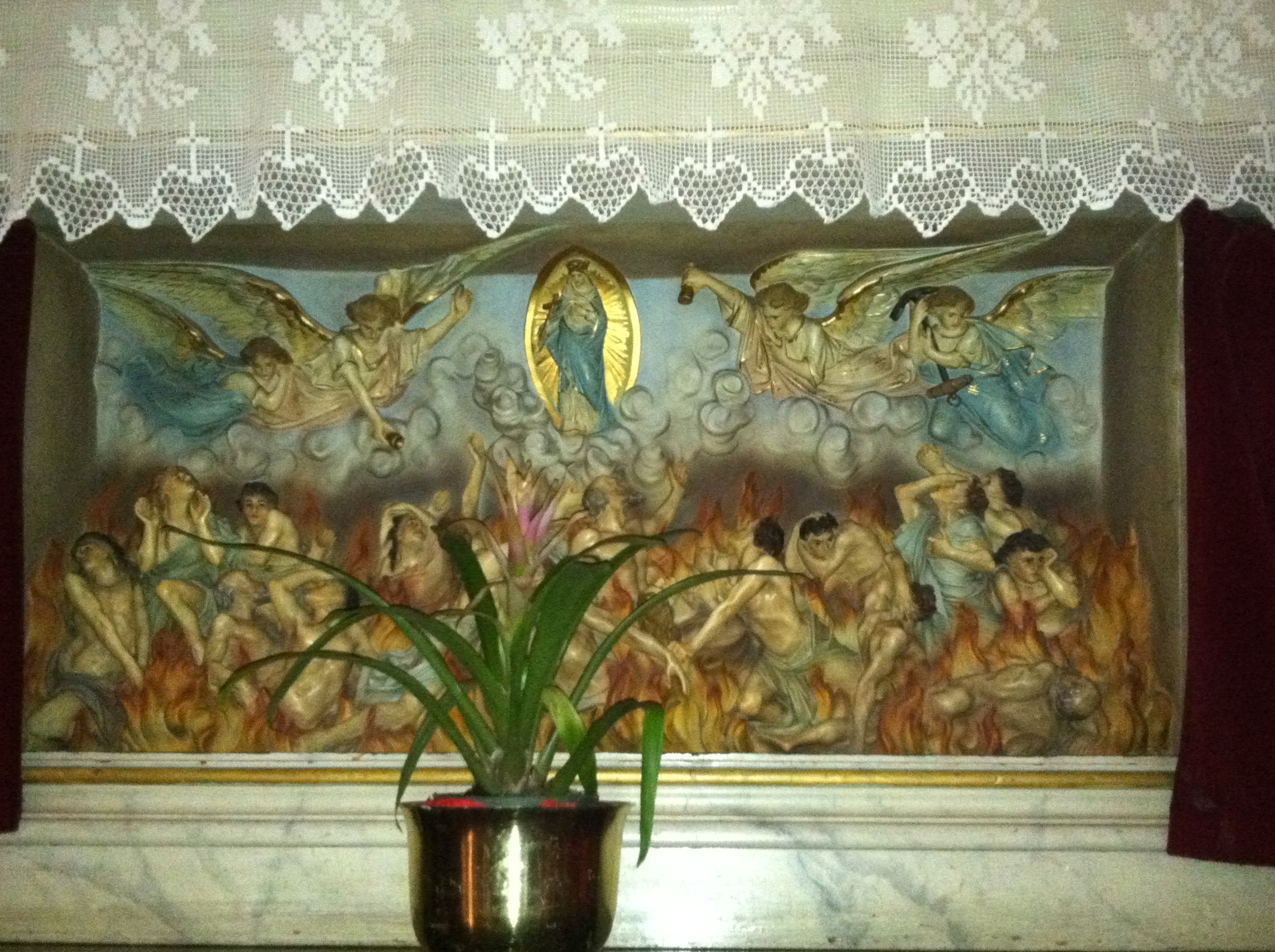
The scavenger hunt can consist of finding an image such as this one.
(10) Five Wounds Church: Interpretive Project Profiles-Ascertaining Authenticity

Interior of Five Wounds: Examine the Architectural style
Ascertaining Authenticity:
This ongoing project will address such questions of authenticity within the intangible and tangible portions of church structures. for example, making architectural descriptions available to audience members over the correct analysis of Five Wounds becomes foundational to any claims of “authentic” (or in this case, unauthentic) style. This project will be executed by reprimanding the official church website to correctly identify the buildings “authentic” style. How? By building paragraphs embodying a certain portion of Manuelian architecture, such as armillary spheres found on ships (a navigational instrument and the personal emblem of Manuel I), and then providing two pictures for the reader to choose from; one picture will perfectly embody the Manuelian style, and the other will not. We hope that this will begin to help audience members establish what the core representation styles of Manuelian architecture are in order for them to create critiques not only on the church of the Five Wounds, but what will ultimately serve them in any travels as they mention to their mate “Aha! I have seen such a structure before – this style is Manuelian!”

Exterior Picture: Examine the Architectural Style
(11) Five Wounds Church: Research Staff

Research Team Enjoying Portuguese Food in Little Portugal
Andres E. Tobar
Native to the City across the bay, he resurrected the Anthropology Club at City College of San Francisco after nearly a decade of being ignored. The Club has drawn notable attention form CCSF faculty/students and is now in its third strong year even in Andres’ absence since he transferred to UCB in 2010. Registered as a dual-major in Rhetoric and Anthropology with an emphasis on Cultural and Social Theory, Andres has recently been nominated to co-facilitate the University’s Association for Undergraduate Anthropologists and somehow also found time initiate the AUA’s Journal with Editors in Chief Judith Grey and Ryan Whitacre on top of taking four upper division courses. Future academic endeavors include some form of graduate level training to be decided on in the following year as he finishes his time at Berkeley as a Senior. However, academia plays second fiddle, remarks Andres, to his love for his Family and loyalty to the Bay Area.
Leonard Martinez
Nati ve of La Puente, CA. To the surprise of many, he transferred to UC Berkeley in the fall semester in 2009. His experience at UC Berkeley and his involvement with student organizations has been life changing. During the 2010-2011 academic year, Leonard served as Financial Director for Reflejos de Mexico De UC Berkeley and was recently promoted to President for the Fall semester in 2011. In addition, he was also the Chicano Studies representative for Ethnic Studies 5th Account, and the Chicano Studies student advisor to the department chair of Chicano Studies. In the fall semester of 2011, Leonard will be graduating with a double major in Chicano and Ethnic Studies and a minor in Anthropology. As an advocate for equal justice and immigration Leonard hopes for one day pursue a career in immigration law.
Joshua Sales

Is a native of Richmond, CA. Joshua will be graduating in the fall semester in 2011 from UC Berkeley with a major in Anthropology. Joshua considers himself a huge gamer and Golden State Warrior fan. In the future, he hopes to pursue a career in business administration and marketing.
SEE OUR CHURCH OF THE FIVE WOUNDS HERITAGE, REVITALIZATION AND SUSTAINABILITY PROPOSAL
Five Wounds Church Proposal
Green Gulch Zen Center: Wildlife

In order to understand the deep connection of the Green Gulch Zen community to the land, one must first have an understand of the history behind how the Zen Center came to acquire the land. At the time of the arrival of the Europeans, the watershed was in habited by the Coast Miwok tribe. The known history of the land between the 1800’s and mid-1900’s was that it was used for farming. In 1945, George Wheelwright, co-founder of Polaroid, purchased the land and turned the property into a family farm, which included the present day organic farm, as well as a number of dairy cows. Although Wheelwright was, in many ways, very connected to the land of Green Gulch, his intent to create a pasture for his livestock meant the construction of a dam, levees and drainage channels to divert the Redwood Creek, which runs through the property into the Pacific Ocean.
In 1972, Wheelwright sold the Green Gulch Farm to the Zen Center on two conditions: that members of Green Gulch Zen Center would maintain the working farm and, “in the spirit of the surrounding Golden Gate National Recreation Authority property,” remain open to rhe public for trails. Although use of the land belongs to the Green Gulch Zen Center, the area itself is an inholding of the National Park Service, with whom the Zen Center works closely to protect and conserve the land.
One of the founding principles of the Green Gulch Zen Center is that humans need to protect the environment from us, not the other way around. The community of Green Gulch has been, and continues to be, actively working to live harmoniously with the surrounding nature and to take measures to protect it.
Green Gulch Farm is the habitat of many diverse species of wildlife, including fish, birds, mammals and plants. The Redwood Creek, which runs through the property, is an essential spawning and rearing ground for coho salmon, steelhead trout and coastal cutthroat. In 2005, the coho salmon were listed as a federally endangered species and between 2007 and 2009, no salmon were seen during the winter run. However, in 2010, around 40 salmon were spotted and produced 23 clusters of eggs. This number however is only about 1% of the 1940 levels of coho salmon.The Green Gulch property is also home to many native songbirds, as well as numerous egrets and the Northern Spotted Owl. The pond that sits in the middle of the property was excavated by the National Park Service in 2009, to provide a habitat for the California Red-legged Frog.
Green Gulch is currently collaborating with the Park Service on a plan to restore the marshland in the lower fields. This plan, which would involve removing the parking lot that currently overlooks Muir Beach, in order to restore the land to its original marshland form. Through their work with NPS, they have “been studying the ecology of our watershed and asking ourselves questions about how the land might look and behave if left to itself.” One part of this process would involve removing the concrete channels which currently hold the stream flow, and allow this to run through the lower fields, now used for agricultural purposes.
Green Gulch Zen Center: Buddhist for a Day Program

Garden Center Statue at Green Gulch Farm Zen Center in Marin, CA
Buddhist for a Day Program: This program will allow people to experience the daily life of a monk. Extra activities will be included to enrich the guest’s experience, but the overall day will focus on learning about Zen Buddhism and Green Gulch. People interested in learning about the Buddhist lifestyle will benefit from the day. The following themes will be addressed: culinary through cooking classes, landscape through garden work, and spirituality through Zen practice. The specific audiences focused on include students of Zen Buddhism, Bay Area residents and international visitors.


 Who Owns the Past? Cultural Heritage in the Digital Age