Category Archives: Anthro136kF2015
Interpretive Plans
The following proposals will enhance the experience of Alcatraz’s visitors by expanding upon current tour options and introducing entirely new plans. These proposals make specific use of digital technology to provide Alcatraz’s visitors with modern, interactive methods by which to learn about and engage with Alcatraz as a cultural heritage site. The proposals will be focused on providing visitors with accessible information and educational opportunities to learn about Alcatraz’s discovery, wildlife and landscape, and rich history as a communal home.
Interpretive Project Plan #1: Wildlife of Alcatraz Smartphone App
by Rachel Tanabe

Alcatraz’s gardens and native wildlife represent an important aspect of the island’s heritage. However, Alcatraz’s current visitors have only limited opportunities to learn about the island’s gardens and wildlife through scheduled tours offered a few times per week . My interpretive plan, the Wildlife of Alcatraz Smartphone App, would allow all of Alcatraz’s visitors to learn more about the island’s plant and animal species. The app will include two specific features to appeal to visitors; a story-mapping feature as well as a virtual scavenger hunt
Story Mapping Alcatraz’s Gardens
The story mapping feature would use GPS technology to provide visitors with location-specific information about the plant species in each area of the gardens, as well as the animal species that are native to Alcatraz. As visitors walk through the gardens, the app would provide location-based information about the various plant species found in specific areas of the garden. In addition to providing information about the island’s 13 gardens, the app would also feature audio commentary by the volunteers who work to maintain the island’s plant life. This audio commentary would provide users with firsthand accounts of Alcatraz’s rich history from some of the island’s most dedicated stewards who work to maintain the expansive gardens.
Scavenger Hunt Feature

The app would also feature a scavenger hunt feature aimed at engaging the island’s youngest visitors. Alcatraz’s violent history as a maximum-security prison may not be suitable for young children. The app’s scavenger hunt would offer young children visiting the island another way of engaging with Alcatraz’s history. Children would use the app’s GPS based virtual map to identify different plant and animal species, which would then be rewarded with points that could be redeemable for a small prize such as a sticker or pencil from the Alcatraz gift shop.
Interpretive Project Plan #2: Enhancing the Experience for All Visitors with Multi-sensory Virtual Tour Booths
by Sophie Ballard
In this project, we would incorporate visual, audio, and olfactory components to create a virtual, interactive, self-guided tour of Alcatraz. We would use technology and historical archaeological knowledge to bring these three senses together to recreate the experience of Alcatraz in a way that would be as lifelike as possible. The viewer would sit in a booth located on Alcatraz near the entrance. The booth would be painted black and closed with a door, so the viewer could isolate their senses to those presented to them by the simulation. As the viewer controlled where they walked, using remote controls attached to the booth, the booth would release different odors depending on the viewer’s location in the tour. The viewer would also wear noise-cancelling headphones so that they could best hear the accompanying sounds and voices coming from the virtual tour. The themes that the multi-sensory virtual tour booth focuses on are prisoner life, community and/or home, education, wildlife and landscape. There would be tours available from the different significant time periods from Alcatraz’s history.
By spreading awareness of the significance of the site, more tourism will ultimately be generated. As more people learn about Alcatraz and become fascinated with its history, they will want to tour it themselves and will encourage their friends and family to do the same. These virtual tour booths will give visitors the opportunity to see the island as it was in its various reincarnations. They will be able to stroll through the island when the Native Americans occupied it— follow the paths that they took to their campsite and observe the graffiti they decorated the walls with. Also, they could even speak to some of the characters in the tour to better understand what Alcatraz means to them. Our ultimate goal for the multi-sensory virtual tour booths is that they can be a tool to help draw interest from and educate the world about the island and its valuable roles throughout history.
Interpretive Project Plan #3: Seeing Alcatraz Through a Lens
By Daniel Hong

Alcatraz currently offers audio tours where tourists use headphones to listen as they take a walking tour around the site. We think this experience could be improved upon if people could visually see things besides the empty prison cells and common areas that once used to be occupied by prisoners. In this plan, a set of virtual tour glasses would be added to the already implemented headphone tour that the Alcatraz hosts for the tourists coming to visit the site every day. The glasses and headphones will be synced together to show certain things that the participant is hearing at the same time to enhance their experience of the tour at Alcatraz.
Additionally, this interpretive plan is highly educational. With this project, guests would be able to see virtual prisoners doing what the tour would explain them doing. Certain locations of the tour would have portions where the visitor would stand still and a slideshow-style projection would come out through the virtual glasses’ lens to teach the participants. The lens will also project interviews of ex-prisoners who are alive today, so they can hear firsthand how it felt to be a prisoner living in these cells. They will also learn about the discovery of the site itself while on the tour.
Interpretive Project Plan #4: Interpretative Projection Installation
by Paulina Antaplyan
This plan aims to make the walking tour more educational by incorporating an interactive projection as the visitors walk through the cells. While visitors go from cell to cell, a projector would display a hologram on the wall. They could see a projection of the daily life of a prisoner as he goes about his routine. This project would incorporate the themes of prisoner life and community and/or home. To further depict the daily life of a prisoner, the projector could transition from the prisoner having a breakdown to having someone come provide comfort. It is very important to show the emotional roller coaster the inmates went through. Also, having the visitor walking into the cells adds another level of emotion. Physically being in that space, while watching these videos, helps build a more holistic picture of prisoner life.
Another way to do this holographic projector would be to depict the significant time periods in Alcatraz’s history. One prison cell could have a hologram show when Alcatraz was a site used for armory; how it looked or what was going. The next cell could show when the site was a factory. Then, in another cell, the hologram could show the prison. Instead of focusing on the individual prisoner, it could focus on the prison as a whole. Another cell could look back on when the Indians of All Tribes occupied the island and show the graffiti and areas of conflict.

Currently Alcatraz has walking tours that allows you to see into the cells and walk through the common areas, but nothing that gives significant insight into what prisoners’ lives were like within the cells. Visitors can enter in large groups and the projection that continuously loop allowing people to visit the cells regardless of time. This projection plan will humanize the site instead of pose it as a structural facility.
Ashkenaz: Interpretive Projects
Through the themes of music, education, community and history of political activism, this plan is aimed towards improving sustainability and outreach to all types of visitors and stakeholders, whether they are longtime supporters or visiting for the very first time. Ashkenaz already has a firm hold on plans for the future and enables visitors to interact through music and dance from cultures around the world incorporating these themes. But there are more opportunities to upgrade conservation efforts and to draw new people in and keep them coming back, lengthening the viability of the establishment and the heritage it shares.
It’s the music!
The music is what keeps everything afloat and the dancing afoot. People from far and wide who recognize Ashkenaz as “home” are coming for its yard stompin’ roots revival, whether it be local music fans and dancers or the travelling musicians themselves. Though home is also the backbone to a family when the hard times hit, so it is home where world music can still exist. If it were not for venues like Ashkenaz that celebrate the people’s music, the symbolic art to whom the music represents would not reach to inspire the desperate souls of either folk or kin. But being a home means to those that other places are not home, by definition, so Ashkenaz must embrace its role to educate and distribute notes for a cooperative musical compilation.
Nothing screams music history like the Rock & Roll Hall of Fame; in fact, they are the leading pioneers for music education in the digital age, bringing in a new concept called the digital classroom. Upon clicking open the digital classroom doors it becomes apparent that teachers are encouraged to share the information, as noticeable by the infographics and explicit texts to save the pictures for lesson plans.
 Users navigate through music genres and are brought into a list of monthly musicians within that genre. From there, after selecting a specific musician group, the user can play music recordings of popular songs and/or have a chance to see a music tutorial about their specific notation. Inside each musician group’s page provides a detailed bio and a lesson plan of objectives. The user interacts with these objectives in a visual-auditory combination to become more familiar and intimate with musicians for an appreciation of their uniqueness they bring.
The implications of appearing more transparent about music education affords Ashkenaz more web traffic in which internet surfers would be continually redrawn back into their website for information regarding the next month’s artist lineup, since those lineups would be organized
into music education classroom objectives. Teachers of all grade levels will be on the lookout especially, and depending on popularity Ashkenaz may even get more international recognition. In this cause for music education and online availability, Ashkenaz can pair up with other organizations worldwide to create a digital folk music classroom. Taking cue from the Rock ‘n’ Roll Hall of Fame, these digital classrooms may involve video conferencing special events to further open the availability of folk music back to its origins in which physical distance is the only obstacle of reaching larger audiences.
Ashkenaz does an excellent job of sharing cultural diversity through a variety of experiences, but slightly hidden behind the main focus is the heritage of Ashkenaz itself, which lies in its inception and legacy. Although it is spilling over with symbols of this, the meaning may not be apparent to all. This tour allows people to experience the richness of the place in addition to the culture it encourages. The focus incorporates music, but showcases the other themes of education, community and history of political activism.
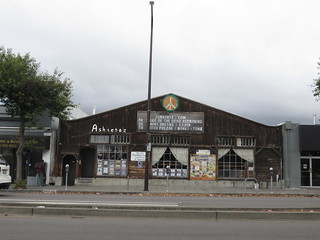
Beginning the tour outside shows how the building was remodeled based on synagogues in Europe so the founder, David Nadel, could show his connection to his Jewish ancestry. The name “Ashkenaz” has the same origin and visitors are able to read David’s handwritten notes about this as they enter the building.
Moving into the venue guests experience the energy and passion behind the political activism in Berkeley during the 1970s, following David’s journey promoting peace and human rights. The original protest posters covering the walls recall many events, including his tireless presence in People’s Park advocating for the homeless. These actions in the name of peace resulted in multiple arrests and a lawsuit filed against him by the University of California. But they also resulted in great honors; David was gifted a flag from Cesar Chavez’s coffin and later the Cesar Chavez Legacy Award. Including background noise from protests, jail doors slamming shut, or hammering of judges’ gavels all help visitors grasp the power of these moments.
Throughout the tour, references showcasing impact on the community are present in the memorabilia, including documents dedicating Ashkenaz an official landmark , designating David Nadel Week and multiple magazine covers awarding Ashkenaz. Adding audio excerpts from dance classes and musicians intensify personal feelings and augment the community involvement that has always occurred here.
Beyond the main room, visitors may enter the band room if it is open to explore photographs and personal marks left by countless musicians. As they loop back, guests learn the dance floor is made of discarded pencils from a local lumber company and multiple gifts from artists show sentiments from the community. Heading towards the exit, the café provides food and drinks. The menu is always vegetarian, but everyone should be warned the culturally diverse homemade cuisine changes frequently.
Caution is advised in mentioning David’s death; visitors must be assured safety but also informed of this important moment. Overall, an interactive self-guided audio tour enhances experiences by educating history, political activism, and community involvement through our five senses. Additional visitation to the café will increase income as will the purchase of the tour, likely paying for itself at a download cost of one dollar. It affords Ashkenaz a wider audience, offering a multi-sensorial experience to those who may not want to dance and appealing to those intrigued by history. Finally, this tour should be offered as a simple audio file, requiring no specific device, making it more appealing to audiences not savvy with technology.
As a result of Ashkenaz’s drive for cultural variation and a sense of community, the venue has become popular with people from many different backgrounds, ethnicities and ages. In order to further their efforts in community development and education, a large pin board wall inside the venue would give space for the visitors to express their insight, memories and stories of their time at Ashkenaz with each other and the staff.
Behind the main stage there is a hallway lined with old newspaper articles and maps, a space which could also incorporate an interactive installation in the form of a community memory pin board. Large panels of thick corkboard would create an area for visitors to respond to a weekly question or prompt pinned to the top of the board to initiate discussion. Each week would provide guests the opportunity to share a new piece of information about a range of topics posed; for example, positive changes at Ashkenaz, favorite memories of events, interesting information about the guest’s culture, or what they appreciate about the community that the venue has established. A table with note cards, pens and thumbtacks placed near the couch already situated towards the back wall will allow people an opportunity to sit and be creative about their responses. By the end of each week, the community would have created a wall together filled with stories and feedback from regular and new customers, hoping that the next week’s topic may interest them enough to come back to discover what else they can contribute or read from others.
This feature may appeal especially to long time visitors who can reminisce about their memories at Ashkenaz. The power of remembering special occasions cultivates a feeling of happiness for those who have been veteran visitors. Because Ashkenaz is particularly family friendly, this pin board will also give children an expressive project to even further enhance the family atmosphere.
The wall would also serve the managers of Ashkenaz as they would have an additional way for customers to provide feedback and maybe even obtain some new ideas for how the patrons envision Ashkenaz going forward. Staff would have an opportunity to elicit feedback from their visitors on any specific topics that seem pertinent to them.
Although this installation mainly engages the visual sense, there is also a sense of touch within the active writing and drawing process, connecting visitors to their expressive sides. The project can enhance the sustainability of Ashkenaz by attracting returning customers who now have the chance to feel more involved in the location, and with this renewed sense of belonging they will be able to feel more connected to its history by learning about old memories. This perception of social inclusion would aid in bringing patrons together within the community Ashkenaz is attempting to create. The information can enable changes that would increase the number of return visitors by further catering to their interests.
Youth Involvement in Creative Games
This interpretive project focuses on activities for children who visit Ashkenaz. The venue already hosts Sunday matinees geared towards children, but th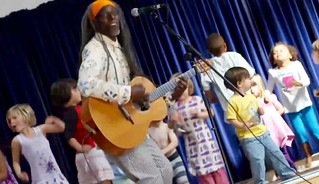 e creation of more pervasive and accessible games and activities would make
Ashkenaz a more enticing and accessible place
for young people in the Bay Area. These would,
out of necessity, be cost-effective and low-
maintenance to ensure sustainability, but could
still have a significant impact on children’s
cultural and affective development. This
interpretive project encompasses all four of our
themes of education, community, political
history, and music in various and intersectional ways: Through education and music, the plan seeks to create a passionate future for stakeholders by exposing them to Ashkenaz’s political history and engaging them with its present community.
e creation of more pervasive and accessible games and activities would make
Ashkenaz a more enticing and accessible place
for young people in the Bay Area. These would,
out of necessity, be cost-effective and low-
maintenance to ensure sustainability, but could
still have a significant impact on children’s
cultural and affective development. This
interpretive project encompasses all four of our
themes of education, community, political
history, and music in various and intersectional ways: Through education and music, the plan seeks to create a passionate future for stakeholders by exposing them to Ashkenaz’s political history and engaging them with its present community.
Cost is a major factor for any and all projects Ashkenaz seeks to implement; as a nonprofit, Ashkenaz depends heavily on donations, especially from well-heeled “angel benefactors” to meet its expenses. Therefore, “analog” or technology-free ways to engage and educate children are not only the most financially feasible for Ashkenaz to implement but are also most in line with its ethos of embodied community. Activity sheets—incorporating word searches, coloring pages, and games centering around the venue and its political and artistic history—are cheap to reproduce in plentiful quantities and can be displayed in easy-to-reach places. These same sheets can include instructions for scavenger hunts to acquaint children with the venue, including tasks such as counting stained glass fixtures, finding the “Tofu Records” poster, or signing the visitor pin board. These activities require a minimum of adult supervision depending on the age of the child, and very little upkeep, making them sustainable in spite of any financial or bureaucratic challenges the venue faces.
Depending on volunteer availability and willingness, more involved, structured, and supervised activities for children could take place in Ashkenaz’s back studio during performances. These activities could include dance lessons and instruction about the kinds of music played at Ashkenaz but would not necessarily have to be limited to pure didacticism; merely having local children interact within Ashkenaz—which is, after all, a community center—would foster strong bonds between local children and the venue, even if they are just playing duck-duck-goose in the back room. Walking into Ashkenaz itself, one feels transported into a different age, and these activities seek to strengthen and elaborate on that embodied sensation. Education on the venue’s historical significance provide a context into which children can situate; playing games, enjoying music, and meeting friends provides them with a present and embodied connection that will allow the continued creation of historical significance.

Home
Background
Appraisal
Implementation
Interpretive Projects
Project Media
Ashkenaz Cultural Heritage Interpretation & Site Management Plan (.pdf)
Ashkenaz: Music Education
It’s the music!
The music is what keeps everything afloat and the dancing afoot. People from far and wide who recognize Ashkenaz as “home” are coming for its yard stompin’ roots revival, whether it be local music fans and dancers or the travelling musicians themselves. Though home is also the backbone to a family when the hard times hit, so it is home where world music can still exist. If it were not for venues like Ashkenaz that celebrate the people’s music, the symbolic art to whom the music represents would not reach to inspire the desperate souls of either folk or kin. But being a home means to those that other places are not home, by definition, so Ashkenaz must embrace its role to educate and distribute notes for a cooperative musical compilation.
Nothing screams music history like the Rock & Roll Hall of Fame; in fact, they are the leading pioneers for music education in the digital age, bringing in a new concept called the digital classroom. Upon clicking open the digital classroom doors it becomes apparent that teachers are encouraged to share the information, as noticeable by the infographics and explicit texts to save the pictures for lesson plans.
Users navigate through music genres and are brought into a list of monthly musicians within that genre. From there, after selecting a specific musician group, the user can play music recordings of popular songs and/or have a chance to see a music tutorial about their specific notation. Inside each musician group’s page provides a detailed bio and a lesson plan of objectives. The user interacts with these objectives in a visual-auditory combination to become more familiar and intimate with musicians for an appreciation of their uniqueness they bring.
The implications of appearing more transparent about music education affords Ashkenaz more web traffic in which internet surfers would be continually redrawn back into their website for information regarding the next month’s artist lineup, since those lineups would be organized
into music education classroom objectives. Teachers of all grade levels will be on the lookout especially, and depending on popularity Ashkenaz may even get more international recognition. In this cause for music education and online availability, Ashkenaz can pair up with other organizations worldwide to create a digital folk music classroom. Taking cue from the Rock ‘n’ Roll Hall of Fame, these digital classrooms may involve video conferencing special events to further open the availability of folk music back to its origins in which physical distance is the only obstacle of reaching larger audiences.
Take a look at our other proposed interpretive projects:
Home
Background
Appraisal
Implementation
Interpretive Projects
Project Media
Ashkenaz Cultural Heritage Interpretation & Site Management Plan (.pdf)
Appraisal: The Current Interpretive Plan & Multivocality
The current Interpretive Plan exists to develop new interpretations of I-Hotel history and Filipino heritage and to develop interpretations at the Manilatown Heritage Foundation Community Center. Visitors can reach to the I-hotel by driving a car, walking or taking transportation. The MUNI 8X bus stops right in front of the center and it is only a 15-minute walk from the Montgomery Street BART and MUNI station.
When visitors walk inside the first floor of I-Hotel, where Manilatown Heritage Center is at, there is a new interactive single room occupancy exhibit, that demonstrates the actual Filipino housing, adopted from Chinese Historical Society of America’s Living in Chinatown project, and inspired by the Manongs of the I-Hotel who fit their entire lives into an 8×10 foot living space. All of furniture, books, clothes and even cigarettes came from initial I-Hotel and Philippines and are donated by an actual person who stayed in I-Hotel in the 1960’s. This mini-model of the I-Hotel tenant’s room presents nostalgia in people as well as demonstrates their confined life to visitors.
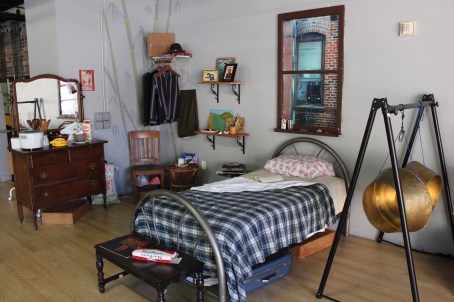
Single room occupancy exhibit, the Actual Filipino Housing, inspired by the Manongs of the I-Hotel in 1960’s.

Fight Poster of I-Hotel
Besides the single room occupancy exhibit, pictures of I-hotel’s history, activist, and real brick of the initial I-Hotel come into sight. The center features an informational gallery on the fall of the I-Hotel, in addition to hosting community events that further promote its mission. On the Club Mandaly, people could enjoy learning Ballroom and Latin dance from Benito Santiago at the I-Hotel. Also, Carlos Zialcita, who is one of the influential members of the community explore the rich musical, literacy, fashion and cultural history of the San Francisco Bay Area by being a host on Jazz Meryenda Pop-up Jazz club. In addition, the current Board-president Tony Robles, a poet, writer and prominent activist lead rest of the events on Club Mandalay with reading his latest book, Cool Don’t Live Here No More to emphasize his generational memory of San Francisco where alienation, deportations, and technological invasions.

Fliers of movie “The Fall of the I-Hotel” by Curtis Choy
They also show a movie about I-hotel called “Fall of the I-Hotel” by Curtis Choy for visitors in order to inform them about the incident from the past, especially 1977 Elder Filipino and Chinese tenants standing up to developers to fight eviction from their homes in San Francisco’s Manilatown neighborhood. In addition, the director describes the story of people who got evicted fights, their eviction and the effects it had on the city’s tenants’ rights movement as well as the tenant’s issues now being faced and how they can fight eviction in their neighborhood and get involved. These events help advance a group’s mission, in the spirit of the tenants of the I-Hotel and celebrated the anniversary of the fall of the International Hotel, a mass eviction etched in the psyche of San Francisco.
Ashkenaz: Youth Involvement in Creative Games
This interpretive project focuses on activities for children who visit Ashkenaz. The venue already hosts Sunday matinees geared towards children, but the creation of more pervasive and accessible games and activities would make
Ashkenaz a more enticing and accessible place
for young people in the Bay Area. These would,
out of necessity, be cost-effective and low-
maintenance to ensure sustainability, but could
still have a significant impact on children’s
cultural and affective development. This
interpretive project encompasses all four of our
themes of education, community, political
history, and music in various and intersectional ways: Through education and music, the plan seeks to create a passionate future for stakeholders by exposing them to Ashkenaz’s political history and engaging them with its present community.
Cost is a major factor for any and all projects Ashkenaz seeks to implement; as a nonprofit, Ashkenaz depends heavily on donations, especially from well-heeled “angel benefactors” to meet its expenses. Therefore, “analog” or technology-free ways to engage and educate children are not only the most financially feasible for Ashkenaz to implement but are also most in line with its ethos of embodied community. Activity sheets—incorporating word searches, coloring pages, and games centering around the venue and its political and artistic history—are cheap to reproduce in plentiful quantities and can be displayed in easy-to-reach places. These same sheets can include instructions for scavenger hunts to acquaint children with the venue, including tasks such as counting stained glass fixtures, finding the “Tofu Records” poster, or signing the visitor pin board. These activities require a minimum of adult supervision depending on the age of the child, and very little upkeep, making them sustainable in spite of any financial or bureaucratic challenges the venue faces.
Depending on volunteer availability and willingness, more involved, structured, and supervised activities for children could take place in Ashkenaz’s back studio during performances. These activities could include dance lessons and instruction about the kinds of music played at Ashkenaz but would not necessarily have to be limited to pure didacticism; merely having local children interact within Ashkenaz—which is, after all, a community center—would foster strong bonds between local children and the venue, even if they are just playing duck-duck-goose in the back room. Walking into Ashkenaz itself, one feels transported into a different age, and these activities seek to strengthen and elaborate on that embodied sensation. Education on the venue’s historical significance provide a context into which children can situate; playing games, enjoying music, and meeting friends provides them with a present and embodied connection that will allow the continued creation of historical significance.
Take a look at our other proposed interpretive projects:
Home
Background
Appraisal
Implementation
Interpretive Projects
Project Media
Ashkenaz Cultural Heritage Interpretation & Site Management Plan (.pdf)
Ashkenaz: Community Pin Board
As a result of Ashkenaz’s drive for cultural variation and a sense of community, the venue has become popular with people from many different backgrounds, ethnicities and ages. In order to further their efforts in community development and education, a large pin board wall inside the venue would give space for the visitors to express their insight, memories and stories of their time at Ashkenaz with each other and the staff.
Behind the main stage there is a hallway lined with old newspaper articles and maps, a space which could also incorporate an interactive installation in the form of a community memory pin board. Large panels of thick corkboard would create an area for visitors to respond to a weekly question or prompt pinned to the top of the board to initiate discussion. Each week would provide guests the opportunity to share a new piece of information about a range of topics posed; for example, positive changes at Ashkenaz, favorite memories of events, interesting information about the guest’s culture, or what they appreciate about the community that the venue has established. A table with note cards, pens and thumbtacks placed near the couch already situated towards the back wall will allow people an opportunity to sit and be creative about their responses. By the end of each week, the community would have created a wall together filled with stories and feedback from regular and new customers, hoping that the next week’s topic may interest them enough to come back to discover what else they can contribute or read from others.
This feature may appeal especially to long time visitors who can reminisce about their memories at Ashkenaz. The power of remembering special occasions cultivates a feeling of happiness for those who have been veteran visitors. Because Ashkenaz is particularly family friendly, this pin board will also give children an expressive project to even further enhance the family atmosphere.
The wall would also serve the managers of Ashkenaz as they would have an additional way for customers to provide feedback and maybe even obtain some new ideas for how the patrons envision Ashkenaz going forward. Staff would have an opportunity to elicit feedback from their visitors on any specific topics that seem pertinent to them.
Although this installation mainly engages the visual sense, there is also a sense of touch within the active writing and drawing process, connecting visitors to their expressive sides. The project can enhance the sustainability of Ashkenaz by attracting returning customers who now have the chance to feel more involved in the location, and with this renewed sense of belonging they will be able to feel more connected to its history by learning about old memories. This perception of social inclusion would aid in bringing patrons together within the community Ashkenaz is attempting to create. The information can enable changes that would increase the number of return visitors by further catering to their interests.
Take a look at our other proposed interpretive projects:
Home
Background
Appraisal
Implementation
Interpretive Projects
Project Media
Ashkenaz Cultural Heritage Interpretation & Site Management Plan (.pdf)
Modern Context and Preservation
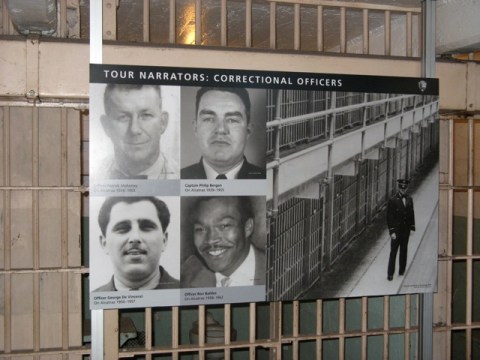
Since 1972, the National Park Service has maintained the island and managed its tourist operations. A ticket to visit Alcatraz includes a ferry ride from San Francisco’s Pier 33 to the island and an audio tour of the cell hours. Audio tours are narrated by former correctional officers and offered in eleven different languages. Visitors can also attend scheduled presentations and tours to learn more about specific topics, such as the island’s gardens and infamous escape attempts. However, these narrowly focused presentations are only offered a few times per week. The island is open to visitors for both daytime and evening tours. Alcatraz has gained international recognition as a popular and fascinating tourist site, and according to the National Park Service, approximately one million tourists visit Alcatraz Island each year.
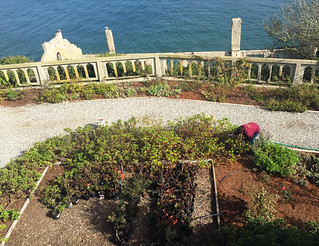
Alcatraz is currently in good condition because the National Park Service has invested time and effort to ensure the preservation of the island’s structures and wildlife. However, due to its location in the San Francisco Bay, Alcatraz is subject to harsh sea winds and constant humidity, both of which contribute to gradual erosion of the island’s structures. The National Park Service will have to continue to monitor the condition of the island’s structures in order to ensure their protection from erosion so that the island can remain open for future tourism.
In the future, Alcatraz’s structures and wildlife could be affected by rising sea levels resulting from global warming. In order to protect the island from the risks associated with global warming, the National Park Service will have to work with the United States government to advocate for policies aimed at curtailing the negative effects of climate change.

Ashkenaz: Self-Guided Audio Tour
Ashkenaz does an excellent job of sharing cultural diversity through a variety of experiences, but slightly hidden behind the main focus is the heritage of Ashkenaz itself, which lies in its inception and legacy. Although it is spilling over with symbols of this, the meaning may not be apparent to all. This tour allows people to experience the richness of the place in addition to the culture it encourages. The focus incorporates music, but showcases the other themes of education, community and history of political activism.
Beginning the tour outside shows how the building was remodeled based on synagogues in Europe so the founder, David Nadel, could show his connection to his Jewish ancestry. The name “Ashkenaz” has the same origin and visitors are able to read David’s handwritten notes about this as they enter the building.
Moving into the venue guests experience the energy and passion behind the political activism in Berkeley during the 1970s, following David’s journey promoting peace and human rights. The original protest posters covering the walls recall many events, including his tireless presence in People’s Park advocating for the homeless. These actions in the name of peace resulted in multiple arrests and a lawsuit filed against him by the University of California. But they also resulted in great honors; David was gifted a flag from Cesar Chavez’s coffin and later the Cesar Chavez Legacy Award. Including background noise from protests, jail doors slamming shut, or hammering of judges’ gavels all help visitors grasp the power of these moments.
Throughout the tour, references showcasing impact on the community are present in the memorabilia, including documents dedicating Ashkenaz an official landmark, designating David Nadel Week and multiple magazine covers awarding Ashkenaz. Adding audio excerpts from dance classes and musicians intensify personal feelings and augment the community involvement that has always occurred here.
Beyond the main room, visitors may enter the band room if it is open to explore photographs and personal marks left by countless musicians. As they loop back, guests learn the dance floor is made of discarded pencils from a local lumber company and multiple gifts from artists show sentiments from the community. Heading towards the exit, the café provides food and drinks. The menu is always vegetarian, but everyone should be warned the culturally diverse homemade cuisine changes frequently.
Caution is advised in mentioning David’s death; visitors must be assured safety but also informed of this important moment. Overall, an interactive self-guided audio tour enhances experiences by educating history, political activism, and community involvement through our five senses. Additional visitation to the café will increase income as will the purchase of the tour, likely paying for itself at a download cost of one dollar. It affords Ashkenaz a wider audience, offering a multi-sensorial experience to those who may not want to dance and appealing to those intrigued by history. Finally, this tour should be offered as a simple audio file, requiring no specific device, making it more appealing to audiences not savvy with technology.
Take a look at our other proposed interpretive projects:
Home
Background
Appraisal
Implementation
Interpretive Projects
Project Media
Ashkenaz Cultural Heritage Interpretation & Site Management Plan (.pdf)
Key Players
The National Park Service currently acts as the main steward of Alcatraz, as it maintains the facilities and oversees tourist operations. Volunteers also act as stewards of Alcatraz. For instance, dedicated volunteers care for the island’s expansive gardens. In the past, various stewards, such as Native American occupants, prison employees, and American military, maintained the island. Interestingly, Alcatraz’s prisoners also acted as stewards, as they helped maintain the island’s gardens.
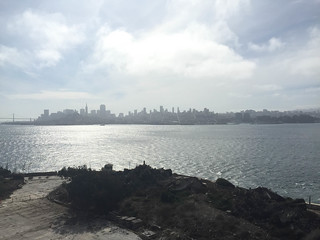
There are several unique groups of individuals who are stakeholders in Alcatraz’s past, present, and future use. Former prisoners and their descendants are stakeholders of Alcatraz, though they have a range of experiences with the site. Interestingly, some former prisoners have expressed their admiration and nostalgia for the island prison. The infamous bank robber Whitey Bulger, who was imprisoned at Alcatraz for three years before being transferred to another federal penitentiary, later wrote of his yearning for Alcatraz and its scenic view of San Francisco, as pictured below.
Former correctional officers and their descendants are also stakeholders of Alcatraz. During Alcatraz’s prison era, correctional officers and their families lived on the island themselves, in houses and apartments that were separate from the main cell house.
Additionally, Alcatraz is a site of historical and cultural significance for Native Americans. The Indians of All Tribes’ nineteen-month occupation of Alcatraz represents an important act of protest by Native Americans towards the American government. Native Americans today represent an important group of stakeholders in Alcatraz because of the protests that took place on Alcatraz Island.
Finally, Alcatraz is a site of interest to various interpretive groups and academics. For instance, the We Players, a theater group dedicated to performing classic dramas in unusual locations, performed Hamlet on Alcatraz Island, as pictured below.


 Who Owns the Past? Cultural Heritage in the Digital Age