Category Archives: Anthro136kF2015
Art Documentation
Some of the art within 924 Gilman has political overtones and some are purely artistic. The bathroom walls are also a canvas covered in many layers of tags, some readable, others in the style that only other taggers will understand. This project documents the multitude of wall art that has become a fixture of this venue. The goal is to create a visual experience via photo catalogue of the various artworks deemed important by the Gilman community, curated with the assistance and support of the Gilman community.
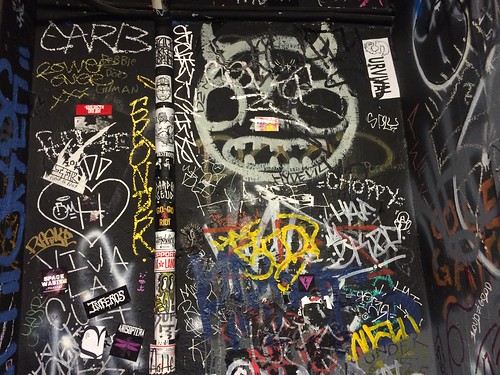
(A collage of graffiti in one of the Gilman bathrooms. Photo by Silas Jones.)

(One of the darker, more surreal Gilman artworks. Photo by Silas Jones.)
When one of our team members visited the venue and commented on the new graffiti, he was immediately invited to add his own. Ethos and ephemerality are the big focus here. Having a place that not only allows but actively encourages wall art and graffiti inside is a major part of the idea behind Gilman. It’s “everyone’s place.” People express themselves through visual art just as others express themselves through music, both are done within the rules of the venue (no racist, sexist, or homophobic art or music, for example). However, nothing lasts forever. This project will create a snapshot in time of the art of 924 Gilman Street circa November 2015. One can compare the art seen before and after this period of time. Some may be painted over, others may still be there.
Any audience can interact with this project. While the punk community in and out of Gilman may see these artworks in person, we may catch something they miss. For the other audiences who may not ever set foot in Gilman, this project is their window into the inside of this venue. The artwork contributes to the sustainability of 924 Gilman by representing the memories that have been collected over the last few decades. Much of the art found layering the walls of 924 Gilman are the result of art shows presented by the venue. Some of the murals, such as the naked lady with hairy legs, represent longevity and resilience.
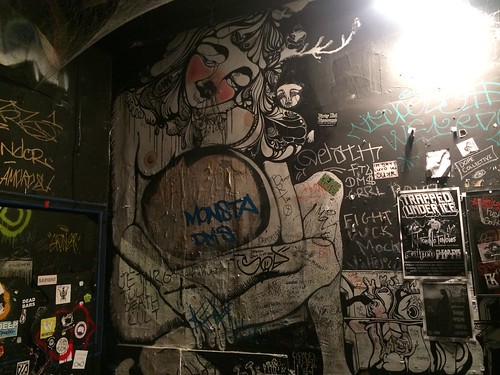
(The Gilman “naked lady” resides in a corner of the venue. Note the tags beginning to accumulate. Photo by Silas Jones.)
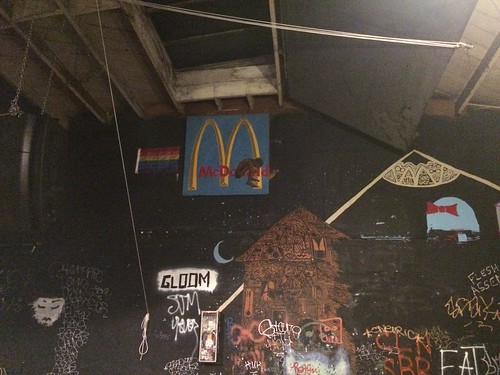
(A collection of art. At the top is a long lasting political piece, contrasting a starving African boy with a McDonald’s logo. Photo by Silas Jones.)
Our documentation and research of 924 Gilman has allowed us the opportunity to present these artists creative ideas for others to enjoy as true art and not vandalism. According to an informant, the art within the venue is very much alive and constantly changes as the community changes, and there is no one way to classify 924 Gilman because of these changes.
“924 Mixtape”
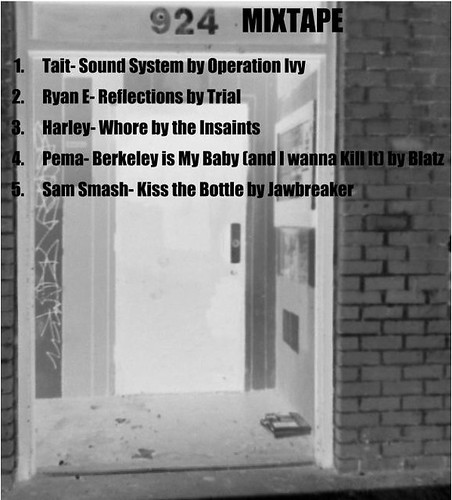
The goal of this project is to collectively build an interpretative soundtrack with the members of the Gilman community because the most legitimate way to achieve an understanding of the community’s values, meanings, and philosophies as it relates to punk rock culture is to listen to the musical expressions of these concepts which bring this community together in the first place. Participants are asked a single question: if you had to describe Gilman with one song, what would that song be and why? This project will contribute to the sustainability of the site because it will contribute to a wider accessibility of potential audiences into the punk music scene by giving visitors who don’t necessarily have a context or an initiation for exploring the musical aesthetic, an introduction to punk indicative of what one might experience by naturally engaging with Gilman. Furthermore, the ambiguity of the question we ask allows participants to ascribe what is specifically and personally meaningful to them at the forefront of the Gilman experience. By being able to describe that affect through the use of a song allows for participants of the project to guide the audience in a personal narrative, while allowing the audience to make their own interpretations about how the song reflects their understanding of the culture, history, and musical aesthetics which are connected to the site.
Tait- Sound System by Operation Ivy:
Ryan E- Reflections by Trial:
Harley- Whore by the Insaints:
Pema- Berkeley is My Baby (and I wanna Kill It) by Blatz:
Sam Smash- Kiss the Bottle by Jawbreaker:
Ashkenaz: Implementation
5-Year Short Term Goals

#1: Preservation of tangible heritage. Scanning, archiving, and replacing original documents will preserve the historical record while still maintaining usability. Additionally, digital versions are to be organized on the Ashkenaz website.
#2: Increase marketing to reach a diverse population. Mainly, a new position opens space for a web designer internship. A modern interface and a more interactive site would likely bring in more customers who could spend time online discovering everything Ashkenaz has to offer. This person would be responsible for linking social media news feeds to the website, frequently updating media sites with events, and uploading archives.
#3: Expand educational outreach. Organizing history museum showings of the site itself will enlighten visitors about what has happened behind-the-curtains. Further alliances with elementary schools and the Berkeley World Music Festival are necessary for anchoring its position in the Bay Area.
#4: Decrease environmental impact. As simple and cheap as installing water faucet aerators and LED lighting with, if possible, donated light filters and materials. Replacing streetside thin pane windows with heat conserving windows can also be a long-term goal, but should be focused on as soon as possible for safety concerns. Installing higher quality sound meters will ensure noise levels do not bother neighbors. Lastly, installing bike racks and offering ticket incentives to bicyclists will increase environmental friendly means of transportation.
 #5: Gain additional funding opportunities. Holding fundraisers, events with sponsorship, requesting more grants, and staying up to date with volunteer matching websites will be necessary for reducing spending and gaining resources.
25-Year Long Term Goals
#1: Secure funding sources. Securing a regular source of funding through grants, endowments, or personal bequests is necessary, though it is difficult to predict the changes that will occur in the Bay Area over 25 years.
#2: Digitally preserve and protect tangible heritage. Given the rapidity at which digital technology changes it is crucial that this information be stored in a format that will not become obsolete. Use of a digital storage service such as Mukurtu could safeguard these files so that they can be accessed indefinitely.
#3: Continue to provide a welcoming space for all. As mentioned in the 5-Year plan, a diverse and passionate patron base is key to ensuring the venue’s longevity.
Home
Background
Appraisal
Implementation
Interpretive Projects
Project Media
Ashkenaz Cultural Heritage Interpretation & Site Management Plan (.pdf)
The Story So Far…
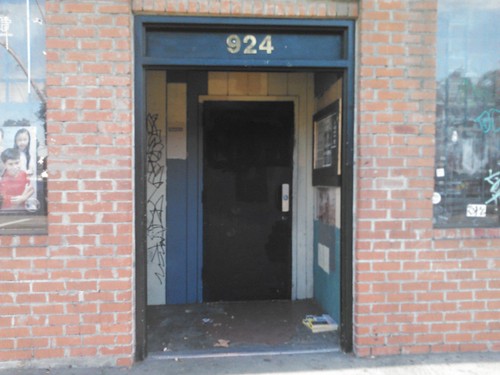
On the corner of 8th Street and Gilman Street in North Berkeley, there stands a small, nondescript brown building. No signs say what it is, only a painted arrow pointing to the caning shop next door. One might walk by without paying a second though. Yet behind the door under the numbers “924” lies a stage that has provided a stage for countless bay area punk bands, and a home for the city’s dissidents, rebels, and rockers. The origins of 924 Gilman Street can be traced to the actions of two men: Tim Yohannon and Victor Hayden. They envisioned a non-profit performance venue where the artists and patrons made the rules, a space where people could make the place their own, instead of yet another commercial space. The current building was scouted in 1984 and given approval by the city of Berkeley. Renovations began in the summer of 1986, and the very first show was held on December 31st of that same year.
The Gilman Street project would briefly close in 1988. Not only were the venue’s financial managers grossly mismanaging Gilman’s funds, Tim Yohannon also believed that the goal of creating a space for self-expression was not being met. 924 Gilman Street would then reopen under the organization the Alternative Music Foundation, and it remains open and hosting the latest underground punk talent to this day, enduring financial close calls and actions from many city councils opposed to the presence of the punk community. Many famous punk bands would get their start at Gilman. Green Day, Rancid, Operation Ivy, NOFX, The Offspring, all played here in their early years. Gilman has inspired other similar non-profit, community run venues. Many have since closed, but Gilman retains the spirit and means to keep going ever since its doors first opened.
Management Policies and Constraints
In many respects, the venue relies on the community just as much as the community relies on the venue. Any management plan which seeks to preserve the culture heritage of 924 Gilman must ensure that the comradeship of the community remains a priority. At different times, different parts of the community become the frontrunner for keeping the club alive, be it through striving to keep the multivocality prevalent, through keeping the shows and audiences coming, or by just simply making sure the bills get paid. 924 Gilman Street represents a whole lot of things to a wide variety of people. By keeping the community accessible to active participation and involvement, this diversity of voices is heard and maintained.
Furthermore, the people who are generally drawn to Gilman are either unable freely define their identities in regards to mainstream culture, or they simply refuse to be restrained in such a way. Punk rock forces us to ask questions like: Why is this wrong or right? Who decided this? Do I agree? The result is to consider how and why one believes in the things they believe in. In this sense, any management policy must also undergo scrutiny where as many community perspectives are considered as possible before any action is taken. Management policies should therefore must be flexible to amendment and without a predetermined result.
Implementation
Our proposed plan of action would first include setting up an archival system, where all artifacts, photos, books, and other historical pieces would be recorded. The small glass case in the front entryway that has extremely valuable artifacts is not convincing enough for people to fully internalize the fraternity chapter at this location. This archival full of artifacts should be put in the original places among the house in which they were found.
We would additionally like to promote a similar short term development consisting of two steps, involving some of the economics regarding the preservation. The first being to create one central site, where the history of the site could be documented online in a manner that would be accessible to all interested parties. This way the site can continue to serve its non-use value purposes for Zeta Psi brothers nationally, other Greek-letter organizations and people interested in the development of the UC Berkeley campus.
The second step of the plan would ensure that the 2251 College Building remained in use as the Archaeological Research Facility to preserve the direct-use values of the site for the University, the Department of Anthropology, UC Berkeley students and interested community members. This includes maintaining the program of outreach events to community members as well as continuing conducting research in the facility labs so that the importance of the archaeology component of the Department of Anthropology continues to be acknowledged at the University. We would also suggest maintaining a fund, in addition to asking the state for funding, that could be used to help pay for future updates/safety renovations for the building as deemed necessary by the faculty whose offices are housed in the building.
In order to maintain the house’s sustainability with as little environmental impact as possible, we would like to secure a second seismic evaluation to occur by 2023 (two decades after the outfitting between 2001 and 2003). This construction, while inducing a slight impact on the environment, will ensure the site continues serving and educating students and professors alike. At the time of the 2023 evaluation, we would also take action to implement more energy conscious tactics, such as solar paneling to reduce the environmental impact of energy used by the facility.
Lastly, our long term plan of action will include demonstrating the historical aspect through incorporating the Berkeley Zeta Psi chapter into some of Berkeley’s classes and academic efforts. It would be extremely beneficiary to draw on the house as an example for students to understand in their research, as they would be able to experience and study it first hand. However, not only would the Anthropology Department and the Archaeological Research Facility at Cal implement the fraternity’s history, but other departments at the University would as well. This way, a more wholesome view of the Zeta Psi fraternity could reach a greater level of the student body opposed to only being spread to a certain niche of Berkeley students.

Interpretive Projects
The interpretive plan for the 2251 College Building consists of four distinct components that all interact to create a comprehensive and immersive experience for anyone that visits or wants to learn about the site. The first component of the plan is the, “Picture the Past” project, which leads visitors on a visual tour of what the facility looked like during its time as a chapter house for the Iota chapter of the Zeta Psi Fraternity. The visual tour includes placing artifacts from the days of the fraternity in areas of the facility where they would have been used during the time of the fraternity. The visual tour will incorporate an app for cellular devices that will guide the visitor through the house along the tour of the artifacts, perhaps with an element of augmented reality such as Google Cardboard that would allow the visitor to see the room as it would have been back then if they chose to use that element of the tour.
The second component of the plan is “A Walk Through the Ages: An Audio Journey of the 2251 College Building” which will lead visitors on an audio tour of the facility. Visitors will have the option to listen to a tour that guides them through the facility as it would have been during its time as a fraternity house with narration and stories told by alumni of the fraternity. The second audio tour would work in the same way as the previous one, but would guide the visitor through the facility as it would have been during the NASA/UC Berkeley space research center years, narrated by Ruth Tringham.
The third component of the plan is the, “A Night Out with the Zeta Psi Brothers” project which includes planning mixer events during which members of the Zeta Psi fraternity and alumni could visit the facility, see the artifacts, listen to stories about the house, potentially take the tours and enjoy an authentic meal that would have been served during the times that the house was the fraternity.
The fourth and final component of the plan is the “An Interactive History of the 2251 College Building ” website on which all of the photographs, interviews, videos, floor plans and histories of the facility can be uploaded for visitors who are unable to physically visit the site. The website will incorporate a single stop in which visitors can access the visual tour video, audio tour sound clips, videos from mixers and can purchase tickets for the mixers. The website will be accompanied by a display case in the entryway of the facility that includes artifacts from when the facility was a fraternity, photographs, and objects from the modern-day Zeta Psi Iota chapter for comparative knowledge. The online website will be accessible remotely to anyone who has a computer as well as to visitors inside the facility on electronic tablets in order to provide a way to enhance their visit to the site.
Appraisal
The preservation of cultural heritage of the original Zeta Psi fraternity house located at 2251 College Avenue holds strong value to the UC Berkeley community.
Professor Conkey noted on her commitment to renovating the house during 2001 through to 2003, where all cultural, spiritual, historical, and aesthetic values were reawakened. While replacing certain walls, the crew discovered carved names into wood panels sustaining the fraternity chapter’s cultural practices. Along with this intriguing finding, the ARF and Anthropology department have displayed a case of original artifacts from the fraternity that were discovered during renovation.
Some change however, in the aesthetic values overall, allowed the building to be preserved and represent a culture that was once run by the young elite brothers of Berkeley. The values of the building have remained in place, as many of the rooms, stairwells, large living spaces, and artifacts still keep the original fraternity house alive with some of its original visual integrity.
As much of the UC Berkeley campus and city have also changed, the house is now technically not on College Avenue, where it once received a lot of traffic of people. The department and research facility use is additionally not great, therefore the foot traffic inside of the house helps preserve and maintain the structure.
If there were to be one major threat to our site, it would be the Boalt Law School of Berkeley. Their portion of campus is directly next to the 2251 Colleg eBuilding, and if they were to expand further it would be logical for them to absorb our site and utilize the land differently.However, their recent expansions, first of their garage (due east of the back of the 2251 College Building) and, most recently, with a re-orientation of Boalt to the south with extensive interior renovations have not impacted on the 2251 College Building.
Background
2251 College Building is one of the oldest buildings associated with the University of California, Berkeley. It is also one of the only brick buildings still left on campus. This building has been used as a fraternity house and a space research facility. The building is currently being used as an archeological research facility and partially as the Department of Anthropology.
The Zeta Psi fraternity – Iota chapter was founded in 1870, where it became the “first fraternity on the West Coast – indeed, the first fraternity to establish a chapter west of the Mississippi.” (Zeta Psi Fraternity). The fraternity needed a chapter house to facilitate them and thus a building was built at what was then the 2251 College Avenue location in 1876; the building itself was considered very luxurious for the time period since its Victorian style façade paired with running water and electricity in the interior was a sight not commonly seen. This house though was torn down and quickly replaced on the same location by the Zeta Psi’s in 1910. This second, rebuilt Zeta Psi House served as the chapter’s house from 1910 to 1956. By the 1950s, the Zeta Psi membership was larger than the 2251 College Building could accommodate, which is one of the main reasons the brothers decided to abandon the property. Another big reason for abandoning 2251 College Building was because the brothers felt they were isolated from the rest of Greek life as well as the fact that there was an increased number of fraternal competition. This was combined with the fact that there was increased amount of surveillance on their location due to the close proximity to UC Berkeley academic buildings. Thus, the Zeta Psi’s traded their property on campus with the university for the 2728 Bancroft Avenue – a building the university owned.
This location is currently being used to host the Archaeological Research Facility and the faculty offices of archaeologists in the Department of Anthropology at the University of California, Berkeley. The structure mainly is similar to how the building was at the last rebuilding in 1910, with changes only due to necessary updates that have come with use and time.
While the campus address of the building is still the “2251 College Building”, it is technically no longer on College Avenue, since now the building is not on that street but is entirely surrounded by the university grounds. The address is a piece of heritage that the site will always be able to boast of and a way of connecting its past with the present.


 Who Owns the Past? Cultural Heritage in the Digital Age