Category Archives: Anthro136kF2015
Modes of Outreach
There are several modes of outreach that are used by the venue including zines, posters, and maintenance of a Facebook, website, and updated event calendar. The venue has been widely recognized in the punk scene, where its reputation has attracted international bands and visitors. The incorporation of pre-sale tickets, which are often available online (particularly for larger shows) has allowed for greater accessibility to those who are traveling to the area.
Although Gilman has an established status and is recognized in the music world, particularly in independently run venues and in punk culture, there is not a whole lot of outreach toward including people who are not already immersed in the culture. Our plan aims to link various communities and reach out to a wider audience — one that is not exclusively affiliated with punk culture. To reach a wider audience, we are placing our project online and using accessible mediums to increase awareness and interest in 924 Gilman as a historic and significant site within communities that are not already or necessarily invested in the cultural center.
There are several resources that have been published about 924 Gilman including a documentary and a book, 924 Gilman: The Story So Far. In addition, there are a number of videos that are available on sites such as YouTube that document live shows at Gilman. Our interpretive projects are mainly honing in on training and education — whether it is educating the public about the various aspects of the Gilman community that are in fact, cooperative, helpful, and invested in social/political matters (verses the stereotype of the Gilman/punk community as being deviants) or creating videos that will walk team members through various volunteer positions. By demonstrating aspects of Gilman volunteerism, this interpretative management plan will increase sustainability by spreading awareness that one can volunteer at Gilman. People who may not have considered or even known about volunteering might consider it. Gilman will then be able to operate more effectively and for a longer period of time with more volunteers. Our goals are ultimately to increase the music club’s sustainability, and our main contribution to this matter is through the training and education projects.
Ashkenaz: Project Media
More goes on at Ashkenaz than we could ever show you online!
But you can get a glimpse of how Ashkenaz shares cultural heritage through music and dance by checking out these galleries of what we’ve created, compiled and collected:
- Photos – including scanned newspapers
- Videos
- Audio: Interview with Office & Financial Manager, Susan Pleck – Part 2
- Audio: Interview with Office & Financial Manager, Susan Pleck – Part 2
Home
Background
Appraisal
Implementation
Interpretive Projects
Project Media
Ashkenaz Cultural Heritage Interpretation & Site Management Plan (.pdf)
Ashkenaz: Appraisal
 Ashkenaz has stayed true to its mission since 1973; it has long held values that focus on community enrichment and has continuously promoted these core beliefs through shared cultural heritage. They have maintained their code of acceptance and peace through welcoming traditional music and dance from across the globe, welcoming all genres, from American roots to West African Kora ensembles and Persian ballet.
The management staff at Ashkenaz includes members of the local community who have been involved in the music venue since it first opened. Larry Chin – managing director and manager of Ashkenaz – has been working at the site since it first opened in the early 1970s and has witnessed the growth and changes that have occurred since. The years of experience and multiple talents of the staff means they are passionate about and understand the mission of the venue, often taking on many roles to keep the place running smoothly.
Many 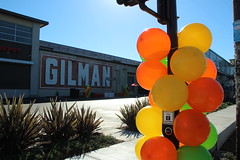 of the threats to Ashkenaz include issues that arise with gentrification – or, commercial urbanization and subsequent demographic displacement – of the surrounding community, and an increasingly technologically driven world. Predictably, along with this increase in online interaction comes a less physically interactive community. So, inadvertently, Ashkenaz also faces the threat of missing out on new return customers whom discover music online or engage in online forums for the betterment of the community.
To attain these repeat customers who let the values live on, the management holds a policy that the space be rented out to local dance teachers during the daytime for a low affordable rate. They also offer free dance lessons before some of the live music – a policy that, coupled with low ticket prices, gives back to the community while maintaining their loyal patronage.
Moreover, Ashkenaz does not have its own parking lot though there is street parking nearby, but also actively discourages patrons from parking on the residential streets to avoid disturbing neighbors late at night. This lack of free and secure parking could serve to encourage bicycle commuting, but suffers from a lack of secure bicycle storage.
We propose the addition of more programming aimed at children, web-based resources for patrons, and an audio tour of Ashkenaz. We do not foresee the need to upgrade any of the existing infrastructure in the building except for the retrofitting that is already planned, and routine maintenance and small installations, like a community pin board for visitors to inscribe with memories.
Home
Background
Appraisal
Implementation
Interpretive Projects
Project Media
Ashkenaz Cultural Heritage Interpretation & Site Management Plan (.pdf)
Ashkenaz: Background
Ashkenaz is located in West Berkeley, at 1317 San Pablo Avenue. It was initially a for-profit business in 1973, founded by David Nadel, as a place for a combination of ethnic flavors in music and dance that everyone can enjoy. Nadel envisioned Ashkenaz as a space for shared world music and dance performances that would dissolve the boundaries that keep people apart. In a word, the Jewish term “ashkenaz” symbolizes just that, and in honor of Nadel’s Ashkenazi Jewish heritage he named and remodeled an abandoned warehouse to the architecture of an Eastern European synagogue.
As volunteers joined and became part of the business’s foundation, Nadel sought after various outlets that would ultimately attract attention. The business became involved with social class and ethnic strife in pursuit of fulfilling its values. Later, Nadel relaxed on politics to focus more on community building, including building relations internationally. In 1996, Nadel was shot and killed at the front door by a man who had previously been ejected for harassing patrons. The venue closed for six months while a group of patrons purchased the building and converted into a registered nonprofit organization seeking to continue Nadel’s vision.
One of the reasons it has not only been to able continue business but also stay true to its mission, is because the board of directors consists of five volunteers, three of whom are founding members and friends of David during his life. The board makes decisions about finances and administration, maintenance and grant proposals, but each member also has their own specific role such as archiving or fundraising. As a nonprofit that receives government and other organizational funds, and subsequent tax exemptions, Ashkenaz does not have the same freedoms of political expression that Nadel had as a for-profit small business; now it must lean more toward education than advocation.
Nevertheless, the city of Berkeley declared Ashkenaz landmark status in 1992 and David Nadel Week in 1997. Although work has been done some considerations about the current physical condition must be met to further preserve its landmark status. Most importantly for preservation are sources of funding, so with the addition of the executive director the nonprofit should be able to concentrate more on seeking additional funding sources and promoting the services it has to offer. Moreover, the current points of interpretation are scattered and aren’t getting the recognition they deserve in terms of a diversified visitor profile.
Home
Background
Appraisal
Implementation
Interpretive Projects
Project Media
Ashkenaz Cultural Heritage Interpretation & Site Management Plan (.pdf)

3-D Virtul Interior Interactive Tour of Davis House

The virtual tour of the inside of Davis House is completely based online and out of the privacy of your very own home. It is based around web-enhanced software and allows the participant to engage with the interior of Davis House. This tour enables users to gain intimate access via the virtual touring world and has audio and textual implementation and stimulation throughout the tour. The user will be able to start on the outside of the house, enter various rooms and also be able to interact with inanimate objects inside of each room, all whilst being able to hear and conceptualize different stories in the home.
Prospective students are able to gain access prior to living in the space and investors are also able to see and experience their investments in an entirely new digital representation. Those looking or intending to destroy the site may also benefit from this tour and intimate, virtual interaction and be able to connect emotionally and empathetically. Those stake stakeholders are able to interact and hear the intimate stories and intangible heritage of those dwelling in the residence and are able to empathize with those of whom will be affected and the heritage in which the stakeholders potentially intend to destroy.

ThruTime App Interpretive Plan
by Brenda Arjona
Project Thrutime is an application to be used on smartphones, both iOS and android will support this app, that is meant to digitally transport you through time. Like other similar apps (DeTour, Layar, Rephoto), Thrutime is meant to be used while you are at a particular site, and its aim is to

ThruTime App
enhance your experience at that place by immersing you in the environment without the restrictions of time. You can digitally travel into the past through the various features that Thrutime has to offer.
Project Thrutime allows one to explore and experience the heritage and culture of a past place, in this case the Albany Bulb, by incorporating photography, audio, and virtual architecture. For example, you can use this app to do an audio tour, which has a more structured and guided feel to it. Another option is to just explore the various structures that existed at the bulb through photographs and sound. For frequent bulb-goers, there will also be an option that allows you to overlay your older photographs with the current scenery to see how things have changed. All of these features will incorporate GPS data and will track your location as you explore the bulb.

Example of older photo over current landscape
This project will draw in audiences of many ages and walks of life. The app can be experienced by former residents, community members, tourists, and even those who have sought to destroy the bulb can learn something from the app. Various stakeholders are included in these groups of people, but the goal is to not exclude people from having this experience. Our aim is that Thrutime is easy enough to use for those that may not be technologically savvy.
Thrutime will allow the intangible and tangible heritage to be accessible through one app and also to be salvaged and stored digitally for future generations to experience. Although time, along with the state’s developments and the city’s enforcements, will eventually transform the Albany Bulb into just another bay area park, sustainability will be achieved through the technological advancements and heritage preservation. We also plan to create a feature that allows anyone to contribute photography, audio, and video files from their experiences at the bulb, which will create a sustainable and evolving cache of heritage.
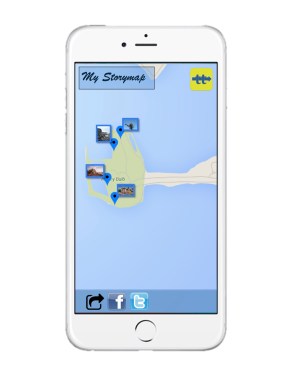
Lastly, there will be a feature in Thrutime that will allow app users to track their experience at the Albany Bulb and then save and upload a custom made “story-map” to Facebook.
Interactive Story-map
The story-map will incorporate photos and 20 second videos (like Snap-Chat) at specific checkpoints or landmarks, which the app user creates. This map will be interactive, so others will be able to click on checkpoints created by the user and view the photos/video associated with the checkpoints. The goal is to create an experience that can not only be easily shared on social media, but can be fun to talk about and might encourage more people to create their own unique story at the Albany Bulb, and hopefully keep the bulb alive for future generations.
Members Bios
Tyler Brown (Copy Editor) 

Tyler transferred to UC Berkeley in Fall of 2014 from Los Medanos College in Pittsburgh, California. He’s an Anthropology major and is graduating next May. His academic interests include American History. Tyler is a sports enthusiast, a musician, and is interested in aviation.
Marisol Cuong (Media Manager)

Marisol is a senior at Cal double majoring in Latin American Literature and Anthropology. She is originally from Los Angeles, California where she is the youngest of three siblings. Her academic interests are teaching and learning new languages, currently Marisol knows English, Spanish, Portuguese, and Nahuatl. After graduation, she hopes to take time off to work and possibly travel. Shortly after, she plans to apply to graduate school to pursue a PhD in Latin American Literature. While also wanting to open up her own non-profit to encourage multilingual literacy as well as higher education to all minority groups.
Jeremy Spratlen (Project Manager)

Jeremy transferred to UC Berkeley this semester from Merritt College in Oakland, California. He’s a third year Anthropology major. Some of his academic interest include Peru and Inca culture, as well as gender and sexuality studies. He keeps chickens and gardens at home. In 2016 he hopes to break ground on a community garden project in East Oakland to provide access to local, organically farmed foods.
Shelley Trout (Researcher/Designer)

Shelley is a senior undergraduate student at UC Berkeley, majoring in Anthropology with a particular focus in archaeology. A native of Wales, she has always held a deep fascination with ancient lifeways and the people of the past, and looks forward to pursuing her interests further at graduate school. When she is not busy studying, she enjoys art, music, and road-trips to new places.
Project Media
Video
These videos can give you a feel for what its like to be inside of the tower and also offer insight into the tower’s history with some informative interviews.
Use the arrow buttons to toggle between different videos.
Audio
These audio clips give a sense of the sounds associated with the tower.
Pictures
Interpretive Projects
Scope of the Interactive Plan:
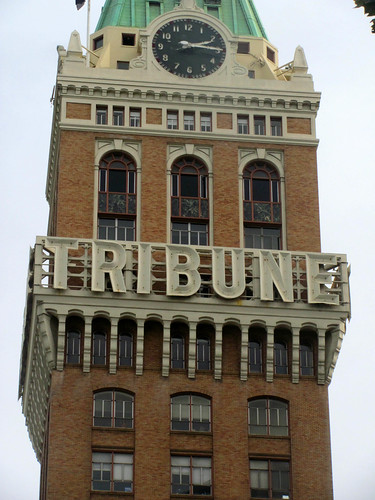
The Oakland Tribune Tower is located in downtown Oakland off of 13th street. The building is in good condition today and looks the same on the outside as it has for many decades. The Tower itself was built in 1923, with the building that it is attached to being built prior in 1906. The large neon letters that light up at night reading “Tribune” are still in place on the Tower’s four sides. They are maintained to this day in order to preserve the iconic image of the building as it presides over the City of Oakland, just as it has done for many years.
The first floor of the Tower itself is fairly accessible to the public due to the restaurant located on the ground level of the building. Much of the space above the lower levels is used as office space and for small businesses, and as such, has limited access. The Tower is located in the middle of a large urban area and not hard to spot out or travel to. However, one concern with accessibility is the limited parking around the Tower. There is a parking garage nearby and parking along the street, but much of this is taken up by residents of Oakland and employees in the Tower. This may be a concern with making the site a tourist location, and the parking issue will need to be revisited upon these interpretive plans being executed. Other than this, the only other issue that will need to be addressed in terms of accessibility of the building is its current users and how to properly accommodate them or work out an agreement with them in terms of use of the building.
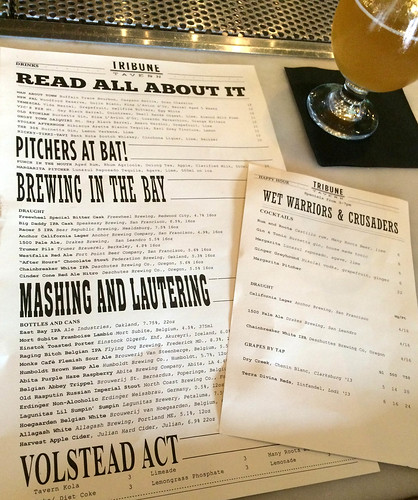
The Tower is currently and actively used by other businesses. For example, there is the aforementioned restaurant that occupies the bottom floor of the building called “The Tribune Tavern”. This restaurant has done a lot to preserve the history and tradition of the Tower, incorporating many artifacts into the restaurant and almost making it a commemorative place for The Oakland Tribune while also serving as a restaurant. Our aim is to work alongside the businesses in the Tower and the restaurant on the ground floor to ensure that our interpretive plans are made possible while still allowing them to occupy their space. However, this endeavor might prove difficult as some of these interpretive plans do require a considerable amount of space in the Tower, but all in all, it would be most favorable if all parties concerned could continue to use the building.
At the same time, we would want to make sure that we are not neglecting the use the Tower serves the community today while carrying out these interpretive plans. This would take away from the key role that the Tower is playing in the community today, which is the present version of the past that we are trying to shed light upon. Carrying out these plans with the Tower would require some work and negotiation, but we believe it is possible to accomplish these interpretive plans, and that our final implementation would be well worth the effort.

Themes:
- Historical
- Past & Present Accessibility
- Media Production
- Technological Innovations
- Ownership
- Tourism
How we intend to reach out to each audience:
The Oakland Tribune has been reaching out to its audience throughout the years via the news. This is something we would like to continue, while simultaneously providing an inside perspective by re-creating the Oakland Tribune Tower as a museum. Before opening the museum, it would be ideal to meet with community members, building owner(s), restaurant owner(s), people involved in the publication of The Oakland Tribune, Safety Commissioner(s), Water and Power Department, etc., to ensure this museum would benefit the City of Oakland, and to make sure the community as a whole supports the re-opening of the Tower.
If it is decided to open the Tower, the current owner will certainly benefit by making a profit, considering that the museum will attract more people and bring in more money. Also, other stakeholders like restaurant owners and workers will gain an increase in revenue, resulting from the increase in the number of customers. Community members will benefit from a free museum completely open to the public. And finally, the curiosity people will experience when hearing about the Tower will encourage them to engage with the Tower by looking inside, where they will find history told through narratives and material objects.
The cultural/ historical property of the Tower that has accumulated over time will now be shared with the public through a more intimate perspective. This “public” is comprised of people ranging from local community members to tourists visiting far from home.
Another way we will be reaching out to the community aside from newspaper will be through our multi-sensorial interpretative projects, which will cater to all age groups for the public to enjoy. There are four different interpretive plans:
- “The Interactive Tribune Museum” plan will immerse the visitor in the news publication process. A reproduction of the newsroom floor will be the setting for the museum. A linear timeline, showing progress from the origination of The Oakland Tribune as a news source to the contemporary period, will guide the visitor throughout decades that shaped the history and created the city of Oakland as we know it today.
- “Read All About It: Technological Innovations (for kids from 1 to 92)” is a plan that will take place on a track similar to a rollercoaster that will run through all the floors. Kids will be given a sheet of paper where they will have the chance to write their own news based on their experience within the museum or being in the City of Oakland.
- “Re-Imagining the Tower: An Alternative History of Oakland” is a steam-punk visual novel that seeks to immerse the user in an online, fictional retelling of an event that took place in Oakland during the 1920s.
- “Frozen in a moment: The Oakland Tribune Tower Audio Tour” is an audio tour taking you through a staged setting of the Tower reflective of a significant era of its past. The purpose of this is to convey the feelings/visuals/sounds of what it might have been like to work in the Tower news room on a typical business day in the 1950s.
The Oakland Tribune Tower as a whole is a continuum when it comes to the news being produced there. However, with the renovation of space through these interpretive plans, a new historical perspective will be ushered in that will engage the visitor with the rich history of the Tower.
Implementation
We as a team hope to continue to bring more community member to engage with the building and its history. With the use of our interpretative plans we have reimagined the Oakland Tribune Tower open to the public as both a cultural heritage site and a museum.
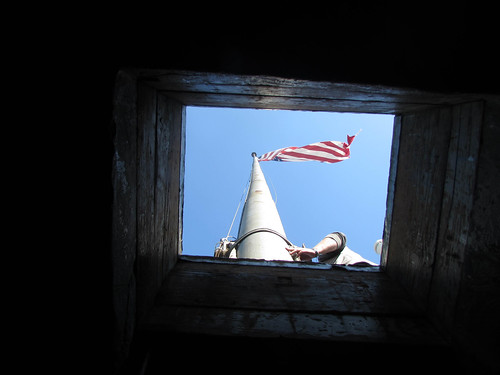
Trip to the roof of the Oakland Tribune Tower- photo by Marisol Cuong
With the Tower being converted into a museum we aspire the community to see the building not just as an iconic building, yet as something that represents the Oakland history. Having had experienced the Oakland Tribune Tower from its physicality to the remembrance of people that have been part of the building we know and respect its intangible attributes which is why we want to help sustain it through a set of long term and short term implementations. Short term consist of the following:
- Funding
- Make sure building is up to code
- Consent from current owners
- Parking
Long term consist of the following:
- Hopes for the Oakland Tribune Newspaper to return to the building.
- Establish our interpretative plans
- Ask people in the past and present that have a connection to the tower to share their stories.
- Instill a sense of pride in the Oakland Community by highlighting the importance of history through the use of the tower.
- Digitally document and establish a reliable archive of The Oakland Tribune Tower newspaper.
As of now, perhaps exhibits or tours could be established while work is in progress but this would depend on the availability of space in the tower and how negotiations go with the current owner, Tom Henderson, the businesses, people that occupy the space, and the use of the tower.


 Who Owns the Past? Cultural Heritage in the Digital Age