Category Archives: Anthro136kF2015
Informative Website

Davis House is not well known yet. Therefore, our first step is to inform about Davis House to potential audiences. To reach larger audiences, we will build an informative website. The content of the website will be the history of Davis House, links to the virtual tours, a brief description of the walking tour, a bulletin board, a local map of the area, and a sample of schedules of current residents living at Davis House. We will share the link of the website on many other websites such as Berkeley Student Cooperative (BSC) website, general housing pages and blogs. We aim to reach UCB students and Berkeley residents through BSC website and housing pages, and Julia Morgan fans and history enthusiasm through representative blogs. The strength of the website is that it will bring all information and features together in one place. Also, it eliminates physical limitations to know about Davis House.
Multi-Sensory Experience/Community Narrative Video Zine

(Poster inviting Gilman members to share their experiences with the team. These are still hanging in the venue as of this writing. Posters designed and posted by Danielle Belanger.)
This interpretive plan will create a video zine, which will not only aim to explore the idea of ephemerality and the mutually dependent relationship between the venue and the community, but also the reasons for which attending a live concert or show are privileged over experiencing a concert or show through secondary media and recordings. The physicality of the environment as well as the community at shows and concerts largely contribute to the differences between a live experience of a performance and one that is recorded.
The goal for this video zine will be to depict a sense of community, but it will also include themes of Gilman’s ethos and mentalities. Because the audiences and members of Gilman are constantly changing, this video will embrace themes of ephemerality. In addition, the video zine will contribute to sustainability by capturing a digital log of varied perspectives and views of Gilman at this moment in time — future generations of Gilman members will be able to look back on this video to see what the community of Gilman is like in 2015, perhaps even to reflect on whether the community or the venue’s ethos has changed. I am interested in fashioning the video zine so that it appeals to a wide range of audiences — people who have never heard of Gilman before, people who are curious to learn more about the venue, and people who are fully invested and want to get even further connected to the Gilman community.
Key Players and Interest Groups
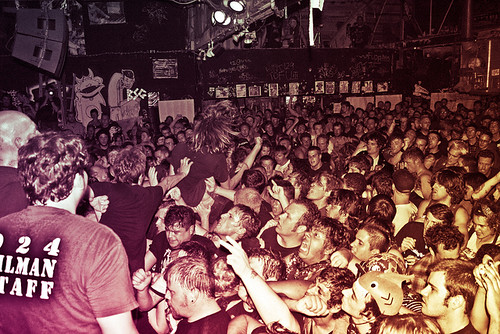
(A very packed 924 Gilman Street. Professional photo acquired online.)
924 Gilman Street’s primary stakeholders and interest group is the punk rock community of Berkeley and the greater Bay Area. The youth of Berkeley have played a major role in shaping Gilman, as the venue was one of few places where they could express their identity and ideals without fear of repression from authority figures, such as parents, teachers/principals, and the police. At the time Gilman was founded, the punk movement had not entered the limited mainstream contact it currently has, and punks were viewed as deviants. The venue was a haven to these people (to the point where some people slept there when homeless). It was and continues to be a scene for musical experimentation and expression of ideas and ideals. The venue is known for being a safe space. Any sort of discrimination is not tolerated, as is violence and consumption of drugs and alcohol.
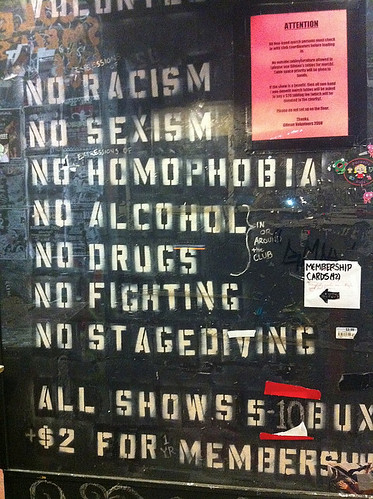
(The venue’s rules board, seen immediately upon entry. Photo taken from online source.)
The venue has a “do-it-yourself” mentality, and is run by the community as volunteers. Those who are invested in the punk scene treasure the venue highly. The stewards of 924 Gilman Street are the volunteers and community members who sacrifice their time and efforts to organize and continuously provide an outlet for the Bay Area underground punk rock scene. Some of these stewards are long time members who have witnessed the many faces come and go while others are relatively new patrons who have found their place within the culture. The venue focuses on booking lesser known bands and those not supported by major record labels. Successful bands such as Green Day, Rancid, and The Offspring got their start at Gilman. In fact, bands affiliated with major record labels are not allowed to play there, to avoid a sense of allowing “corporate music” to gain a foothold. Green Day was banned after 1993 for signing with a major label, and only recently was allowed to come back to Gilman to play a benefit show in April. Their return was significant, because Gilman agreed to bend its rules to allow Green Day to return to support the community instead of making money. However, despite Gilman’s anti-establishment mentality, it has become famous in the punk community for being a launch pad for successful punk bands. Bands make a great effort to secure a show at Gilman, even international groups. Gilman has helped contribute to many other DIY establishments and projects related to music. Some project following Gilman’s non-corporate ethos include record labels and publishing companies like Tankcrimes and Pirate Press.
The city of Berkeley is also an interest group. 924 Gilman Street has had trouble with the law and the city due to noise, unrest, and general suspicion of the punk scene and the general public. The city has tried to shut the venue down multiple times, and one city council member infamously described Gilman as a “festering sore” during a hearing in the 1990s. The punk community has had to carefully balance relations with the greater Berkeley area in order to remain open. Gilman’s members have had to demonstrate they were capable of keeping order. In an interview with former security member Sam Smash, eventually an unofficial, unspoken agreement came out with the Berkeley Police Department, agreeing that 924 Gilman Street was capable of self-policing, and that any 911 calls were something to be taken seriously. However, there have been productive interactions. The community worked to oppose the opening of a restaurant and brewery nearby, fearing the availability of alcohol would impact Gilman’s principles of an alcohol free space. This are just a few examples of these different interest groups interacting with each other, something that this project aims to continue.
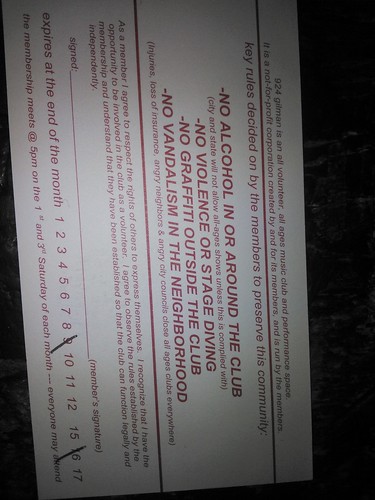
(Back of the card all Gilman members carry. Photo by Tait Adams.)
Modern Context

(A long line of people waiting for the doors. All photos on this post sourced from online sites by Silas Jones.)
In recent years, the 924 Gilman community functions less like a community or an organization and more so as an organized family of volunteers who share a similar vision, values and goal for the present and future of Gilman. There’s been ownership change and waves of volunteers over the decades, but ultimately, the venue has outlived overcome many obstacles to become one of the longest surviving, nonprofit, volunteer-led organizations in the Bay Area and beyond.
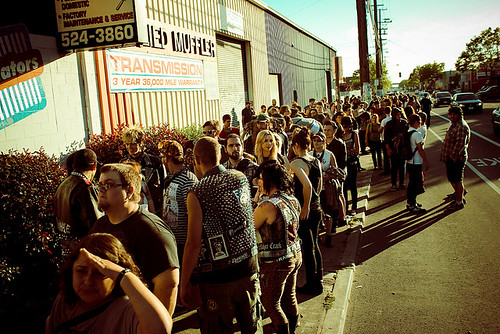
The venue continues to serve its purpose of being a venue for underground punk rock bands. Shows are held Friday and Saturday nights, with shows usually running from 7-11:30 PM. Shows are sometimes held on Sunday nights. While punk remains the most popular genre at Gilman, the venue is officially open to all genres of underground music the community wishes to see. The Bay Area heavy metal scene become increasingly tied to Gilman. In addition, some hip hop and “psychobilly” shows have been played. Gilman has also very recently started a “game night” on Thursdays for members to play various board games.
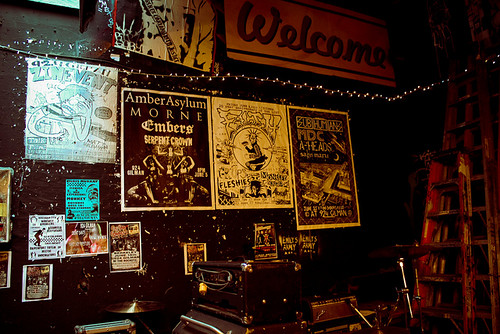
(Another view of the entryway).
Speaking with Gilman members has revealed that the community is in a state of transition, and that Gilman is a lot less “crazy” than it has been in the past. Many members are “growing up” and settling into full-time careers and relationships/families, and thus have less time to spend at the venue, and thus show attendance and revenue has been dropping. At the same time, as kids become teenagers, they discover their identities, one of which could be punk, and thus discover Gilman, and attendance might rise again. This state of transition ties into our defined theme of ephemerality. Gilman is constantly changing. Gilman veterans note that this is not the first time such change has happened, nor will it be the last. In five years, 924 Gilman Street may achieve its previous level of punk rock mayhem.
Management Plan
Our heritage site at Davis House focuses primarily on four major themes: community, gender, race, and progress. In the short term (5 years), our focus is on the immediate and pressing needs of the house, as outlined above; maintenance of structural and aesthetic features must necessarily be a priority because the house in its current state is so vulnerable to damage. This need for preservation does not, however, preclude the establishment of heritage projects in the property, and may in fact be helped by increased visibility and the procurement of grants and other funds available to heritage projects.
Long term goals (up to 25 years) focus more on the broader social, historical, and cultural footprints of the building. To attempt to preserve the legacy of the house without considering its functionality would be impossible, as it is still a home that houses 36 residents. Their needs must be considered and it is best if we view the house comprehensively as a living organism that will grow and adapt with changing times. Therefore, we are proposing a series of heritage projects that will speak to everyone from house members to people outside the community. All of these projects will consider how Davis House fits in with broader social and cultural trends, and how this particular site can serve as a focal point for these changes. At the same time, we ask “What are the changes still needed in today’s society, and how can Davis House help illustrate these for us?” Our interpretive plan looks to the past, present, and future as we examine this site and its place in our world.
Significance
Davis House brings an unsurmountable amount of significance to the community. With such a cultural diversity instituted within its very walls, an infrastructure that takes us back in time to the Victorian era, ethics that are bringing young, vibrant people together in healthy, educational ways, community and educational involvement and a geographically located placement that makes it more than convenient to get to classes, it’s no wonder why so many students wish to keep this wonderful place alive. It supports ecological and healthy eating choices and makes eating healthy more accessible for students; which is highly important while they are trying to become the future of our world and make future decisions about political and ethical issues regarding the community and beyond. Davis House wouldn’t have the significance it does without students continually being involved in its liveliness and adding to the intrinsic energy that fills the house. Assisting in making everlasting and lifelong bonds between people living and learning inside the Co-Op, Davis House itself, houses much intangible heritage and keeping it alive is extremely important to the students in whom it has touched their lives forever over the years at UC Berkeley. It is more than just a building, it is more than just a house, and it is a loving and cheerful community in and of itself. It brings a softness to the eye of any person that loves architecture with its gorgeous Julia Morgan style home. Julia Morgan designed more than 700 buildings along the California Coast and adds a historic point of view to the heritage it holds. Built in the early 1900’s Davis House is a truly memorable place for anyone who has lived there and should be able to continue to be for future generations of Cal students.
Target Audiences
As a venue that hosts underground music and celebrates the arts, 924 Gilman is linked to the larger artist community of the San Francisco bay area. Although primarily involved with DIY punk culture, 924 Gilman can speak to a number of varied interests and subcultures. From politically involved individuals to board game buffs, 924 Gilman can be a destination for a range of local and international people. With better publicity of events and ethos, the organization can reach out to a wider and more diverse audience.
The immediate community of 924 Gilman consists of the musicians and their fans, particularly the Bay Area punk music community itself, both in and outside of Gilman. Besides the primary stakeholder of the Gilman community (which is auditing our work in order to avoid misrepresentation), there is a wider Bay Area punk community that can have a greater awareness of Gilman and greater consideration of what it represents to them. In addition, there are people who are just beginning to enter the punk community through friendships or discovery of music. This project would make them aware of the venue, and the emphasis of Gilman’s values of tolerance, nonviolence, and a general safe space for interaction can make the venue more attractive to these “prospective punks.”
The second audience is the neighboring area surrounding Gilman. The venue has had a history of tense relations with neighbors and the city of Berkeley itself. Gilman attracts a following that tends to be loud and has in the past attracted trouble causing violence outside the venue. Combined with the popular stereotype that views punks as deviants, Gilman has not had cozy relations with the surrounding area, and there have been anti‐Gilman interest groups trying to shut the venue down through city action. This plan presents a positive interpretation of 924 Gilman as a site that is connected to a rich and diverse cultural heritage in opposition to the common misconceptions of the music club and subculture.
The third and final main audience is the “casual/curious onlooker” that has heard the name “Gilman” and wants to know more. By presenting our material in as much of an accessible format and medium as possible, we hope that we can maximize appeal and interest in 924 Gilman to a wider audience. This interpretive plan aims to show as complete of a picture of the venue and its community as possible — not only drawing from aspects of cultural heritage in North Berkeley, but also in the greater Bay Area. By opening its doors to the public and providing a safe haven for marginalized peoples, Gilman has naturally cultivated a creative and energetic community. In addition, the community is quite productive in maintaining the operational aspects of the organization (which depend entirely on volunteers), and in becoming involved with a issues that do not directly relate to art and music, such as politics, social awareness, and offering help to those in need.
Management Plan
Short Term Goals:
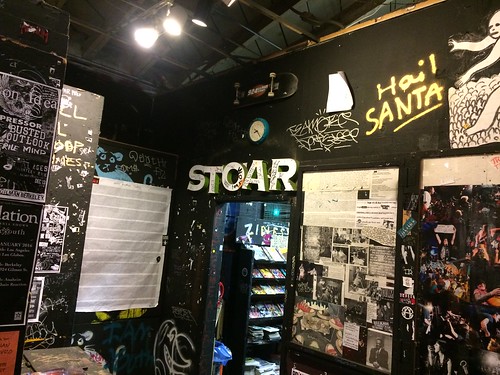
(A shot of the entrance to Berkeley’s concession stand, known as the “Stoar.” Taken by Silas Jones.)
Fundraising for the organization, buying the building, and shared ownership would allow Gilman to continue its collective mission. Improved noise containment during band performances could improve the venue’s potential for longevity and its relationship with surrounding neighbors. Also, increased outreach, such as canned food drives or LGBT awareness events could help the venue gain greater recognition and respect in the public eye raising awareness of Gilman as a center for a culturally rich and progressive community.
To cope with rising costs, 924 Gilman Street has raised prices. Membership cards, costing $2, were originally for life, and were initially credited with helping keep the venue afloat for its initial period of existence. Looking at old fliers and logs shows the policy was changed to a $3 per year membership in the mid-1990s, although it is current only $2. Shows were originally always $5. However, ticket prices have increased, therefore, some shows now cost $12-17, which was “unheard of” until very recently in the venue’s history. The community has expressedfrustration over this rising cost. There has been debate in the past about having shows on more days of the week to boost income, as the venue pays rent by the month, and is only active for a few days out of each week. However, the availability of manpower is a concern.
The Alternative Music Foundation, the nonprofit that runs 924 Gilman, is nowconsidering buying the building outright to ensure the venue’s long term survival. On the website under “Support 924 Gilman” there is an option to donate funds electronically: “Your donation istax-deductible and supports two specific goals: 1) to try to own the building, 2) to lower the doorprice for shows.” Donations are also accepted via personal check made out the Alternative MusicFoundation. The purchase of the building would present a further issue for the Gilman community, as one person or group would own the site. This goes against Gilman’s collectivenature, and includes the fear that the owner may leverage their influence to cause change. Gilman’s members are also debating the idea of collective ownership.
Long Term Goals:
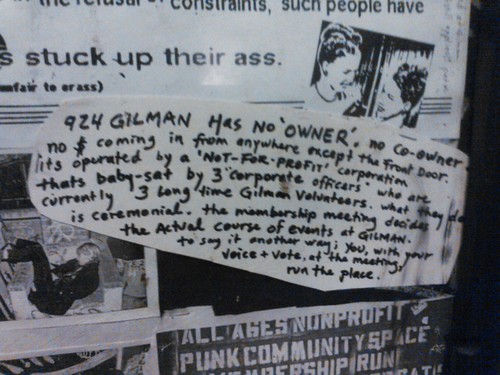
(Some of the posters detailing Gilman’s ideas in the main entryway. Photo by Tait Adams).
In the long term, keeping the community accessible to active participation and involvement is highly necessary. Our management plan seeks to preserve the community participation by means of volunteering, donating or any other means that would perpetuate this vision of “a melting pot of cultures,” as the venue has practiced thus far. It would be better that Gilman close down sticking to their guns, so-to-speak, than it would be for Gilman to remain open under a purely profit based system with zero community involvement. This is the only relevant plan of action because the community constitutes the heart of this organization. In other words, 942 Gilman’s success over the next couple of decades should be more of the same with a heightened emphasis on fundraising in order to combat economic distress. Additionally, the organization should attempt to reach out to a larger range of people by directing their methods of outreach to a more diverse range of issues/populations. Gilman could sponsor volunteer based events which would be open to the public and which could reach out to more diverse social/political arenas. By including a more diverse range of individuals in the community, Gilman can become an increasingly rich cultural center, which would not be limited to just one or two subcultures.
As was recently brought up at a Gilman membership meeting, new generations of committed volunteers will need to be more involved with the organizational aspects of the club in order for it to maintain a democratic ethos and status as a non-profit organization. We are taking the initiative to increase awareness of the venue through training and educational projects, with the hope to increase numbers of participants from younger generations. We would like to see more members who are willing not only to join in on membership meeting discussions but who are also willing to volunteer their time. By encouraging younger generations to step up and join in, we can contribute to long-term sustainability of 924 Gilman, ensuring that the music club’s values and ethos are upheld, but also that the venue’s policies and operations are kept up to date.
It could help the subculture be understood less as a “subversive” stereotype, and more as a group of committed individuals with a willingness to contribute to current and important issues. This knowledge would improve levels of hostility toward the subculture and institutions which are of service to the subculture. In the end, educating the public about Gilman as a volunteer based, community rearing success would help the organization secure its location in an area which is only becoming increasingly gentrified. Conventional understandings of punk need to be expanded and understood by a larger population in order for “punks” to be accepted and tolerated in the changing social climate of North Berkeley.
Background Information
924 Gilman Street is easily located at the corner of 8th Street and Gilman Street on the northwest side of Berkeley, CA. in a light-industrial and commercial area just a few blocks down from a quiet neighborhood and park. It shares a building with a canning shop. Across the street from the building is a Krav Maga dojo and a Whole Foods (a controversial addition due to the company’s role in gentrification). North of the venue are generic commercial buildings. Walking farther north reveals an entrance to a local creek which is a popular hangout spot for Gilman youth.
Inside, the stage occupies a corner of the building instead of an entire wall. The main entrance is on the building’s northern side. To the left of the entrance is Gilman’s concession stand (known as the “Stoar”), to the right is the office. The sound booth is located in the center of the building. Just right of the sound booth is the restroom area. Left of the booth is the side door which is manned by security during performances. The ceiling is convexed, moderately high, and provides decent acoustics.
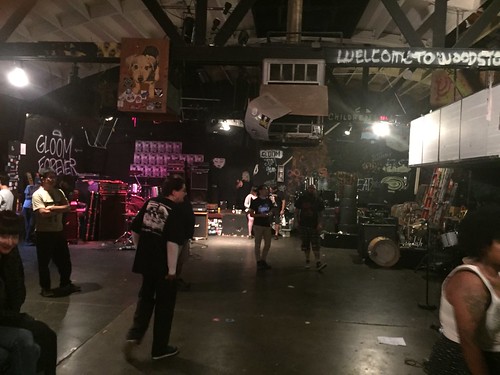
(Early arrivals walk around before a show starts. Photo by Mark Hilton.)

(A piece of graffiti that accurately summarizes the Gilman mentality. Photo by Silas Jones.)
As one walks through the door and around the crowd control barrier, one will see a wide collection of art and graffiti spread across the walls of the venue. In the venue proper, one can see murals and spray paint art. Some is political, and some is purely artistic. The bathroom walls are also a canvas, covered in many layers of tags, some readable, others in the style that only other taggers will understand. Other examples show drawings and mini comics drawn in the local punk style, drawn in Sharpie and White-Out.
Walking around Gilman’s interior reveals it has been heavily used since it opened. The stage and furniture is heavily worn. There is a balcony on the wall near stage left, however, it is now mainly used for equipment storage. There are some oddities, such as a basketball hoop, and strings of Christmas lights on the sound booth. While the interior is covered in the aforementioned art and graffiti, the exterior is currently clean, as outside graffiti is forbidden. The exterior walls do not say “924 Gilman Street” or advertise its existence; it shares the building with a canning workshop (926 Gilman Street), which has its logo painted on the exterior. Gilman’s punk “vibe” is constrained to the inside only. The building was seismically retrofitted in 1995.
Virtual Volunteer Training
Gilman is “run by punks, for punks.” The venue is run by volunteers who show up every weekend to ensure shows run smoothly and the budget is kept in the black. Every position is on a volunteer basis. The exception is security, which is paid as per California law, which requires performance venues to have paid, trained security staff on hand. However, keeping with the volunteer experience, Gilman members take the job, rather than relying on professional security services
To show how volunteers do their jobs, we have created a series of “virtual volunteer training” videos where longtime Gilman volunteers discuss their jobs. This is to help the curious outsider get a better understanding of two things. The first is DIY ethos and community that are integral to Gilman’s continued existence. The second is provide a sense of the “nuts and bolts” of how a performance venue is run, something most audience members take for granted.
Harley shows you the process of setting up Gilman’s concession stand, affectionately known as the “Stoar.”
Former security guard Sam talks about how one gets involved in security, with some highlights from his years on the job.
Liz discusses sound and the general Gilman volunteer experience.


 Who Owns the Past? Cultural Heritage in the Digital Age