Category Archives: Uncategorized
Key Players
The National Park Service currently acts as the main steward of Alcatraz, as it maintains the facilities and oversees tourist operations. Volunteers also act as stewards of Alcatraz. For instance, dedicated volunteers care for the island’s expansive gardens. In the past, various stewards, such as Native American occupants, prison employees, and American military, maintained the island. Interestingly, Alcatraz’s prisoners also acted as stewards, as they helped maintain the island’s gardens.
There are several unique groups of individuals who are stakeholders in Alcatraz’s past, present, and future use. Former prisoners and their descendants are stakeholders of Alcatraz, though they have a range of experiences with the site. Interestingly, some former prisoners have expressed their admiration and nostalgia for the island prison. The infamous bank robber Whitey Bulger, who was imprisoned at Alcatraz for three years before being transferred to another federal penitentiary, later wrote of his yearning for Alcatraz and its scenic view of San Francisco, as pictured below.
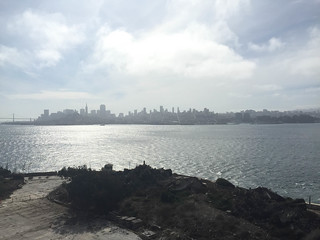
Former correctional officers and their descendants are also stakeholders of Alcatraz. During Alcatraz’s prison era, correctional officers and their families lived on the island themselves, in houses and apartments that were separate from the main cell house.
Additionally, Alcatraz is a site of historical and cultural significance for Native Americans. The Indians of All Tribes’ nineteen-month occupation of Alcatraz represents an important act of protest by Native Americans towards the American government. Native Americans today represent an important group of stakeholders in Alcatraz because of the protests that took place on Alcatraz Island.
Finally, Alcatraz is a site of interest to various interpretive groups and academics. For instance, the We Players, a theater group dedicated to performing classic dramas in unusual locations, performed Hamlet on Alcatraz Island, as pictured below.

Albany Bulb History and Background of Keeping the Bulb Wild
History
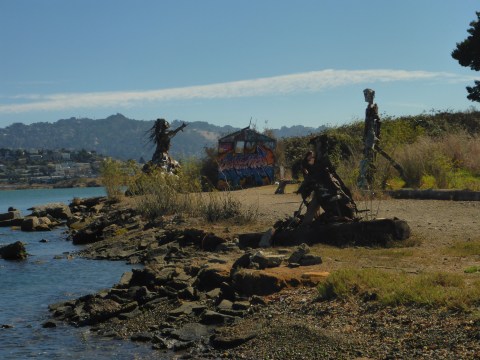
The artistic legacy left by former artists and Bulb residents by Karlene Shippelhoute.
The Albany Bulb was originally a construction dump. Trash from the city of Albany was disposed of in the water forming the landmass which now exists. When the site ceased to be a landfill in 1983, what remained were the narrow neck and bulb jutting out into the San Francisco Bay. After the bulb ceased to be used as a dump, homeless people took up residence at the site and built elaborate houses, community buildings, and artwork out of the construction debris. The area became a park and was used by the surrounding community for outdoor recreation. Recently, the Albany Bulb transferred ownership and the residents of the Bulb were evicted. This action sparked a controversy between multiple stakeholder groups who feel connected to the site and wish to regain access.
Geographic location
The Albany Bulb is located to the north-west of Golden Gate Fields and west of the junction of I-80 and I-580 in Albany, California.

This map shows the Albany Bulb and surrounding streets.
During the first habitation of the Bulb, the homeless were encouraged to take residence there instead of being on the streets. The public officials wanted them off the streets and away from society. The people built spaces they could live in with the materials left over from the landfill. The dwellings that were at the site ranged from makeshift tents to elaborate construction projects with more than one story in height. Remnants of the structures remain today that showcase the once vibrant and innovative community that resided there. To learn more about the former residents follow the link to the documentary Bum’ s Paradise.
https://www.youtube.com/watch?v=K6XYZbY8t4k
The city of Albany’s plan was to make the land more appealing for families, hikers, bikers, sightseers, and wildlife preserves. The people of the bulb were forced once again to move on to the unknown. The process of removing the residents began in 2013, and the construction is currently underway. The most current eviction of homeless groups came in 2014 when 28 residents were forced to vacate the premises. In return the city granted them $3,000 each to relocate and stay away for a twelve month period. One factor that must be considered as development of the Bulb progresses, is the fact that for over fifteen years the Albany Bulb was the location of a complex community that was unique to the Bay Area.
Landscape and Setting
The landscape is interesting because the intense juxtaposition of human-made materials and native plants and animals. This mingling of wilderness and urban space calls into question the human-nature separation that is often characteristic of park narratives. The space is contentious because of the multiple and conflicting narratives which are argued by stakeholder groups. The city wishes to return the land to its natural state, but this argument derives from a concept of the wilderness which is based on a problematic philosophical divide between humans and nature .

The All Seeing Eye at the Albany Bulb source by Karlene Shippelhoute
Modern Context
The bulb is used every day at all hours by dog walkers, hikers, and bikers. Perhaps one of the most unique current uses of this place is the use of rubble and debris to make beautiful works of art, and those works of art are the subjects for many professional photographers, who frequent the bulb for its scenery and fusion of urban development and nature.
Ownership and responsibility
The Albany Bulb is currently owned by East Bay Regional Parks, but it is being transferred to State Parks. As this project is being compiled the city continues to develop the Bulb. Right now use of the space is limited as the East Bay Regional Parks continues to redevelop the land to improve public access around the neck of the Bulb. This includes limiting where the public is able to go and will continue until from summer 2015 to the end of winter 2015 . Although patrons can still access parts of the bulb it is hard to imagine how people will continue to use the Bulb until the construction is complete
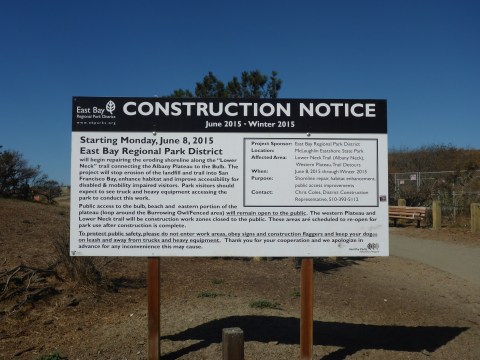
An ominous reminder of the impending city construction.
Current protection and conservation
Measures are being taken to protect the sculptures and artwork at the Bulb, as well as preserve some sense of community by recording stories of Albany Bulb residents. Wildlife and native plants are protected by creating habitat and ecologically friendly spaces. Mitigating hazardous waste at the site will improve the space for everyone.
Key Players, Interest Groups and Process of consultation
The numerous stakeholders and stewards and complex history of this site pose both ethical debates and questions as to how the Bulb should continue to be preserved and who should have the agency to decide who is and is not allowed to use the Bulb.
The remaining waste can be viewed through two lenses; the city and the East Bay State Parks claims that the site has adapted in recent years to serve as a recreational area for individuals and the current state promotes health and safety issues. In addition, they see the area as an eyesore because of its recent history as a “homeless” encampment.

Share the Bulb Rock at the site by Karlene Shippelhoute
The city aims to remove the exposed concrete, rubble, and protruding rebar to “enhance the conservation value and accessibility of the Albany Bulb”. The alternate viewpoint shared by many Bulb goers is that of the landscape should be left to decay “naturally” because an accessibility and enhancement project will change the way the culture of the space is interpreted. Despite these differing viewpoints, it is crucial to look at the implications and associated environmental impacts of each plan of action. In addition local homeless residents came to the Bulb as a place to seek refuge and create their own community.
Recycling the Past Interpretative Plan
The goal of this project is to reach out to children and young adults through the school system. In order for this history to live on, it must be taught through school curriculum. The project will incorporate these themes of community and recycling by teaching a younger generation a little bit of forgotten history and the causes that made it what it was.
In order to get to the younger generation to learn about the bulb, we need to find a way to immerse them into this history. This project will incorporate themes of art and liability. The Albany Bulb is not a kid friendly place at the moment, so this plan will be actualized at a future date when the bulb has been made safe and accessible. The plan for now is to have the young students learn about the Albany Bulb in school. There will be a curriculum taught by a guest speaker to teach the children about the history of the bulb. The goal is to capture the interest of the children without taking them into the bulb and exposing them to potential hazards.
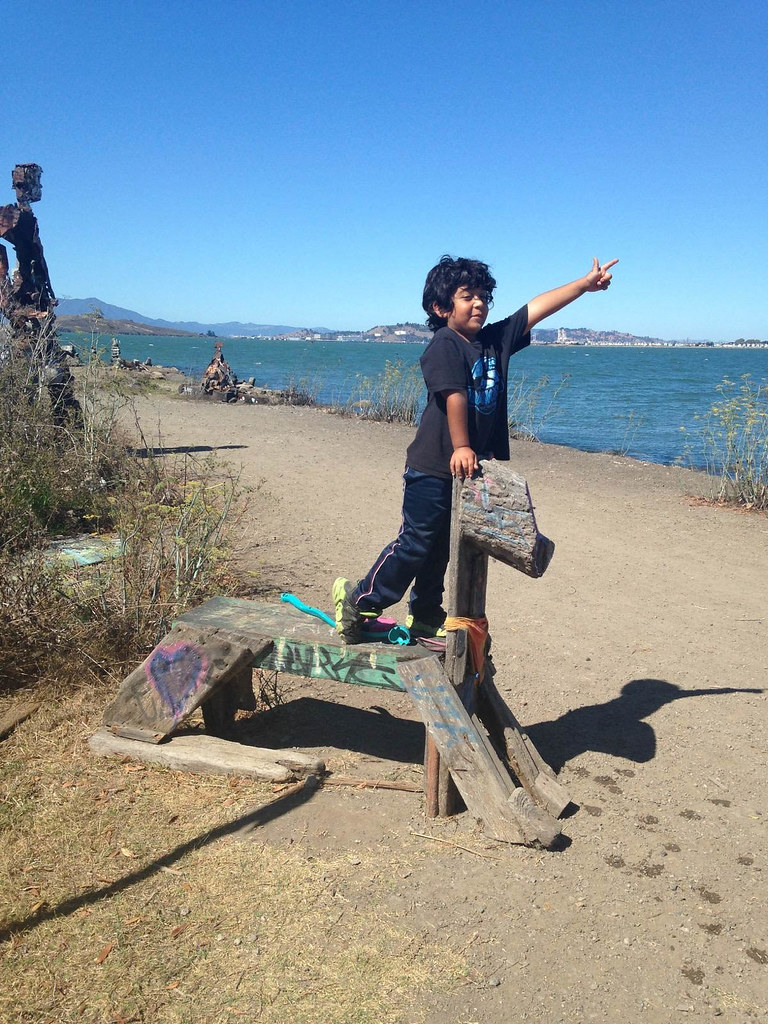
Child Playing on Reclaimed Art at the Bulb by Brenda Arjona
The presentation will consist of photos, audio, video, and hands-on learning. For the hands-on aspect of the lesson, they will learn how to recycle objects that would have otherwise been thrown out and how to reuse objects that can be turned into art or useful tools. For example, they will receive a few items and be asked to take a moment to reimagine them as something else, whether it be an art piece, a tool, or both. In this lesson plan, they will learn about their community’s unspoken history and how to reuse objects to create something could have another purpose or use.
When the Albany Bulb is safer for children to go there, it will be a better experience overall. There will still be guest speakers there to provide a guided tour of the bulb and have the children go to key points at the site. The fieldtrip will be a morning to early afternoon lunch trip in which the students can provide their own lunches or lunches can be provided if there is enough funding. They will visit the locations where the sites would have been and they might possibly be able to use an app to help them see what the site looked like, had the Bulb not been constructed into a park. Those who go on the tour will also be asked to do a project that is hands on. For the younger kids, they will be asked to do drawing projects to make the site more fun for them.
Older students (middle school through high school), will be asked to do some non-official archaeology at the site. Each student will participate in a survey of a particular area or as much of the bulb as they can get to in a day. The goal is to immerse young student in the bulb’s past by having them walk around and explore. Their guides will explain and answer questions about particular sites and objects that might come up along the way.

This screenshot was taken to show where the proposed community building at the Albany Bulb would go. Designer Bernardo Arjona sketched in the hypothetical building at the entrance of the neck of the bulb.
This interactive project touches on sustainability in a few ways. First off, through this project, the students can add to the sustainability of scientific data by doing surveys and learning about research topics. Having them out in the field will give them a better understanding of the type of work that takes place when looking to preserve aspects of the past. The way in which the students will be able to visit and revisit the site, each time being reminded of the intangible and tangible heritage there will add to the sustainability of the Bulb’s past. Finally, the field trips will focus on doing low impact archaeology and projects that aim at keeping the site from being damaged while still being remembered.

Albany Canvas Interpretive Plan
As the city plans to gentrify the park, the art in its current location is in danger. This raises questions of authenticity and sense of place pertaining to the art. The end result of this interpretative plan constitutes display cases placed throughout the Albany Bulb showcasing art of the Bulb commissioned by local artists.
Albany Canvas is a unique program that would be created in cooperation with the city of Albany as a way to preserve the artwork of the Bulb. The focus of this particular interpretive plan is to integrate a way to save some of the art while also encouraging community involvement within the space. The art walk would include a guided tour of the Bulb by former residents and artists. After being inspired by the art walk and taking in the sights, smells, and sounds of the Bulb, artists would be encouraged to create their own artwork that encompasses what the Bulb means to them and their community.
The proposal for this interactive art collaboration is as follows: Throughout the course of a year, which would begin with the guided art walk, visitors would be encouraged to visit the Bulb and interpret the art through different medias, including but not limited to; photography, film, painting, etc. The artists would be allowed to upload their artwork to a website that is designed to share the Bulb’s art culture with visitors.

Albany Canvas App Icon by Karlene Shippelhoute
The intention is that by allowing locals to upload their art, the personal experiences and ways of viewing the Bulb and its wild landscape will remain accessible to everyone rather than the proposal for the area that the city is attempting to present, which considers removing the artwork completely. After the one-year duration of artistic creation the art would be used to create an installation and be given to the city to incorporate into their plan.
Although the East Bay Regional Parks District does not yet operate the actual Bulb and is only working on the Neck they have been given permission by the city to operate the area in the future. On the East Bay Shore Regional Park website they claim that, “The District has a responsibility to preserve the legacy and the history of the peoples who occupied this land before the District was established and park properties acquired, as well as to preserve the history of the District itself. It would appear that upon their acquisition of the Albany Bulb it would be within their mission statement to preserve the art.

An example of a website interface for albanycanvas.com by Karlene Shippelhoute
Preserving the art can be done in many different ways. Although this interpretative plan empathizes with the sentiments of former residents who want the art to remain at the Bulb realistically we understand why the city wants to remove the art due to issues of liability and maintenance costs. Therefore, this plan suggests that the artwork be removed and placed in museum to be enjoyed and preserved as part of the history and culture of the Bay Area.
Interpretive Plans
With a history stretching back more than a century, Davis House speaks to a large number of people. Current and former residents, either from the sorority or the co-op, have a personal stake in this site as a notable part of their lives. So too can the general public appreciate this site for its architectural, historical, and cultural significance. Our goal is therefore to engage all of these groups while still respecting the fact that this is a private residence. For nonresidents, this means using virtual tours instead of physical access, as well as neighborhood tours to help ground Davis House in its historical and cultural settings. Current residents may use the same, as well as material that speaks to the history of the house and of the organization to which they belong.
All of these projects will consider how Davis House fits in with broader social and cultural trends, and how this particular site can serve as a focal point for these changes. At the same time, what are the changes still needed in today’s society, and how can Davis House help illustrate these for us? Our interpretive plan looks to the past, present, and future as we examine this site and its place in our world.
Themes

It is difficult to talk about the culture of 924 Gilman because, in a sense, it is deliberately volatile and undefinable. In many ways, the venue is a living, breathing entity which is consistently and progressively experiencing changes through the ebb and flow of the community that surrounds it. It is significant that everybody has a different story concerning Gilman and that there is no centralized narrative because individual people engage with the experience in different ways.
That being said, the most dominant cultural value, what could be called the paramount piece intangible cultural heritage is the community which the club fosters. The aspects of this community range from the intimate and personal to the structural and symbolic: the volunteer corps, the patrons, the artists, the bands, the neighbors and neighborhood (both commercial and domestic), and even the music and art scene at large can all be considered as taking part.
Historically speaking, Gilman has acquired quite a bit of symbolic capital as it relates to the global punk rock scene. Some attribute this to the venue’s ability to stick to its core values of being an open, all-ages, community and volunteer-run establishment. Others attribute this to the simple fact that they’ve been able to keep the doors open for almost 30 years (1986-Present). Groups such as Green Day, Rancid, NOFX, and the Dead Kennedys put the location on the map as a go-to destination for their fans across the world. The venue also engages the larger music scene outside itself by supporting other DIY businesses and establishments, such as local record companies and printing presses.
Politically, there is no power hierarchy. Every decision goes through a vote at the membership meetings, democratically. They decide which bands are allowed to play, who can hold a key to the venue, who gets “86’d,” or banned from the venue. Our ability to conduct this project was put to a vote. Everyone has a voice and gets time to speak their piece; your opinion is welcome but your respect is required. By virtue of the diversity of the community, a whole variety of voices make up the collective will expressed by the venue. These opinions, of course, change as the community itself changes.
Gilman is not profit orientated, but rather driven from the shared experiences of the show or event that brings the community together. As one informant, Sam Smash, remarks “we found our families at these shows” and this is reflected in the active community participation of the volunteer collective because there is a sense of social responsibility to give back and contribute to that family. Profits are split between the venue and the bands. When something needs to fixed, improved, or replaced, it is done by the members, often through donation. For many, Gilman is a safe space to escape from normative culture, a space where people can freely express themselves and as such its members are consistently focused on ways in which the community can be supported because “there’s not gonna be any support for us unless we help ourselves” (Sam).
Informative Website

Davis House is not well known yet. Therefore, our first step is to inform about Davis House to potential audiences. To reach larger audiences, we will build an informative website. The content of the website will be the history of Davis House, links to the virtual tours, a brief description of the walking tour, a bulletin board, a local map of the area, and a sample of schedules of current residents living at Davis House. We will share the link of the website on many other websites such as Berkeley Student Cooperative (BSC) website, general housing pages and blogs. We aim to reach UCB students and Berkeley residents through BSC website and housing pages, and Julia Morgan fans and history enthusiasm through representative blogs. The strength of the website is that it will bring all information and features together in one place. Also, it eliminates physical limitations to know about Davis House.
Management Plan
Our heritage site at Davis House focuses primarily on four major themes: community, gender, race, and progress. In the short term (5 years), our focus is on the immediate and pressing needs of the house, as outlined above; maintenance of structural and aesthetic features must necessarily be a priority because the house in its current state is so vulnerable to damage. This need for preservation does not, however, preclude the establishment of heritage projects in the property, and may in fact be helped by increased visibility and the procurement of grants and other funds available to heritage projects.
Long term goals (up to 25 years) focus more on the broader social, historical, and cultural footprints of the building. To attempt to preserve the legacy of the house without considering its functionality would be impossible, as it is still a home that houses 36 residents. Their needs must be considered and it is best if we view the house comprehensively as a living organism that will grow and adapt with changing times. Therefore, we are proposing a series of heritage projects that will speak to everyone from house members to people outside the community. All of these projects will consider how Davis House fits in with broader social and cultural trends, and how this particular site can serve as a focal point for these changes. At the same time, we ask “What are the changes still needed in today’s society, and how can Davis House help illustrate these for us?” Our interpretive plan looks to the past, present, and future as we examine this site and its place in our world.
Significance
Davis House brings an unsurmountable amount of significance to the community. With such a cultural diversity instituted within its very walls, an infrastructure that takes us back in time to the Victorian era, ethics that are bringing young, vibrant people together in healthy, educational ways, community and educational involvement and a geographically located placement that makes it more than convenient to get to classes, it’s no wonder why so many students wish to keep this wonderful place alive. It supports ecological and healthy eating choices and makes eating healthy more accessible for students; which is highly important while they are trying to become the future of our world and make future decisions about political and ethical issues regarding the community and beyond. Davis House wouldn’t have the significance it does without students continually being involved in its liveliness and adding to the intrinsic energy that fills the house. Assisting in making everlasting and lifelong bonds between people living and learning inside the Co-Op, Davis House itself, houses much intangible heritage and keeping it alive is extremely important to the students in whom it has touched their lives forever over the years at UC Berkeley. It is more than just a building, it is more than just a house, and it is a loving and cheerful community in and of itself. It brings a softness to the eye of any person that loves architecture with its gorgeous Julia Morgan style home. Julia Morgan designed more than 700 buildings along the California Coast and adds a historic point of view to the heritage it holds. Built in the early 1900’s Davis House is a truly memorable place for anyone who has lived there and should be able to continue to be for future generations of Cal students.
Background: Green Gulch Zen Center
Historically, the Miwok, a group of Native Americans, occupied Green Gulch. Artifacts of their culture, such as stone tools, may still be found on site. The land was then granted to William Richardson 1838 as a part of what came to be known as Rancho Sausalito. Green Gulch was one of five dairy ranches that were established by Richardson. The barn built by Ray Button eventually became the zendo of Green Gulch. The next owner, George Wheelwright, was an innovator and bulldozed the valley floor, straightened the creek, and created a system of reservoirs to aid in irrigation. The land was then given to the San Francisco Zen Center with the help of the Nature Conservancy under two conditions: a working farming would be maintained and the land and trails would be open to hikers. Understanding the history of how Green Gulch came to be a Zen Center is an important part of the heritage of the site.


 Who Owns the Past? Cultural Heritage in the Digital Age