Category Archives: Anthro136kF2015
Appraisal
Intended originally as a zeppelin landing mast for transatlantic travel, the Tribune Tower has also served as the original home for the city’s news publication, The Oakland Tribune, for several decades. Thus the Tribune Tower has always been a symbol of connection within the city – connections to distant places and innovative technologies, and also connections to the many people within the community who read the newspaper, and for whom the tower was a part of their daily lives.
Our primary objective is to enforce and strengthen existing connections between the tower and the community and to hopefully forge new ones that allow for public interaction with both the tangible heritage (the site and space the tower occupies) and the intangible.
A key theme in our management assessment has been the accessibility of the site and the ability for our visitors to forge their own interpretations of the tower. However, there are several constraints in achieving total accessibly. First, the building is privately owned and also is for many an office space and work environment where it would not be appropriate to have members of the public. In addition, much of the site is not ADA approved, due to the building’s age.


There is also the health and safety of the public to consider as the tower has been associated with at least two deaths in the last fifteen years one of them being a suicide carried out by a girl who somehow got past security in the tower and out onto the roof of the 6 story building attached to the tower. This means that great modification of the tower would need to take place for it to become a truly accessible public space leading us to our second objective of our management assessment which is preservation.
Because the tower itself is an iconic image, it is important to avoid altering the aesthetic in any significant way which could render the landmark “unrecognizable” or simply sever people’s attachment to it because it no longer looks like “their” tower.
At the same time however, in matters of preservation, the tower cannot be metaphorically cemented in concrete and forced to remain unchanging as that may render it “too” perfect or pristine for the changing community of Oakland to identify with. Fortunately, the current owner of the tower has already adopted this concept of “flexible preservation.” Rather than replace the neon lights with newer, modern lights, the owner has opted to maintain the existing neon technology. In a similar vein, concepts of “flexible accessibility” have been adopted in our management assessment, querying ways in which the space can be made publicly accessible without the need for actual physical interaction.
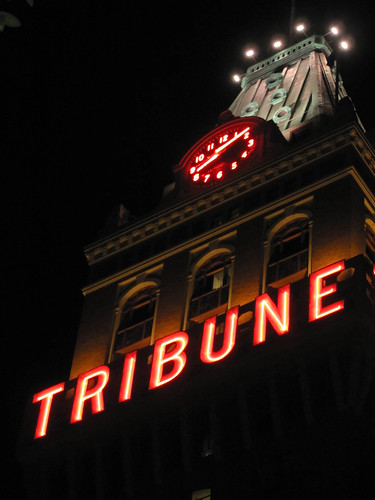
- “Neon, the greatest thing in the world!” -John Law, tenet and long-time caretaker of lighting at the Tribune Tower.
Background
Built in the early half of the 1920s, the Oakland Tribune Tower has housed “a theater, a furniture store, a radio station, a tavern, law offices” (Lighthiser, 2014), and the newspaper from which it derives its name. The Oakland Tribune has reported news in the city since 1874. The building sits at 409 13th Street in downtown Oakland. Its exact location is recorded by Google Maps as 37.8032378N, -122.2708058W.
Prior to the addition of the tower section in 1923, the six story Tribune building that housed the Breuner Furniture Company was built in 1906. The Breuner Furniture Company vacated its home at Thirteenth and Franklin in 1918 prompting Knowland to foresee the empty showroom as the site of his newspaper facility. In the same year he acquired the property from the Breuners and moved news production of The Oakland Tribune there.
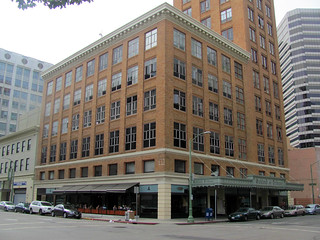
Original 6 story Tribune Building which previously housed the Breuner Furniture Company. Construction of the tower was completed in 1924.
The tower was influenced by the campanile at St. Mark’s Basilica in Venice, Italy which was designed in the Renaissance Revival style by architect Edward Foulkes. With its blend of classical French and Italian architecture, the red brick tower with its green mansard roof stands at 305ft (93m) high and possesses twenty-two stories and approximately 89,000 square-feet of interior floor space. Although it was the tallest building in Oakland during the 1920s, it stands today as the 11th tallest. A parapet wrapped around the tower at the 16th floor says the word “Tribune” in bright white letters that illuminate with red neon light after dark. Each number on the clock is 26 inches and the hour hand is six feet and three inches long weighing about 35 pounds. The minute hand is nine feet and two inches long weighing over fifty pounds according to a 1918 article in the Journal of Electricity. Due to their immense size, the clock hands must be manually reset every few months to maintain an accurate time as a result of the hands lagging under their own weight.
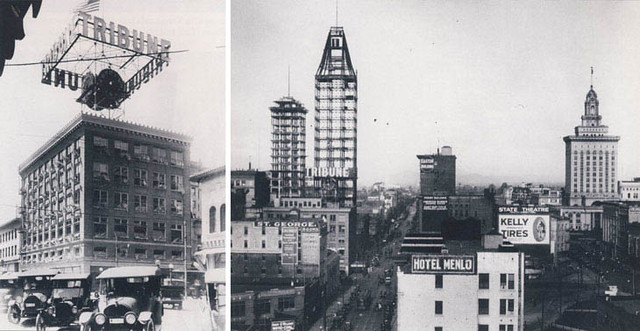
(Left) The Tribune building prior to the tower addition. (Right) Construction of the Tribune Tower, its exposed steel framework looming over Oakland’s City Hall across Broadway.
“In 2011, Tom Henderson, a third generation Oaklander and local entrepreneur, purchased the building for $8 million. Since … he has made several renovations. Located on the ground level of the tower is the Tribune Tavern restaurant and Modern Café. There is a call center for Henderson’s company CallSocket, as well as law offices and nonprofit organizations.” (Arvizu, 2015) Henderson also has history with the newspaper. He was a delivery boy for the Tribune 50 years ago during his childhood. “I’m proud to own the Tribune building,” Henderson said. “We treat it as a 100-year-old building [should be treated], and we take care of it because of its [varied and important cultural] history.”
Today the building itself is in very good shape, although the clocks are in need of constant maintenance. The elevator mechanisms have been replaced with modern technology to make the trips up and down the tower safer, and the original machinery has been preserved inside the tower.
The Tribune building has been re-purposed to serve an ever-evolving community in Oakland. The building was declared a city landmark on May 4, 1976. “The tower has changed and grown and developed over the years, much like the city, but its integrity has remained.” (Lighthiser, 2014) Still, the tower maintains its notable presence in the downtown landscape by creating new spaces of public interest and accessibility for the community.
Albany Bulb History and Background of Keeping the Bulb Wild
History
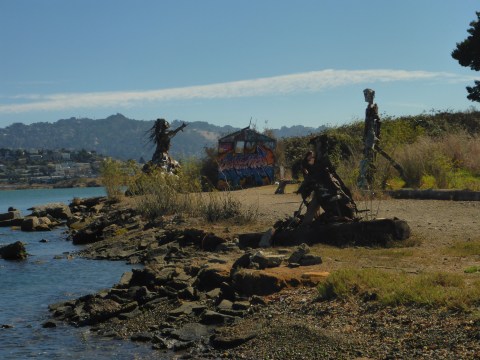
The artistic legacy left by former artists and Bulb residents by Karlene Shippelhoute.
The Albany Bulb was originally a construction dump. Trash from the city of Albany was disposed of in the water forming the landmass which now exists. When the site ceased to be a landfill in 1983, what remained were the narrow neck and bulb jutting out into the San Francisco Bay. After the bulb ceased to be used as a dump, homeless people took up residence at the site and built elaborate houses, community buildings, and artwork out of the construction debris. The area became a park and was used by the surrounding community for outdoor recreation. Recently, the Albany Bulb transferred ownership and the residents of the Bulb were evicted. This action sparked a controversy between multiple stakeholder groups who feel connected to the site and wish to regain access.
Geographic location
The Albany Bulb is located to the north-west of Golden Gate Fields and west of the junction of I-80 and I-580 in Albany, California.

This map shows the Albany Bulb and surrounding streets.
During the first habitation of the Bulb, the homeless were encouraged to take residence there instead of being on the streets. The public officials wanted them off the streets and away from society. The people built spaces they could live in with the materials left over from the landfill. The dwellings that were at the site ranged from makeshift tents to elaborate construction projects with more than one story in height. Remnants of the structures remain today that showcase the once vibrant and innovative community that resided there. To learn more about the former residents follow the link to the documentary Bum’ s Paradise.
https://www.youtube.com/watch?v=K6XYZbY8t4k
The city of Albany’s plan was to make the land more appealing for families, hikers, bikers, sightseers, and wildlife preserves. The people of the bulb were forced once again to move on to the unknown. The process of removing the residents began in 2013, and the construction is currently underway. The most current eviction of homeless groups came in 2014 when 28 residents were forced to vacate the premises. In return the city granted them $3,000 each to relocate and stay away for a twelve month period. One factor that must be considered as development of the Bulb progresses, is the fact that for over fifteen years the Albany Bulb was the location of a complex community that was unique to the Bay Area.
Landscape and Setting
The landscape is interesting because the intense juxtaposition of human-made materials and native plants and animals. This mingling of wilderness and urban space calls into question the human-nature separation that is often characteristic of park narratives. The space is contentious because of the multiple and conflicting narratives which are argued by stakeholder groups. The city wishes to return the land to its natural state, but this argument derives from a concept of the wilderness which is based on a problematic philosophical divide between humans and nature .

The All Seeing Eye at the Albany Bulb source by Karlene Shippelhoute
Modern Context
The bulb is used every day at all hours by dog walkers, hikers, and bikers. Perhaps one of the most unique current uses of this place is the use of rubble and debris to make beautiful works of art, and those works of art are the subjects for many professional photographers, who frequent the bulb for its scenery and fusion of urban development and nature.
Ownership and responsibility
The Albany Bulb is currently owned by East Bay Regional Parks, but it is being transferred to State Parks. As this project is being compiled the city continues to develop the Bulb. Right now use of the space is limited as the East Bay Regional Parks continues to redevelop the land to improve public access around the neck of the Bulb. This includes limiting where the public is able to go and will continue until from summer 2015 to the end of winter 2015 . Although patrons can still access parts of the bulb it is hard to imagine how people will continue to use the Bulb until the construction is complete
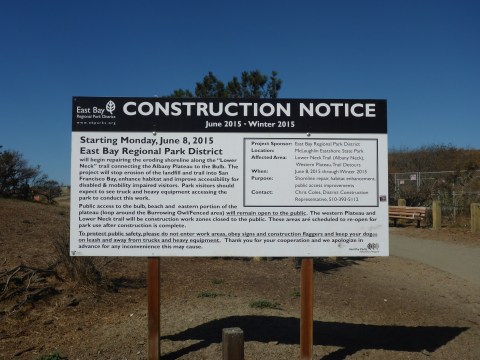
An ominous reminder of the impending city construction.
Current protection and conservation
Measures are being taken to protect the sculptures and artwork at the Bulb, as well as preserve some sense of community by recording stories of Albany Bulb residents. Wildlife and native plants are protected by creating habitat and ecologically friendly spaces. Mitigating hazardous waste at the site will improve the space for everyone.
Key Players, Interest Groups and Process of consultation
The numerous stakeholders and stewards and complex history of this site pose both ethical debates and questions as to how the Bulb should continue to be preserved and who should have the agency to decide who is and is not allowed to use the Bulb.
The remaining waste can be viewed through two lenses; the city and the East Bay State Parks claims that the site has adapted in recent years to serve as a recreational area for individuals and the current state promotes health and safety issues. In addition, they see the area as an eyesore because of its recent history as a “homeless” encampment.

Share the Bulb Rock at the site by Karlene Shippelhoute
The city aims to remove the exposed concrete, rubble, and protruding rebar to “enhance the conservation value and accessibility of the Albany Bulb”. The alternate viewpoint shared by many Bulb goers is that of the landscape should be left to decay “naturally” because an accessibility and enhancement project will change the way the culture of the space is interpreted. Despite these differing viewpoints, it is crucial to look at the implications and associated environmental impacts of each plan of action. In addition local homeless residents came to the Bulb as a place to seek refuge and create their own community.
Recycling the Past Interpretative Plan
The goal of this project is to reach out to children and young adults through the school system. In order for this history to live on, it must be taught through school curriculum. The project will incorporate these themes of community and recycling by teaching a younger generation a little bit of forgotten history and the causes that made it what it was.
In order to get to the younger generation to learn about the bulb, we need to find a way to immerse them into this history. This project will incorporate themes of art and liability. The Albany Bulb is not a kid friendly place at the moment, so this plan will be actualized at a future date when the bulb has been made safe and accessible. The plan for now is to have the young students learn about the Albany Bulb in school. There will be a curriculum taught by a guest speaker to teach the children about the history of the bulb. The goal is to capture the interest of the children without taking them into the bulb and exposing them to potential hazards.
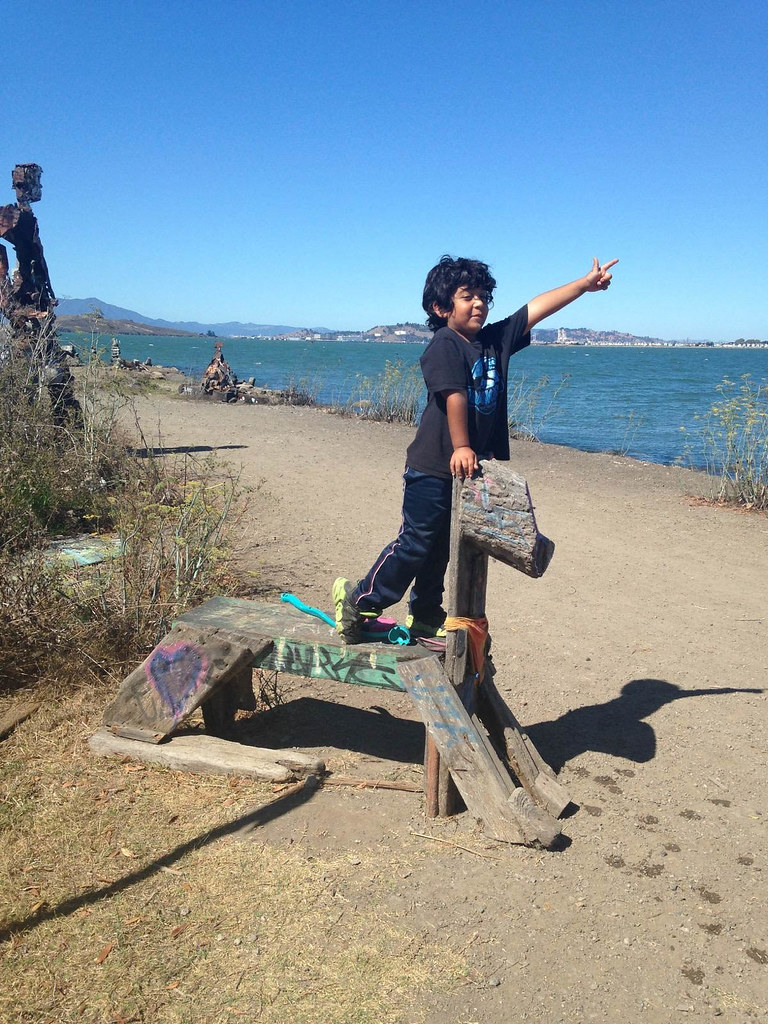
Child Playing on Reclaimed Art at the Bulb by Brenda Arjona
The presentation will consist of photos, audio, video, and hands-on learning. For the hands-on aspect of the lesson, they will learn how to recycle objects that would have otherwise been thrown out and how to reuse objects that can be turned into art or useful tools. For example, they will receive a few items and be asked to take a moment to reimagine them as something else, whether it be an art piece, a tool, or both. In this lesson plan, they will learn about their community’s unspoken history and how to reuse objects to create something could have another purpose or use.
When the Albany Bulb is safer for children to go there, it will be a better experience overall. There will still be guest speakers there to provide a guided tour of the bulb and have the children go to key points at the site. The fieldtrip will be a morning to early afternoon lunch trip in which the students can provide their own lunches or lunches can be provided if there is enough funding. They will visit the locations where the sites would have been and they might possibly be able to use an app to help them see what the site looked like, had the Bulb not been constructed into a park. Those who go on the tour will also be asked to do a project that is hands on. For the younger kids, they will be asked to do drawing projects to make the site more fun for them.
Older students (middle school through high school), will be asked to do some non-official archaeology at the site. Each student will participate in a survey of a particular area or as much of the bulb as they can get to in a day. The goal is to immerse young student in the bulb’s past by having them walk around and explore. Their guides will explain and answer questions about particular sites and objects that might come up along the way.

This screenshot was taken to show where the proposed community building at the Albany Bulb would go. Designer Bernardo Arjona sketched in the hypothetical building at the entrance of the neck of the bulb.
This interactive project touches on sustainability in a few ways. First off, through this project, the students can add to the sustainability of scientific data by doing surveys and learning about research topics. Having them out in the field will give them a better understanding of the type of work that takes place when looking to preserve aspects of the past. The way in which the students will be able to visit and revisit the site, each time being reminded of the intangible and tangible heritage there will add to the sustainability of the Bulb’s past. Finally, the field trips will focus on doing low impact archaeology and projects that aim at keeping the site from being damaged while still being remembered.

Albany Canvas Interpretive Plan
As the city plans to gentrify the park, the art in its current location is in danger. This raises questions of authenticity and sense of place pertaining to the art. The end result of this interpretative plan constitutes display cases placed throughout the Albany Bulb showcasing art of the Bulb commissioned by local artists.
Albany Canvas is a unique program that would be created in cooperation with the city of Albany as a way to preserve the artwork of the Bulb. The focus of this particular interpretive plan is to integrate a way to save some of the art while also encouraging community involvement within the space. The art walk would include a guided tour of the Bulb by former residents and artists. After being inspired by the art walk and taking in the sights, smells, and sounds of the Bulb, artists would be encouraged to create their own artwork that encompasses what the Bulb means to them and their community.
The proposal for this interactive art collaboration is as follows: Throughout the course of a year, which would begin with the guided art walk, visitors would be encouraged to visit the Bulb and interpret the art through different medias, including but not limited to; photography, film, painting, etc. The artists would be allowed to upload their artwork to a website that is designed to share the Bulb’s art culture with visitors.

Albany Canvas App Icon by Karlene Shippelhoute
The intention is that by allowing locals to upload their art, the personal experiences and ways of viewing the Bulb and its wild landscape will remain accessible to everyone rather than the proposal for the area that the city is attempting to present, which considers removing the artwork completely. After the one-year duration of artistic creation the art would be used to create an installation and be given to the city to incorporate into their plan.
Although the East Bay Regional Parks District does not yet operate the actual Bulb and is only working on the Neck they have been given permission by the city to operate the area in the future. On the East Bay Shore Regional Park website they claim that, “The District has a responsibility to preserve the legacy and the history of the peoples who occupied this land before the District was established and park properties acquired, as well as to preserve the history of the District itself. It would appear that upon their acquisition of the Albany Bulb it would be within their mission statement to preserve the art.

An example of a website interface for albanycanvas.com by Karlene Shippelhoute
Preserving the art can be done in many different ways. Although this interpretative plan empathizes with the sentiments of former residents who want the art to remain at the Bulb realistically we understand why the city wants to remove the art due to issues of liability and maintenance costs. Therefore, this plan suggests that the artwork be removed and placed in museum to be enjoyed and preserved as part of the history and culture of the Bay Area.
Assessment of Values
Multivocality is very important; the underground/counterculture music scene varies drastically within sub genres which each have their own discrete cultural values and ideologies. As a community space, 924 Gilman allows for the inter-cultural flow between these groups which allows for people to freely connect with both like-minded and unlike-minded people. The different waves of the Gilman community, and their associated collective will, are often in many ways representative of either a reflection or reaction to larger social and cultural circumstances occurring within the Bay Area and in the music scene as a whole. It’s Gilman’s community basis which allows it to be a space wherein these circumstances might be negotiated. As such, Gilman is characterized by a certain impermanence. The art on the walls constantly gets painted over and reimagined by people who gather there. Which bands that are allowed to play and the values they represent are consistently being mediated by the collective will of the community as it exists at a specific time and space. Gilman is a living entity, so there’s a sense of being in constant flux, but it’s paired with the stability indicative of a sense of unity and comradeship.
Significance
924 Gilman Street is a place of universal value due to the fact that it is a site of significant cultural heritage for the counter-culture associated with punk rock. Both as it relates to the Bay Area as well as attributing to a musical legacy on a global scale, the venue holds substantial human meaning for the following reasons:
● As an all-ages community based venue, it does work to keep the punk music scene viable by allowing non-discriminatory access.
● As a not-for-profit institution, Gilman is inherently community orientated. The
venue functions in the ways it does because of the collective will of its community. There is no single leader or owner, but rather every decision that is made is deliberated and voted on within the membership meetings held on the first and third Saturday of every month.
● Gilman works to remain open and accessible to the widest range of cultural gradient possible, while holding firm to its zero tolerance policy concerning “bullshit behavior” such as that related to homophobia, transphobia, and misogyny.
● Gilman represents a safe haven from normative culture wherein people are allowed and encouraged to express themselves freely. They are always concerned with the ways in which they can support the people in the community and allow them access to the help, assistance, or protection which they need.
Threats to the Venue
Throughout its existence, 924 Gilman Street has encountered frequent financial difficulties. The venue was originally opened on a $2,000 per month rent. It is currently $4,500. Many members blame gentrification, pointing to the recent opening of a nearby Whole Foods as the beginning of the yuppie invasion. In the past few years, many locally owned establishments in the area have gone out of business which speaks to the instability of the real estate and housing markets of the local area.
Additional financial threats to Gilman are structural in nature because financial management of the club also relies on the volunteer corp. This represents a problem because managing the business side of a nightclub requires a certain quality of economic knowledge and a significant time commitment, both on a daily and annual basis. As a non-profit organization they have a Chief Financial Officer who oversees the condition of their budget and funds, but he does this in addition to his full-time real job.
The ever-present threat which Gilman faces, however, is simply keeping the community that is fostered around the venue viable. The members and volunteers who actively participate in the daily function of the club are the true linchpin in this regard, because they are the ones doing all the grunt and behind-the-scenes work so that the bands have a place to play and the kids have a place to mosh. However, among the collective there is an uneven distribution of dedication, both personal and professional. Anyone is welcome to get involved, but nobody is going to force you to make a commitment that you cannot or will not keep. The ultimate fear here is that with a significant decline in member dedication, the club would become centralized under an elite that might then restrict open participation.
Interpretive Plans
With a history stretching back more than a century, Davis House speaks to a large number of people. Current and former residents, either from the sorority or the co-op, have a personal stake in this site as a notable part of their lives. So too can the general public appreciate this site for its architectural, historical, and cultural significance. Our goal is therefore to engage all of these groups while still respecting the fact that this is a private residence. For nonresidents, this means using virtual tours instead of physical access, as well as neighborhood tours to help ground Davis House in its historical and cultural settings. Current residents may use the same, as well as material that speaks to the history of the house and of the organization to which they belong.
All of these projects will consider how Davis House fits in with broader social and cultural trends, and how this particular site can serve as a focal point for these changes. At the same time, what are the changes still needed in today’s society, and how can Davis House help illustrate these for us? Our interpretive plan looks to the past, present, and future as we examine this site and its place in our world.
Themes

It is difficult to talk about the culture of 924 Gilman because, in a sense, it is deliberately volatile and undefinable. In many ways, the venue is a living, breathing entity which is consistently and progressively experiencing changes through the ebb and flow of the community that surrounds it. It is significant that everybody has a different story concerning Gilman and that there is no centralized narrative because individual people engage with the experience in different ways.
That being said, the most dominant cultural value, what could be called the paramount piece intangible cultural heritage is the community which the club fosters. The aspects of this community range from the intimate and personal to the structural and symbolic: the volunteer corps, the patrons, the artists, the bands, the neighbors and neighborhood (both commercial and domestic), and even the music and art scene at large can all be considered as taking part.
Historically speaking, Gilman has acquired quite a bit of symbolic capital as it relates to the global punk rock scene. Some attribute this to the venue’s ability to stick to its core values of being an open, all-ages, community and volunteer-run establishment. Others attribute this to the simple fact that they’ve been able to keep the doors open for almost 30 years (1986-Present). Groups such as Green Day, Rancid, NOFX, and the Dead Kennedys put the location on the map as a go-to destination for their fans across the world. The venue also engages the larger music scene outside itself by supporting other DIY businesses and establishments, such as local record companies and printing presses.
Politically, there is no power hierarchy. Every decision goes through a vote at the membership meetings, democratically. They decide which bands are allowed to play, who can hold a key to the venue, who gets “86’d,” or banned from the venue. Our ability to conduct this project was put to a vote. Everyone has a voice and gets time to speak their piece; your opinion is welcome but your respect is required. By virtue of the diversity of the community, a whole variety of voices make up the collective will expressed by the venue. These opinions, of course, change as the community itself changes.
Gilman is not profit orientated, but rather driven from the shared experiences of the show or event that brings the community together. As one informant, Sam Smash, remarks “we found our families at these shows” and this is reflected in the active community participation of the volunteer collective because there is a sense of social responsibility to give back and contribute to that family. Profits are split between the venue and the bands. When something needs to fixed, improved, or replaced, it is done by the members, often through donation. For many, Gilman is a safe space to escape from normative culture, a space where people can freely express themselves and as such its members are consistently focused on ways in which the community can be supported because “there’s not gonna be any support for us unless we help ourselves” (Sam).


 Who Owns the Past? Cultural Heritage in the Digital Age